Curriculum focus: Explain the behaviour of gases under different conditions, apply gas laws to quantitative problems, and appreciate their everyday and industrial applications as part of 2.0 Physical Chemistry.
1. Particle Model of Gases #
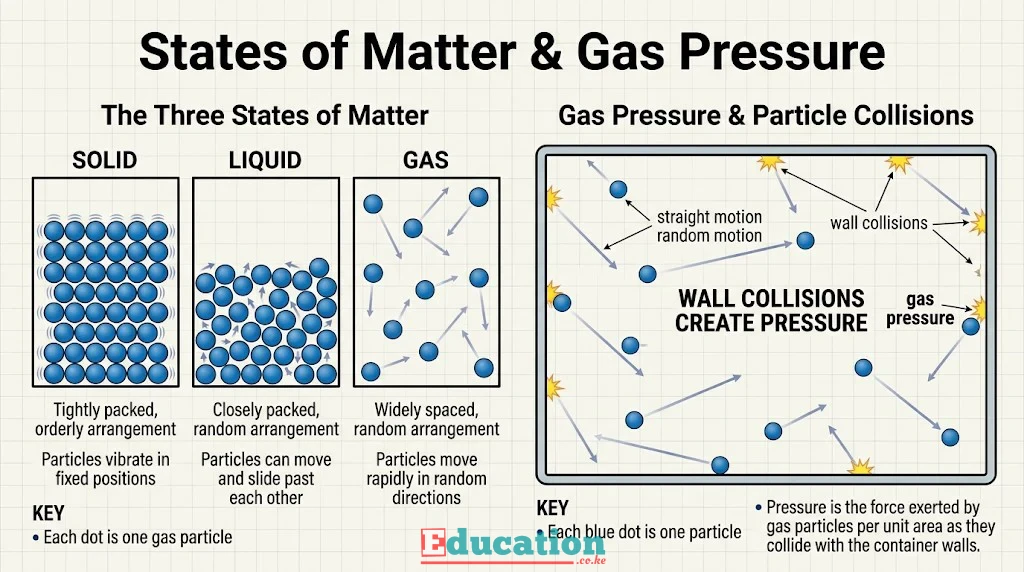
A gas consists of particles moving rapidly and randomly in all directions. They are far apart relative to their own size, so gases are compressible. Collisions with container walls produce pressure. Temperature in kelvin is related to average kinetic energy. The ideal gas model assumes negligible particle volume and negligible intermolecular attraction; real gases approach it most closely at relatively low pressure and high temperature.
- Gas pressure is force per unit area.
- At the same temperature, ideal gas particles have the same average translational kinetic energy.
- Real gases deviate from ideal behaviour at high pressure and low temperature.
2. Pressure and Temperature #
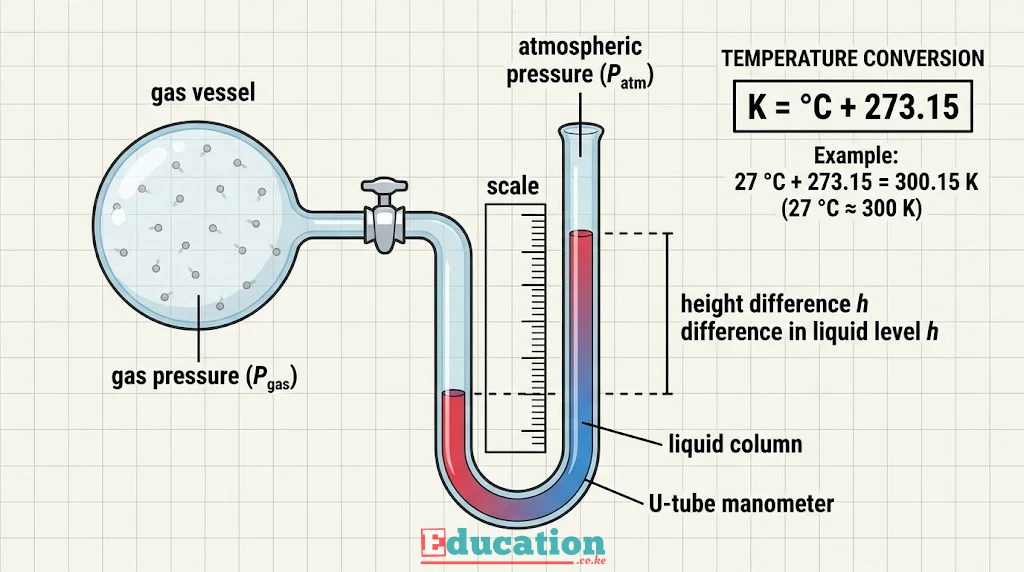
Gas pressure is measured in Pa or kPa; atmospheric pressure is about 101.3 kPa. Gas-law calculations require absolute temperature: T(K) = t(°C) + 273.15. Use consistent units and identify which variables remain constant.
- 1 atm ≈ 101.3 kPa.
- 1 dm³ = 1 L; 1 dm³ = 10−3 m³.
- Never heat a sealed container unless designed and approved for that purpose.
3. Boyle’s Law #
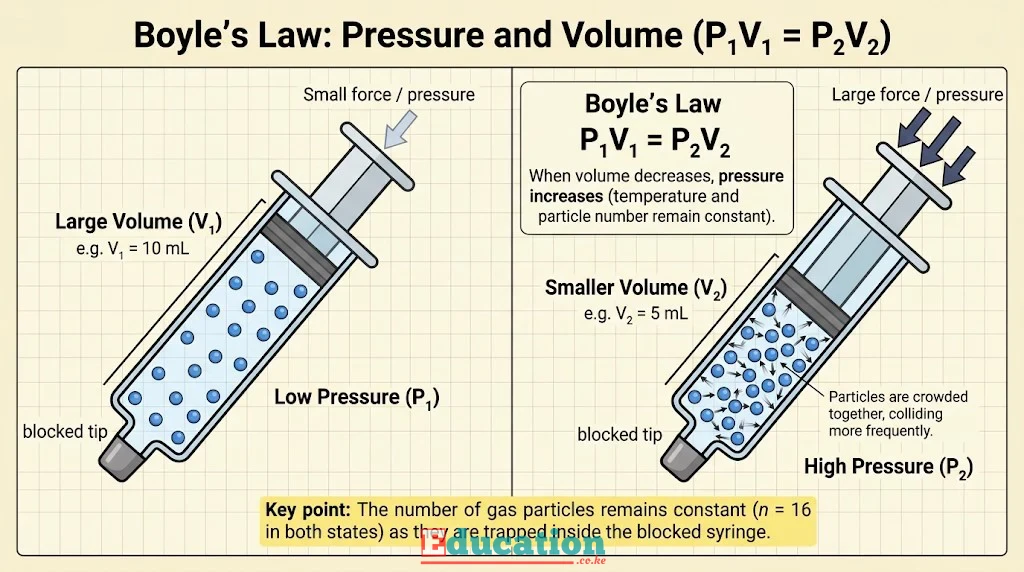
For a fixed amount of gas at constant temperature, pressure is inversely proportional to volume. When volume decreases, wall collisions become more frequent and pressure increases. Equation: P1V1 = P2V2.
- Use identical pressure units and identical volume units for both states.
- Temperature and amount of gas must remain constant.
- Applications include a syringe with its nozzle blocked.
Worked Example 11: Boyle’s Law #
Problem: A gas occupies 600 cm³ at 100 kPa. Find volume at 150 kPa at constant temperature.
- Step 1: Use P1V1 = P2V2.
- Step 2: V2 = (100 × 600) / 150 = 400 cm³.
Answer: The volume is 400 cm³.
4. Charles’s Law #
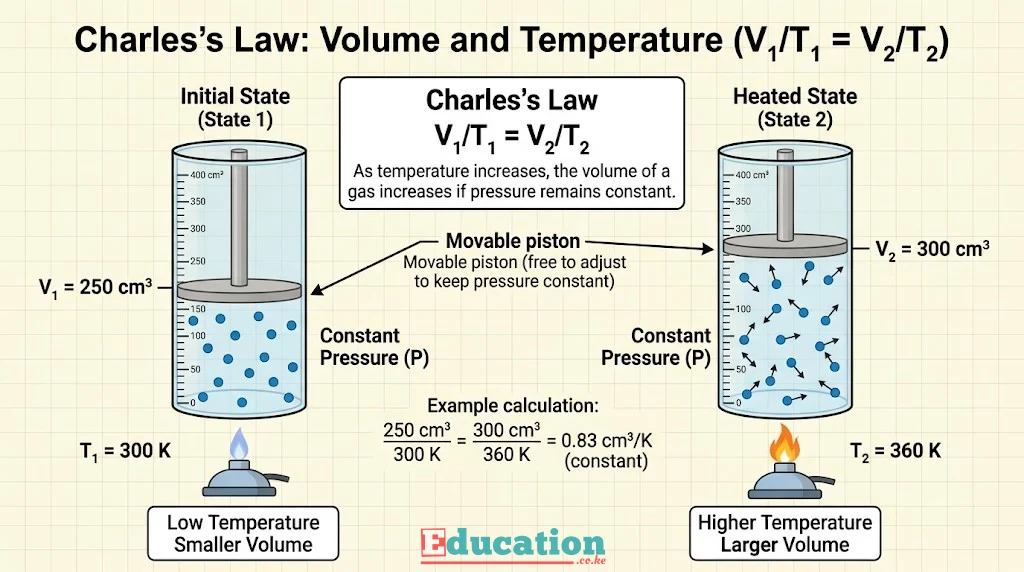
At constant pressure, the volume of a fixed amount of gas is directly proportional to absolute temperature: V1/T1 = V2/T2. Heating increases particle kinetic energy; at constant pressure the gas expands.
- Use kelvin, not Celsius.
- Doubling absolute temperature doubles volume for an ideal gas at constant pressure.
- Hot-air balloon lift also depends on the mass of the balloon and payload.
Worked Example 12: Charles’s Law #
Problem: A gas occupies 250 cm³ at 300 K. Find its volume at 360 K at constant pressure.
- Step 1: Use V1/T1 = V2/T2.
- Step 2: V2 = 250 × 360 / 300 = 300 cm³.
Answer: The volume is 300 cm³.
5. Pressure Law #
At constant volume, pressure is directly proportional to absolute temperature: P1/T1 = P2/T2. Heating a gas in a rigid container increases the frequency and force of collisions with the walls.
- The container must be rigid.
- Tyre pressure changes with temperature, though real tyres do not perfectly satisfy the simple model.
- Heating sealed containers can be dangerous.
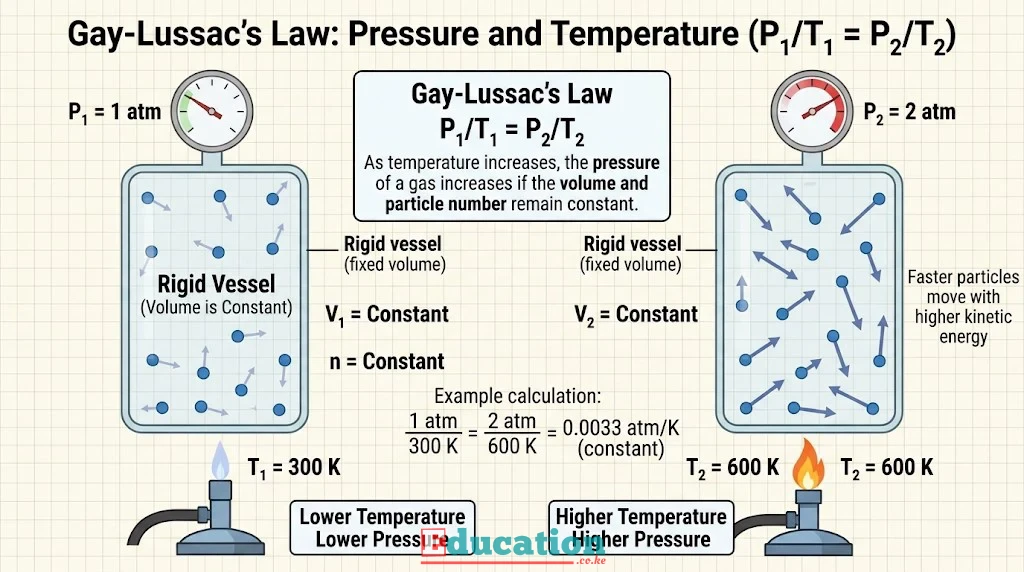
Worked Example 13: Pressure Law #
Problem: A gas has pressure 100 kPa at 300 K. Find pressure at 330 K in a rigid container.
- Step 1: Use P1/T1 = P2/T2.
- Step 2: P2 = 100 × 330 / 300 = 110 kPa.
Answer: The pressure is 110 kPa.
6. Combined Gas Law #
The combined gas law relates pressure, volume and temperature for a fixed amount of gas: P1V1/T1 = P2V2/T2. It combines Boyle’s, Charles’s and pressure laws.
- Convert temperatures to kelvin.
- Use consistent units across both states.
- If one variable is constant, the expression reduces to an individual gas law.
7. Avogadro’s Law and Molar Volume #
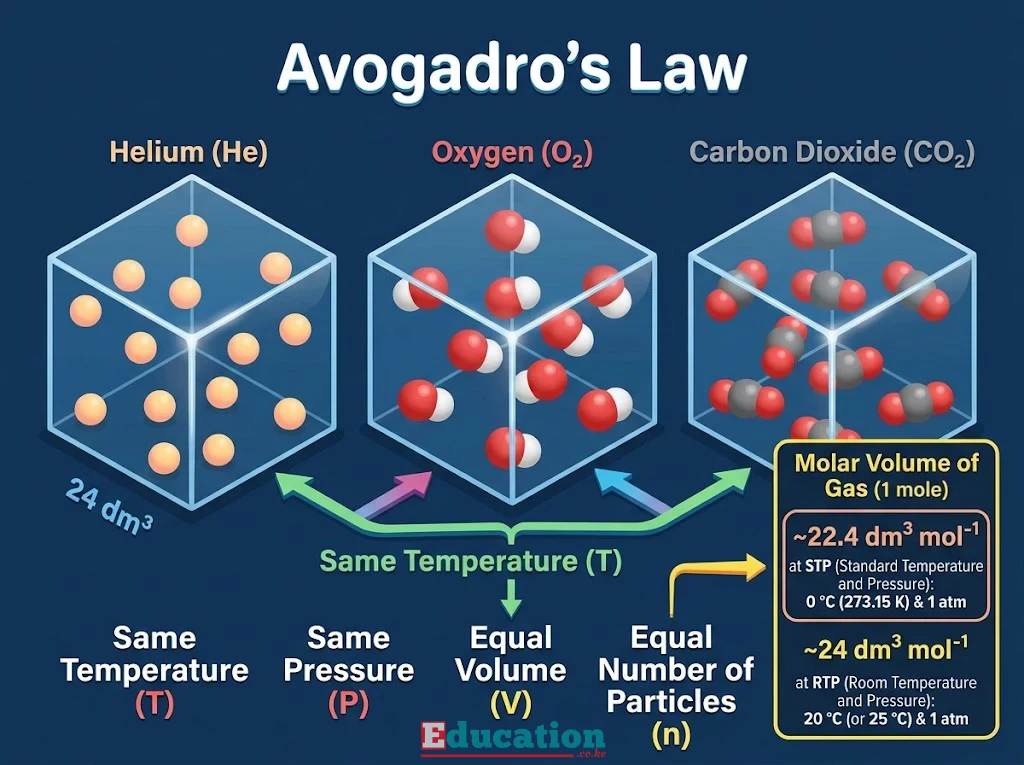
At fixed temperature and pressure, gas volume is directly proportional to amount in moles: V/n = constant. Equal gas volumes at the same temperature and pressure contain equal numbers of molecules. For a deeper review of mole calculations, see 1.1 The Mole.
- At room conditions, a commonly used approximate molar gas volume is 24 dm³ mol−1.
- At 0 °C and 1 atm, the ideal-gas value is about 22.4 dm³ mol−1.
- Always use the molar volume matching the stated conditions.
8. Ideal Gas Equation #
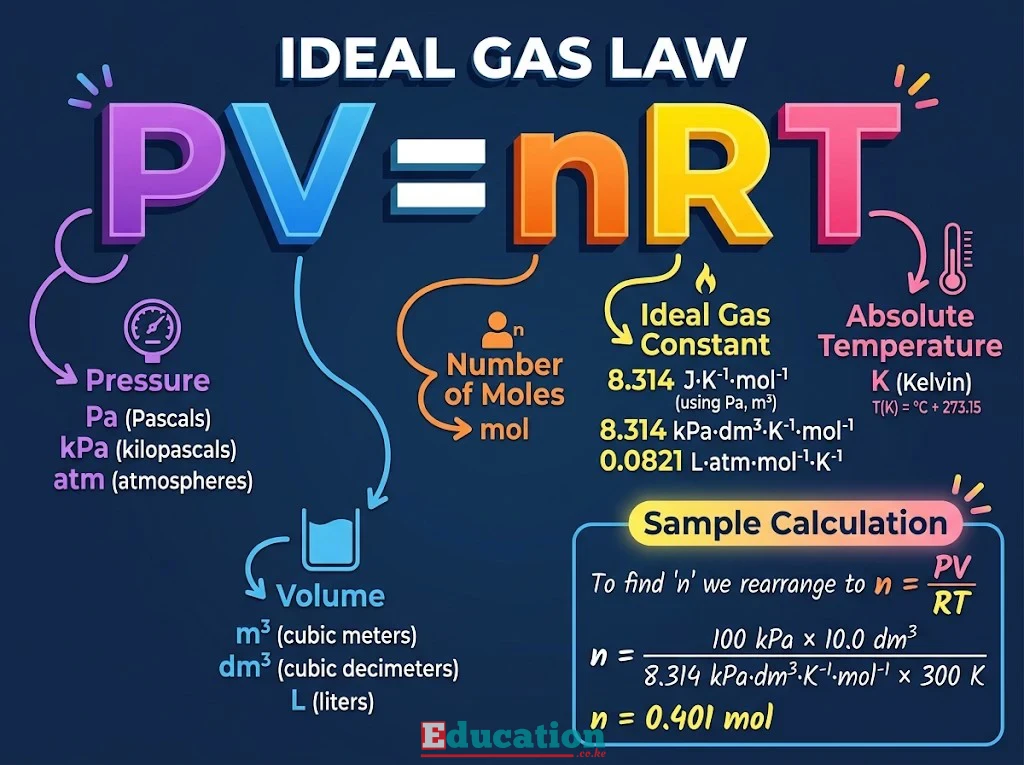
The equation PV = nRT links pressure, volume, amount and absolute temperature. R must match the units used. For example, R = 8.314 kPa dm³ mol−1 K−1 when P is kPa and V is dm³.
- Rearrange the equation to find any unknown.
- Use n = m/M when amount is derived from mass.
- Ideal behaviour is an approximation, not a perfect description of every real gas.
Worked Example 14: Ideal Gas Equation #
Problem: Find moles in 10.0 dm³ at 100 kPa and 300 K. Use R = 8.314 kPa dm³ mol−1 K−1.
- Step 1: n = PV / RT.
- Step 2: n = (100 × 10.0) / (8.314 × 300) ≈ 0.401 mol.
Answer: The amount is approximately 0.401 mol.
9. Gas Stoichiometry #
A balanced equation gives mole ratios. At the same temperature and pressure, reacting gas volumes follow the coefficients in the equation. If conditions differ, convert volumes to moles first.
- Balance the equation.
- Use mole ratios to calculate the unknown.
- Convert the final moles to volume under stated conditions.
10. Graphs and Problem Solving #
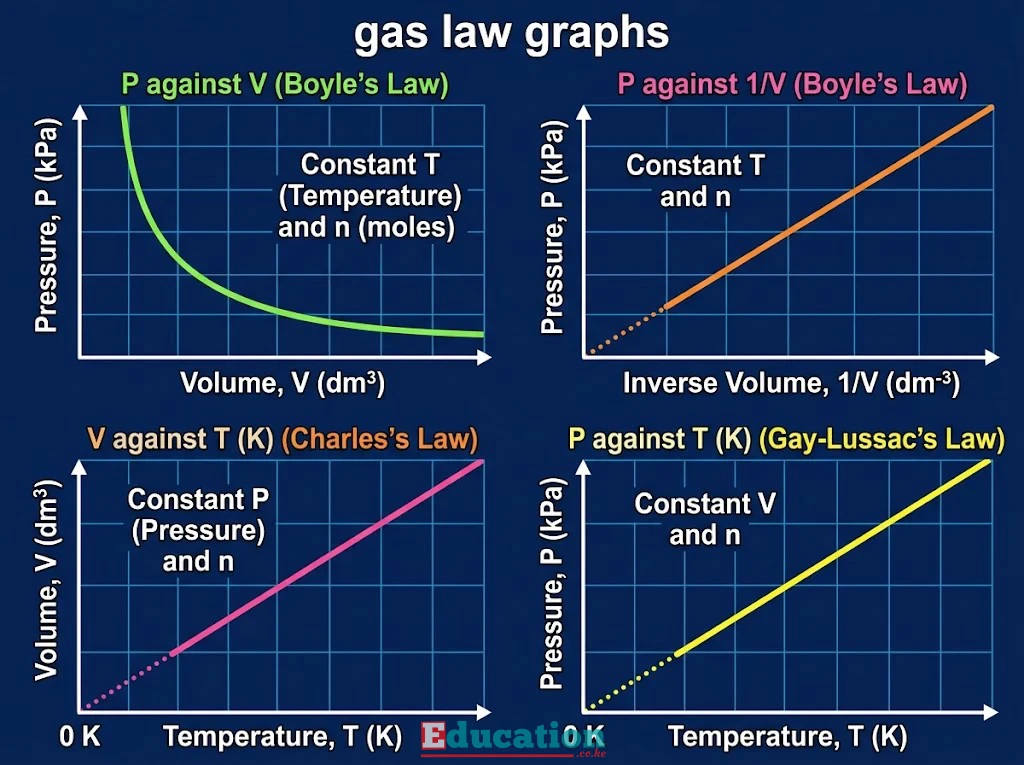
Boyle’s law gives a curve for P against V and a straight line for P against 1/V. Charles’s law gives a straight line for V against kelvin temperature; pressure against kelvin temperature is also linear at constant volume.
- Read graph axes and units.
- Convert Celsius to kelvin before applying proportionality.
- List knowns, choose the law, substitute, calculate and check units.
Summary: Gas Laws #
Gas Law |
Formula |
Constant Variable(s) |
|---|---|---|
Boyle’s Law |
P1V1 = P2V2 |
Temperature (T) and amount of gas (n) |
Charles’s Law |
V1/T1 = V2/T2 |
Pressure (P) and amount of gas (n) |
Pressure Law |
P1/T1 = P2/T2 |
Volume (V) and amount of gas (n) |
Combined Gas Law |
P1V1/T1 = P2V2/T2 |
Amount of gas (n) |
Avogadro’s Law |
V/n = constant |
Temperature (T) and pressure (P) |
Ideal Gas Equation |
PV = nRT |
Use consistent units and kelvin |
Self-check Questions: Gas Laws #
- A gas occupies 500 cm³ at 120 kPa. Find its volume at 200 kPa at constant temperature.
- Convert −10 °C and 85 °C to kelvin.
- A gas occupies 3.0 dm³ at 250 K. Find volume at 400 K at constant pressure.
- Explain why pressure rises when gas is heated in a rigid container.
- State two assumptions of the ideal gas model.
- Calculate pressure of 0.25 mol gas in 5.0 dm³ at 300 K.
Check your solutions in Answers and Self-Assessment.
Compiled and reviewed for Education.co.ke by Fred ArapToo (B.Ed. Physics & Chemistry, Egerton University; M.Ed. Education Administration candidate, University of Kabianga; Experience AI Certified Educator — Google DeepMind, Raspberry Pi Foundation & YSK, 2025; national KSEF facilitator, patron and evaluator; EdTech and open-access education platforms innovator; secondary school science educator with 15+ years of experience).
Looking for more resources?
- Revision & past papers: Teacher.co.ke | Education.co.ke | Teacher.ac
- Career pathways & university placement guide: CareerMap.co.ke
- School management systems & related digital applications: Contact us via Teacher.co.ke or ShuleMax.co.ke