These notes introduce the core ideas of hydrocarbons through explanations, structural formulae, and practical safety guidance for Grade 11 Chemistry (Sub-strand 3.1 Organic Chemistry). Read the explanation, study each formula, and attempt the check-your-understanding questions without looking at the answers.
Learning Outcomes #
- Classify hydrocarbons as alkanes, alkenes or alkynes using bonding and formulae.
- Represent hydrocarbons with molecular, condensed, structural and displayed formulae.
- Apply basic systematic naming rules to straight-chain and simple branched hydrocarbons.
- Explain structural isomerism and simple geometrical isomerism in alkenes.
- Write and balance equations for combustion and selected addition reactions.
- Explain substitution, addition and addition polymerisation.
- Describe uses of hydrocarbons and consider safety and environmental issues.
1. Introduction to Organic Chemistry #
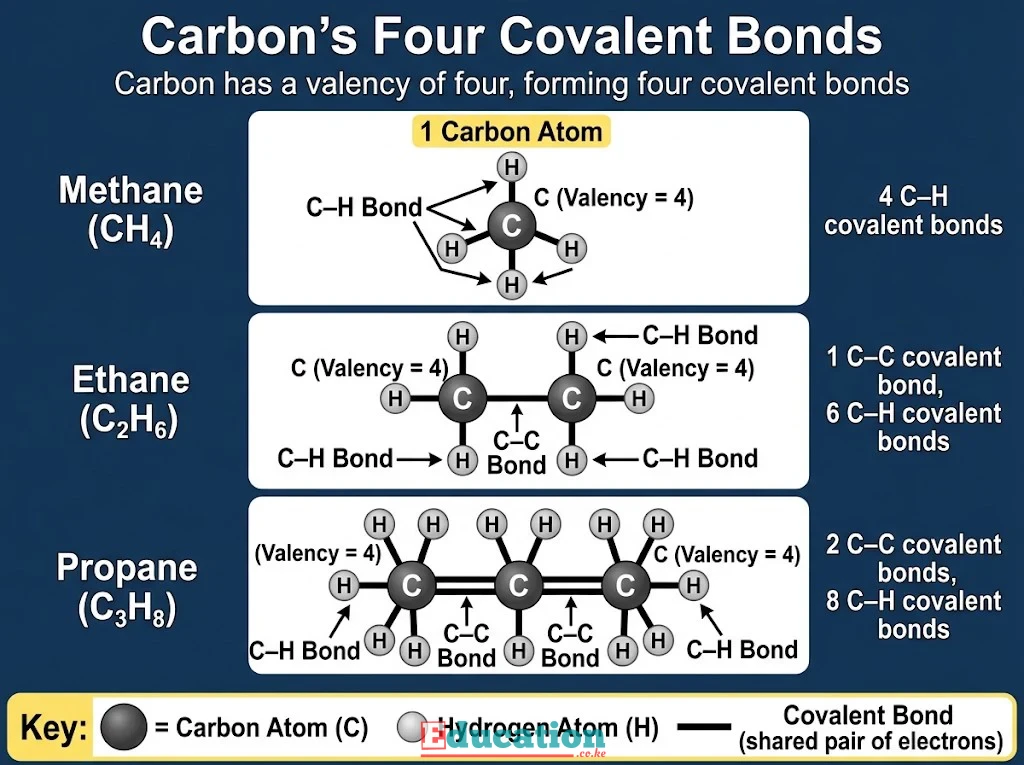
Organic chemistry is the study of carbon compounds, especially compounds containing carbon–carbon and carbon–hydrogen bonds. Carbon forms a very large number of compounds because each carbon atom can form four covalent bonds and carbon atoms can bond to one another to form straight chains, branched chains and rings. These structures may contain single, double or triple bonds.
Hydrocarbons are the simplest organic compounds because they contain only carbon and hydrogen. They are important as fuels, raw materials for plastics and synthetic fibres, lubricants, solvents and many other products. Natural gas, petrol, kerosene, diesel and paraffin wax contain mixtures of hydrocarbons. The composition of a fuel affects its volatility, ignition behaviour, energy release and environmental impact.
Organic compounds are commonly represented using molecular formulae, structural formulae, displayed formulae, condensed formulae and skeletal formulae. A molecular formula gives the actual number of each type of atom in a molecule. A structural formula shows how atoms are connected. A displayed formula shows every covalent bond. Different representations are useful for different tasks, but they must all describe the same molecule.
Carbon atoms are tetravalent: a carbon atom normally forms four covalent bonds. Hydrogen forms one covalent bond. In a hydrocarbon, the total number of bonds around each carbon must be four. This rule helps learners draw structures and identify errors. A carbon atom with five ordinary covalent bonds in a simple displayed formula signals an incorrect structure.
Laboratory Safety: Many hydrocarbons are volatile and flammable; vapours may ignite at a distance from the liquid. Use small quantities, keep containers closed, avoid naked flames unless the method specifically requires a controlled flame, and work with suitable ventilation. Never identify an unknown hydrocarbon by directly inhaling it.
Check Your Understanding #
- Define organic chemistry and hydrocarbons.
- Explain why carbon forms many compounds.
- Distinguish molecular, structural and displayed formulae.
- State two safety precautions when handling hydrocarbons.
2. Hydrocarbons: Classification #
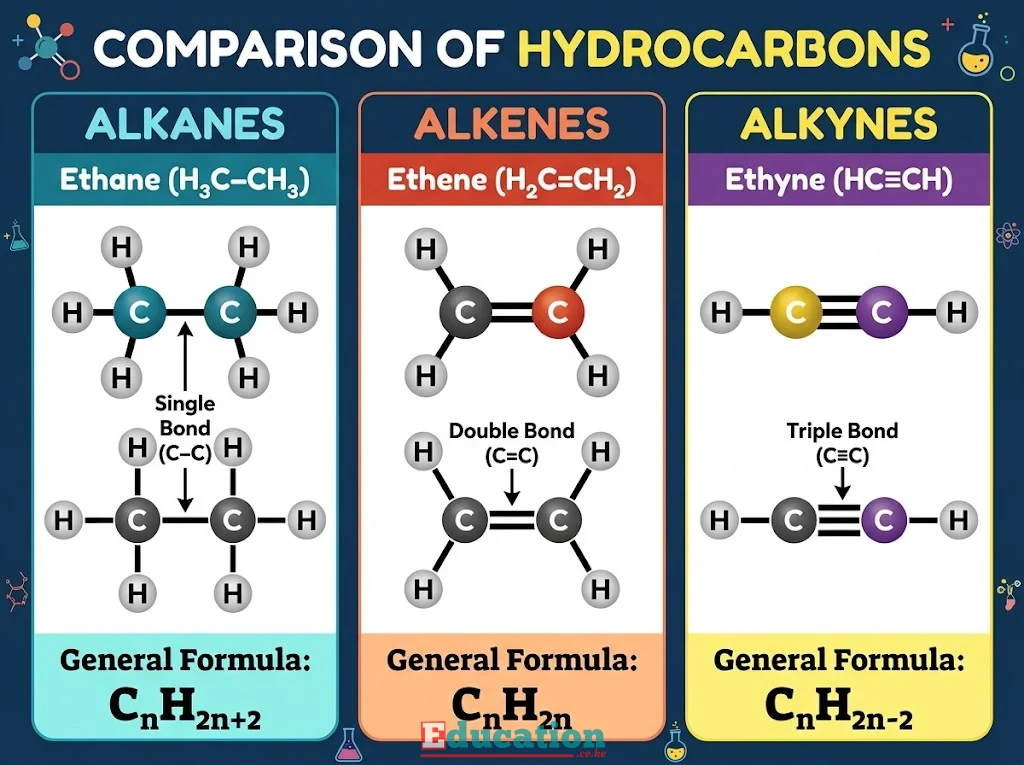
Hydrocarbons can be classified according to the types of carbon–carbon bonds present and the arrangement of their carbon skeletons. Acyclic hydrocarbons have open chains; these chains may be straight or branched. Cyclic hydrocarbons contain rings. At this level, the most important open-chain families are alkanes, alkenes and alkynes.
Hydrocarbon Family |
Bond Type |
Saturation |
Open-Chain General Formula |
Examples |
|---|---|---|---|---|
Alkanes |
Carbon–carbon single bonds only |
Saturated |
CnH2n+2 |
Methane, ethane, propane, butane |
Alkenes |
At least one carbon–carbon double bond |
Unsaturated |
CnH2n (one double bond) |
Ethene (C2H4), propene (C3H6) |
Alkynes |
At least one carbon–carbon triple bond |
Unsaturated |
CnH2n-2 (one triple bond) |
Ethyne (C2H2) |
Saturated means that the carbon skeleton has the maximum number of hydrogen atoms possible for an open chain with single bonds. These general formulae apply only when the stated assumptions are satisfied: open-chain compounds, one double bond for the alkene formula, or one triple bond for the alkyne formula. Rings and additional multiple bonds alter the hydrogen count. Always inspect the structure before applying a formula.
Unsaturation usually makes alkenes and alkynes more reactive in addition reactions than alkanes. The multiple bond can be converted into single bonds as atoms or groups add across it. This difference provides a practical way to distinguish families in appropriate tests.
Check Your Understanding #
- Classify a hydrocarbon as an alkane, alkene or alkyne from its structure.
- Write the general formulae for the three open-chain families.
- Explain the terms saturated and unsaturated.
- State why general formulae must be applied carefully.
3. Carbon Bonding and Structural Formulae #
A covalent bond forms when atoms share electron pairs. A single carbon–carbon bond contains one shared pair; a double bond contains two shared pairs; and a triple bond contains three shared pairs. In simple structural drawings, single bonds are shown by one line, double bonds by two parallel lines and triple bonds by three parallel lines.
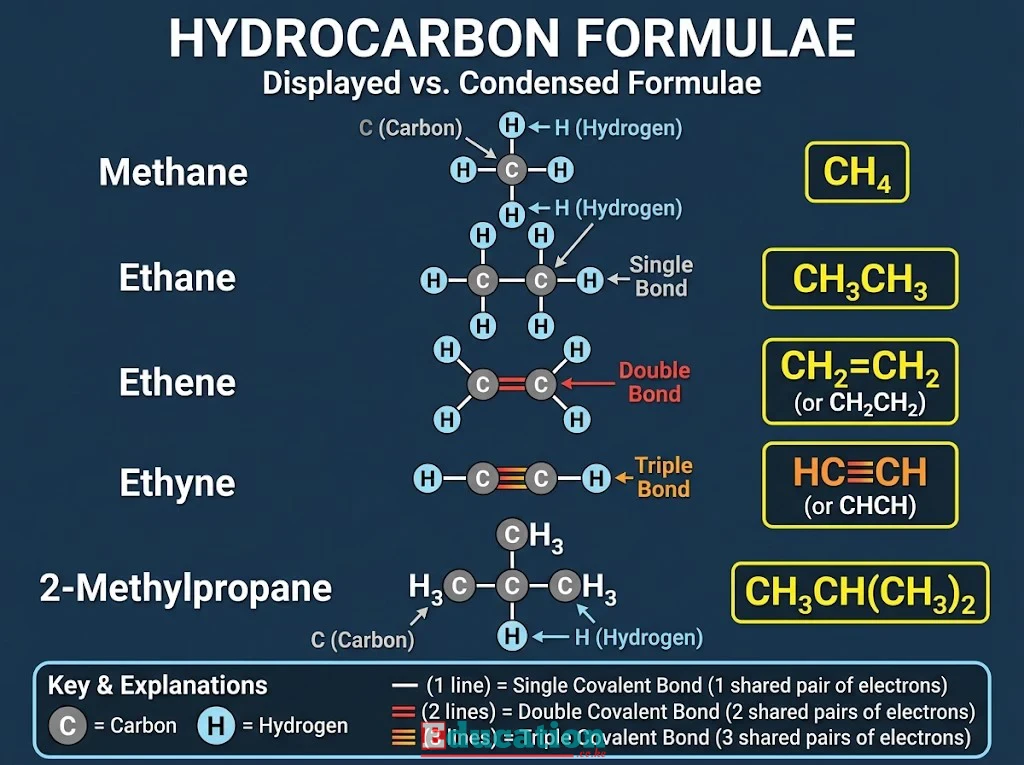
Condensed structural formulae compress a displayed structure into groups. Ethane may be written CH3CH3, propane as CH3CH2CH3 and butane as CH3CH2CH2CH3. For ethene, CH2=CH2 makes the double bond explicit. For ethyne, HC≡CH shows the triple bond. The condensed formula must still communicate the position of multiple bonds unambiguously.
To check a displayed structure, count the bonds around every carbon atom. For example, in ethene each carbon forms a double bond to the other carbon and two single bonds to hydrogen, giving four bonds around each carbon. In ethyne, each carbon forms a triple bond to the other carbon and one single bond to hydrogen.
Structural formulae matter because compounds with the same molecular formula can have different atom connections. Such compounds are structural isomers. For example, butane and 2-methylpropane both have molecular formula C4H10, but one has a continuous four-carbon chain while the other has a branched three-carbon main chain with a methyl branch.
Models can help learners visualise structures, but models are representations rather than exact pictures of molecules. Ball-and-stick models emphasise bonds and angles; space-filling models give a better impression of relative atomic sizes and the space occupied by a molecule.
Check Your Understanding #
- Write condensed formulae for ethane, propane and butane.
- Explain how a displayed formula can be checked for carbon valency.
- Define structural isomers.
- Give one strength and one limitation of molecular models.
4. Naming Hydrocarbons: Carbon-Chain Roots #
Systematic names help chemists communicate the exact structure of a compound. For simple hydrocarbons, the root indicates the number of carbon atoms in the parent chain.
Number of Carbon Atoms |
Root |
|---|---|
1 |
meth- |
2 |
eth- |
3 |
prop- |
4 |
but- |
5 |
pent- |
6 |
hex- |
7 |
hept- |
8 |
oct- |
9 |
non- |
10 |
dec- |
The ending indicates the family: -ane for alkanes, -ene for alkenes and -yne for alkynes. Thus, a two-carbon saturated hydrocarbon is ethane; a two-carbon hydrocarbon with a double bond is ethene; and a two-carbon hydrocarbon with a triple bond is ethyne. The number of carbon atoms must be counted from the chosen parent chain, not from the total number of carbon atoms in every branch.
Naming begins by identifying the longest continuous carbon chain that contains the required multiple bond, if one is present. For alkenes and alkynes, the parent chain must include the double or triple bond. A chain that is longer but excludes the multiple bond may not be the correct parent chain.
Branches are named as substituents. A one-carbon branch is methyl (–CH3), a two-carbon branch is ethyl (–CH2CH3), and a three-carbon branch is propyl. The name includes a number showing the carbon atom to which each branch is attached. Use the lowest appropriate number set while following the rules for the family.
Common names remain widely used for some substances, such as acetylene for ethyne and ethylene for ethene. In school naming exercises, use systematic names unless the question requests a common name.
Check Your Understanding #
- Recall the roots for one to ten carbon atoms.
- Match -ane, -ene and -yne to the correct family.
- Explain how the parent chain is selected.
- Name the substituent formed from one carbon atom.
Compiled and reviewed for Education.co.ke by Fred ArapToo (B.Ed. Physics & Chemistry, Egerton University; M.Ed. Education Administration candidate, University of Kabianga; Experience AI Certified Educator — Google DeepMind, Raspberry Pi Foundation & YSK, 2025; national KSEF facilitator, patron and evaluator; EdTech and open-access education platforms innovator; secondary school science educator with 15+ years of experience).
Looking for more resources?
- Revision & past papers: Teacher.co.ke | Education.co.ke | Teacher.ac
- Career pathways & university placement guide: CareerMap.co.ke
- School management systems & related digital applications: Contact us via Teacher.co.ke or ShuleMax.co.ke