Curriculum focus: Describe and investigate salts, their preparation, solubility and reactions; interpret ionic equations; and connect the chemistry of salts to familiar laboratory, environmental and industrial contexts. This sub-strand builds on the foundational concepts introduced in 2.0 Physical Chemistry.
1. What Is a Salt? #
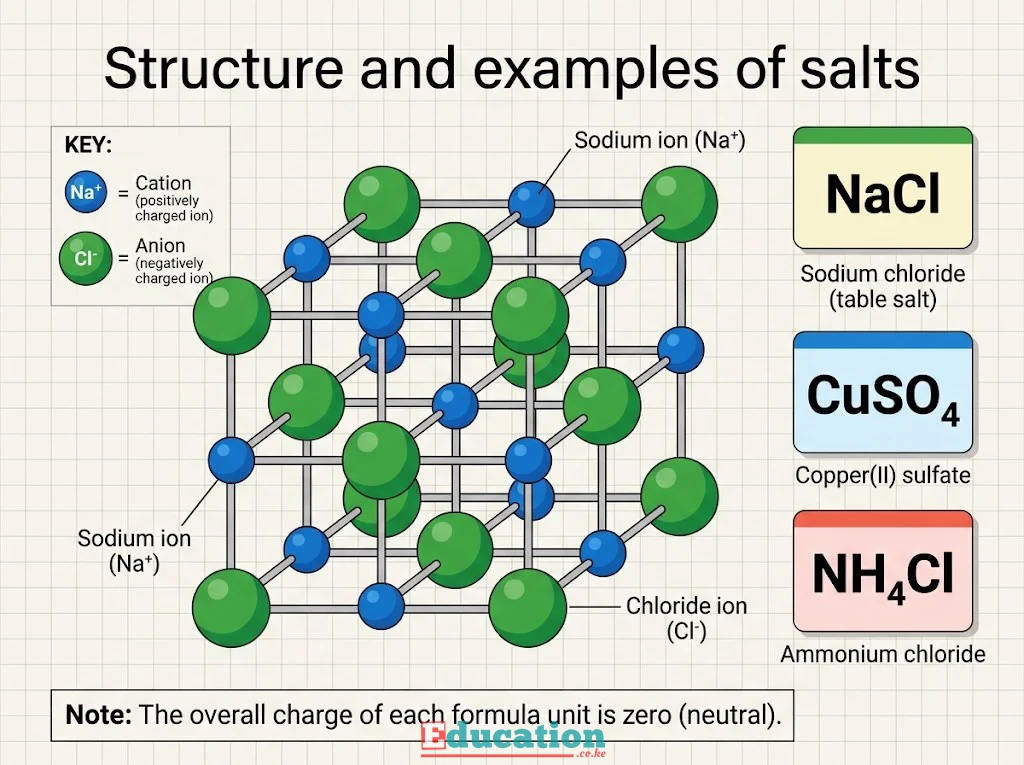
A salt is an ionic compound formed when the replaceable hydrogen ion or ions of an acid are wholly or partly replaced by metal ions or ammonium ions. Salts contain positive ions (cations) and negative ions (anions) arranged in an electrically neutral lattice when solid. In water, soluble salts separate into mobile ions, which explains why their aqueous solutions can conduct electricity.
- Examples include sodium chloride (NaCl), copper(II) sulfate (CuSO4), ammonium chloride (NH4Cl), calcium carbonate (CaCO3) and potassium nitrate (KNO3).
- A salt does not have to be neutral in pH. Some salts produce acidic or alkaline solutions because their ions react with water; the behaviour depends on the ions present.
- Salts are different from common table salt. Sodium chloride is only one member of the much larger chemical family called salts.
2. Naming and Writing Formulae of Salts #
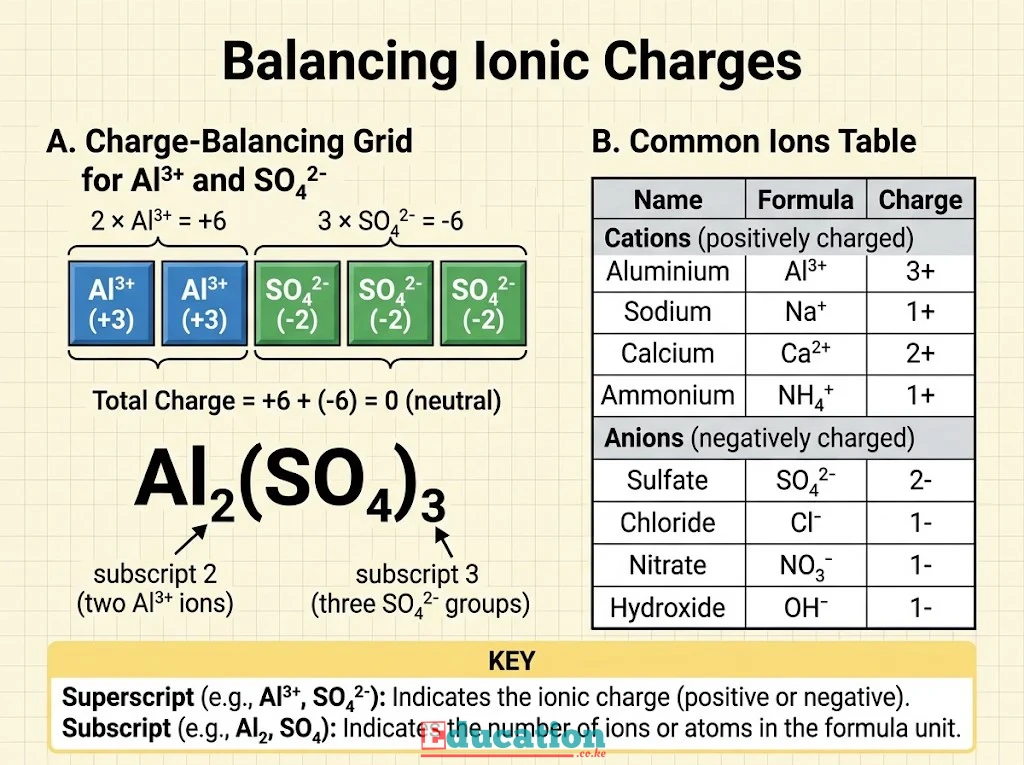
To name a salt, identify its positive ion first and its negative ion second. The positive ion is often a metal ion or ammonium, NH4+. The negative ion may be a single-element ion, such as chloride, or a polyatomic ion, such as sulfate or nitrate. Where a metal forms ions with different charges, Roman numerals identify the charge in the name.
- Common anions: chloride Cl–, bromide Br–, iodide I–, oxide O2-, sulfide S2-, nitrate NO3–, sulfate SO42-, carbonate CO32- and phosphate PO43-.
- Formulae must be electrically neutral. Choose the smallest whole-number ratio of ions that makes total positive charge equal total negative charge.
- Use brackets around a polyatomic ion when more than one of that ion is needed, for example Ca(NO3)2.
Worked Example 1: Formula of aluminium sulfate #
Problem: Write the formula of aluminium sulfate.
- Step 1: Aluminium forms Al3+; sulfate is SO42-.
- Step 2: Two Al3+ ions give +6 and three sulfate ions give -6.
Answer: The formula is Al2(SO4)3.
Worked Example 2: Name FeCl3 #
Problem: Name FeCl3.
- Step 1: Each chloride ion has charge -1, so three chloride ions contribute -3.
- Step 2: The iron ion must therefore be Fe3+; use the Roman numeral III.
Answer: The name is iron(III) chloride.
3. Classification of Salts #
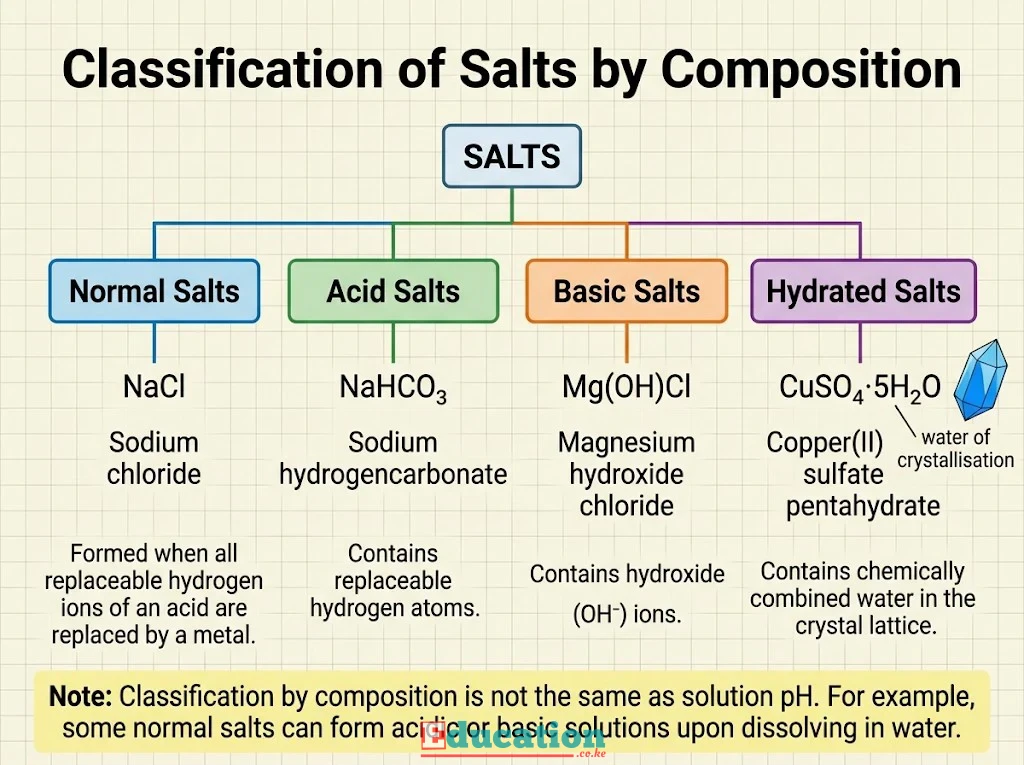
Salts may be classified by their composition and by how they behave in water. Normal salts form when all replaceable acidic hydrogen ions are replaced. Acid salts retain hydrogen in the anion because only partial replacement has occurred in a polybasic acid. Basic salts contain hydroxide groups alongside other anions. The term “acid salt” describes composition and does not automatically mean the solution has pH below 7.
- Normal salts: Na2SO4, KNO3 and CaCl2.
- Acid salts: NaHCO3 (sodium hydrogencarbonate) and NaHSO4 (sodium hydrogensulfate).
- Double salts: Contain two different cations or anions in a single crystalline compound, for example potash alum, KAl(SO4)2·12H2O.
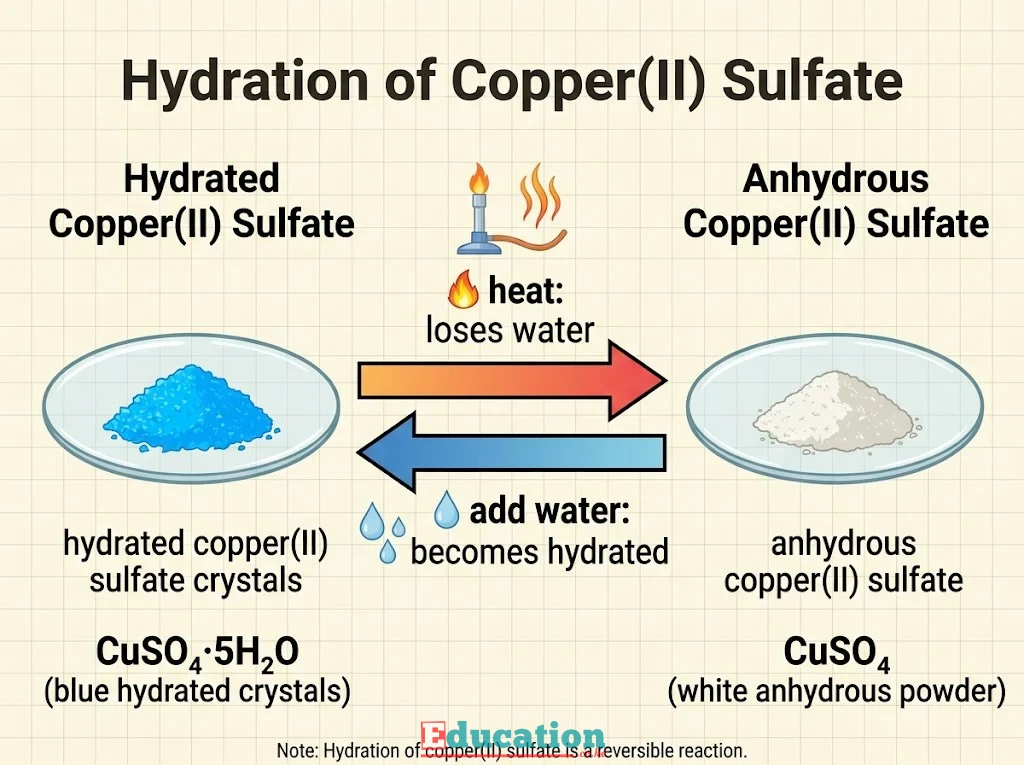
- Hydrated salts: Contain water of crystallisation within the crystal structure, e.g. CuSO4·5H2O. An anhydrous salt lacks this water.
4. Solubility of Salts #
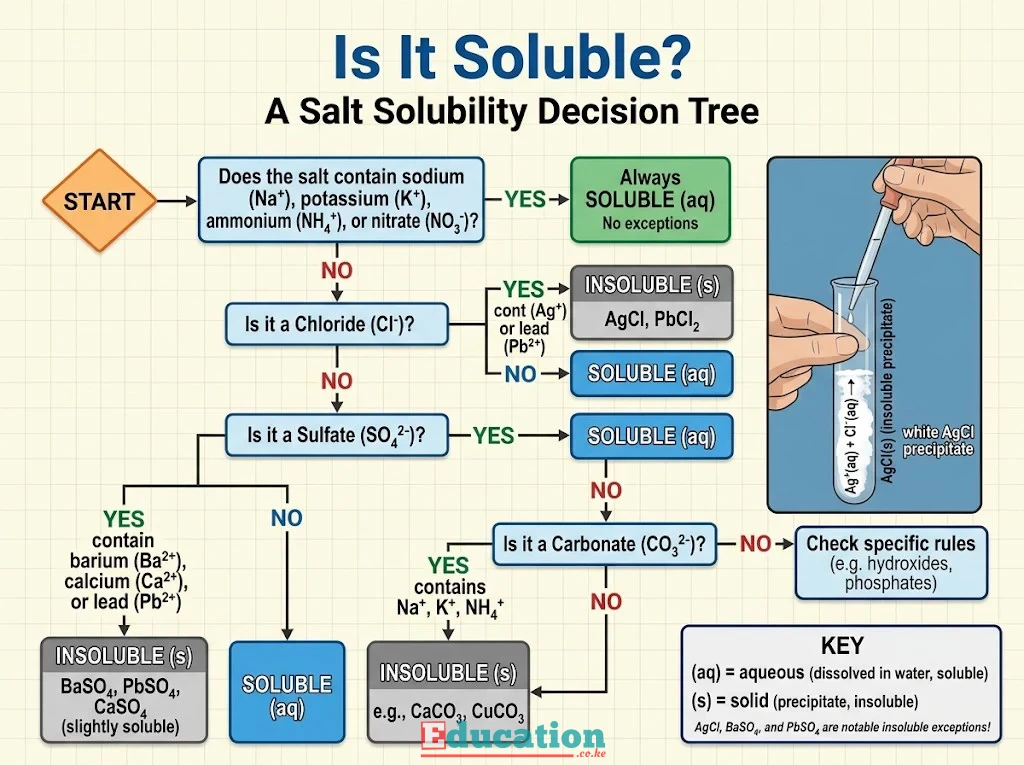
Solubility describes the maximum amount of a solute that dissolves in a given amount of solvent at a stated temperature. A soluble salt produces a solution when mixed with enough water; a sparingly soluble or insoluble salt may leave solid particles. Solubility rules help predict whether a precipitate forms when two aqueous solutions are mixed.
Salt Group |
General Solubility Rule |
Important Exceptions |
|---|---|---|
Sodium, potassium, and ammonium salts |
All common salts are soluble in water |
None at school level |
Nitrates |
All common nitrates are soluble |
None at school level |
Chlorides |
Most chlorides are soluble |
Silver chloride (AgCl) and lead(II) chloride (PbCl2) |
Sulfates |
Most sulfates are soluble |
Barium sulfate (BaSO4) and lead(II) sulfate (PbSO4) are insoluble; calcium sulfate (CaSO4) is sparingly soluble |
Carbonates |
Most carbonates are insoluble |
Sodium, potassium, and ammonium carbonates are soluble |
Note: These are school-level rules; use the supplied solubility table for unfamiliar salts.
Worked Example 3: Predicting a precipitate #
Problem: Aqueous silver nitrate is mixed with aqueous sodium chloride. Predict the products and observation.
- Step 1: Exchange the ions: possible products are AgCl and NaNO3.
- Step 2: Nitrates and sodium salts are soluble; AgCl is insoluble.
Answer: A white precipitate of AgCl forms: AgNO3(aq) + NaCl(aq) → AgCl(s) + NaNO3(aq).
Worked Example 4: Potassium carbonate #
Problem: Predict whether K2CO3 dissolves in water.
- Step 1: Potassium salts are soluble, including potassium carbonate.
- Step 2: The rule for potassium salts applies even though most carbonates are insoluble.
Answer: K2CO3 is soluble in water.
5. Preparing Soluble Salts from an Insoluble Base #
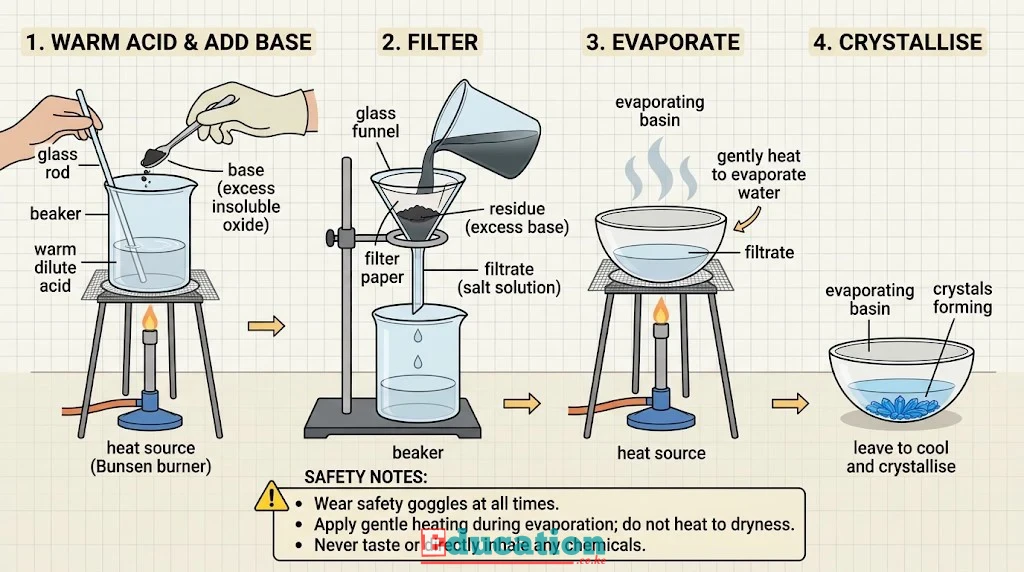
An insoluble metal oxide or hydroxide can be reacted with a suitable dilute acid to prepare a soluble salt. The insoluble solid is added in excess so that all the acid is used up. The remaining solid is removed by filtration, leaving a salt solution that can be concentrated and crystallised. Always follow standard laboratory safety and practical skills when heating acids.
- General pattern: acid + metal oxide → salt + water; acid + metal hydroxide → salt + water.
- Warm the dilute acid gently if instructed, then add the insoluble base in small portions while stirring.
- Continue adding base until a little remains undissolved; this indicates that the acid has been neutralised and base is in excess.
- Filter to remove excess solid. Heat the filtrate gently to concentrate it, then allow it to cool so crystals form.
Worked Example 5: Copper(II) sulfate crystals #
Problem: Describe how to prepare hydrated copper(II) sulfate crystals from dilute sulfuric acid and copper(II) oxide.
- Step 1: Warm dilute sulfuric acid. Add black CuO in small portions while stirring until some remains.
- Step 2: Filter off excess CuO. Gently evaporate part of the water from the blue filtrate, then cool it.
Answer: Blue CuSO4·5H2O crystals form. Equation: CuO(s) + H2SO4(aq) → CuSO4(aq) + H2O(l).
6. Preparing Soluble Salts by Titration #
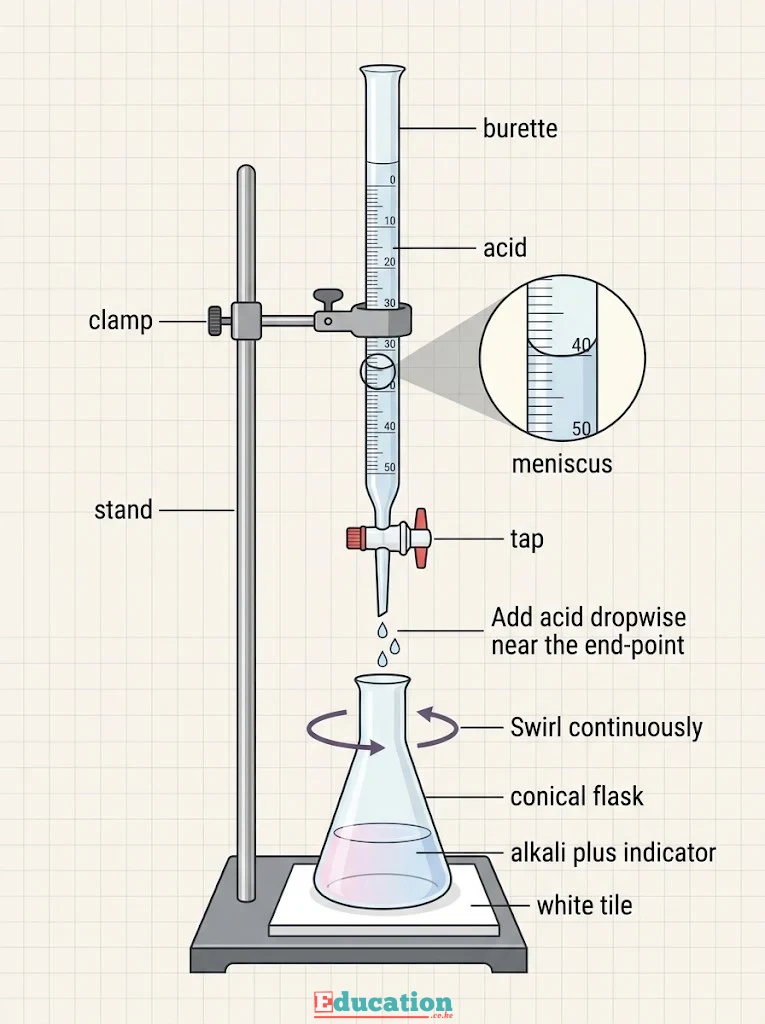
When both acid and base are soluble, neither reactant can simply be removed by filtration. Titration determines the exact volumes that neutralise each other. First use an indicator to locate the end-point; then repeat using the same measured volumes but without indicator so that the product is not contaminated by indicator.
- Pipette a measured volume of alkali into a conical flask and add a few drops of a suitable indicator.
- Fill a burette with acid, record the initial reading, and add acid while swirling until the indicator changes colour at the end-point.
- Repeat until concordant titres are obtained. Use the mean titre.
- Repeat the neutralisation with the same volumes but without indicator, then crystallise the salt solution.
Worked Example 6: Titration volumes #
Problem: A neutralisation requires 25.0 cm3 sodium hydroxide and a mean of 20.0 cm3 hydrochloric acid. What acid volume should be used for an indicator-free preparation?
- Step 1: Use the same measured volume that gave neutralisation in the titration.
- Step 2: The end-point volume of hydrochloric acid is 20.0 cm3.
Answer: Use 20.0 cm3 of hydrochloric acid with 25.0 cm3 sodium hydroxide, assuming the same stock solutions.
7. Preparing Insoluble Salts by Precipitation #
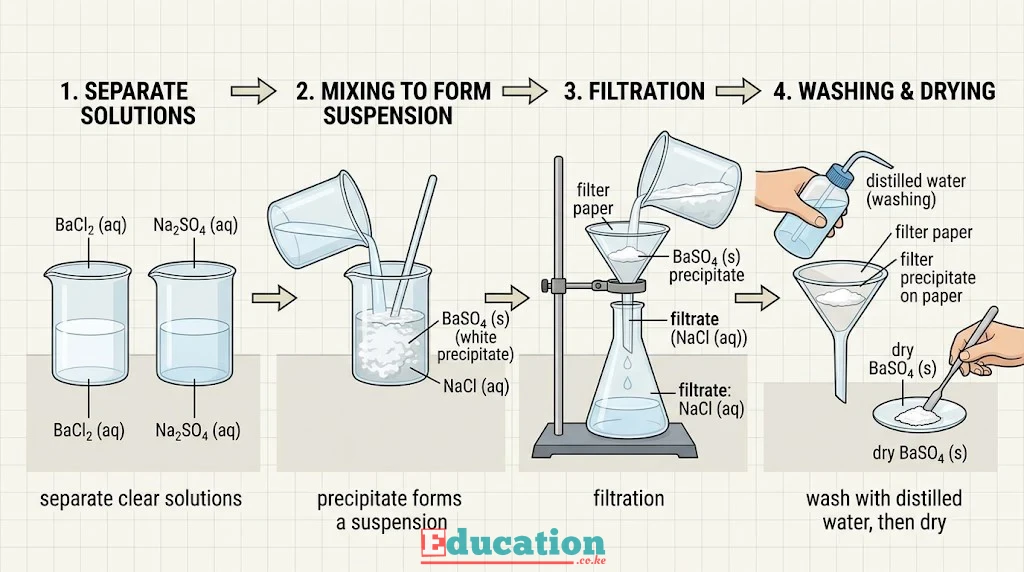
An insoluble salt is often prepared by precipitation: two soluble salt solutions are mixed so that their ions combine to form an insoluble product. The solid is separated by filtration, washed with distilled water to remove soluble impurities and dried appropriately.
- Choose reactants that supply the required cation and anion in soluble form.
- Mix solutions while stirring. The appearance of a solid indicates precipitation.
- Filter the mixture, wash the precipitate with small portions of distilled water and dry it appropriately.
- Use ionic equations to show only the ions that take part in forming the precipitate.
Worked Example 7: Preparing barium sulfate #
Problem: Write the equation for forming barium sulfate from barium chloride and sodium sulfate.
- Step 1: The required ions are Ba2+ and SO42-.
- Step 2: Na+ and Cl– remain dissolved as sodium chloride.
Answer: BaCl2(aq) + Na2SO4(aq) → BaSO4(s) + 2NaCl(aq); net ionic: Ba2+(aq) + SO42-(aq) → BaSO4(s).
8. Crystallisation and Water of Crystallisation #
Crystallisation produces a purified crystalline solid from a solution. The solution is concentrated until close to saturation, then allowed to cool. As it cools, the solubility of many salts decreases and crystals grow. The correct drying method depends on whether the salt is hydrated or anhydrous.
- Evaporate solvent gently to avoid spitting and decomposition.
- Allow the concentrated solution to cool slowly; slow cooling often produces larger crystals.
- Separate crystals from the remaining solution and dry carefully.
- Water of crystallisation is water incorporated in a definite ratio into a crystal structure, shown by a dot in CuSO4·5H2O.
Worked Example 8: Hydrated copper sulfate #
Problem: What does CuSO4·5H2O tell you?
- Step 1: The dot separates the salt formula from water of crystallisation.
- Step 2: The formula shows five water molecules per formula unit of copper(II) sulfate in the crystal.
Answer: Each formula unit contains CuSO4 and five waters of crystallisation.
9. Reactions and Uses of Salts #
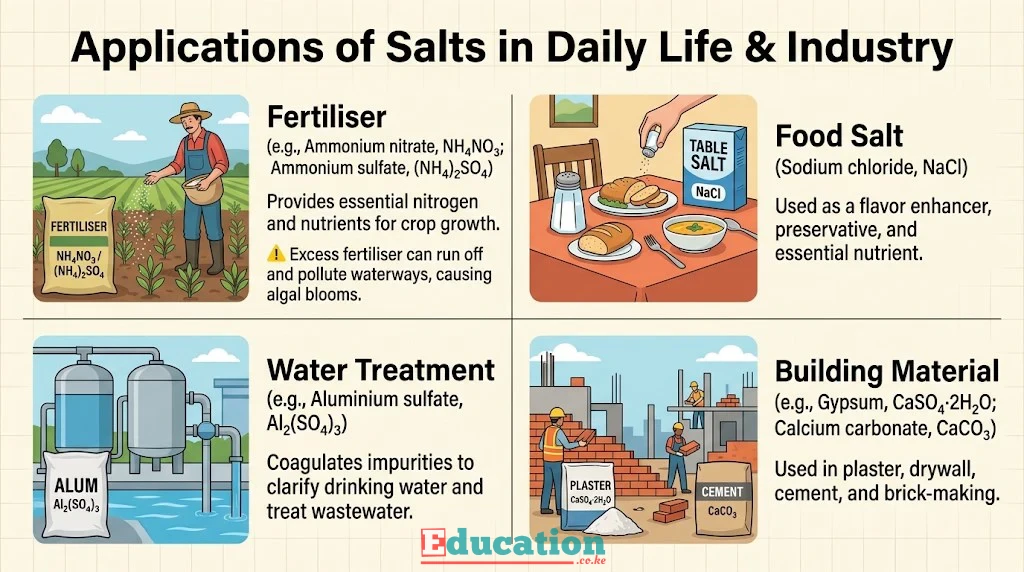
Salts participate in precipitation, reactions with acids, thermal decomposition and displacement reactions. They are used in food preservation, fertilisers, water treatment, construction, medicine, industry and laboratory analysis.
- Carbonates react with dilute acids to produce a salt, water and carbon dioxide.
- Many metal carbonates decompose on strong heating to form a metal oxide and carbon dioxide.
- Some salts identify ions through characteristic precipitates; tests must be interpreted carefully.
- Fertilisers supply nutrients such as nitrogen, phosphorus and potassium; incorrect use can cause runoff and eutrophication.
Worked Example 9: Acid and carbonate #
Problem: Write the products when calcium carbonate reacts with hydrochloric acid.
- Step 1: Acid + carbonate gives salt, water and carbon dioxide.
- Step 2: The salt from calcium ions and chloride ions is calcium chloride.
Answer: CaCO3(s) + 2HCl(aq) → CaCl2(aq) + H2O(l) + CO2(g).
10. Ionic and Net Ionic Equations #
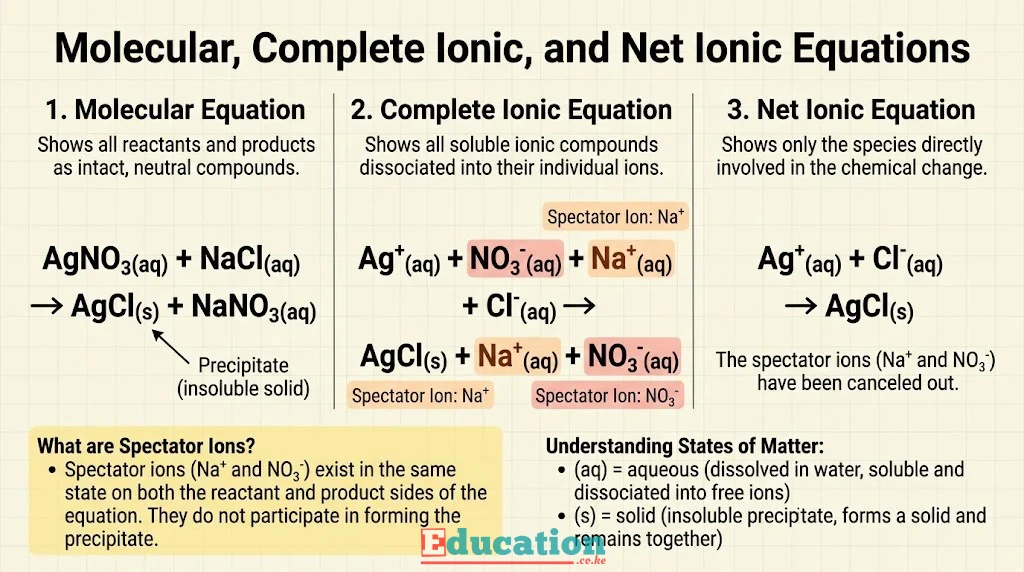
A complete ionic equation represents soluble ionic compounds in aqueous solution as separated ions. Ions unchanged on both sides are spectator ions. A net ionic equation removes these spectator ions and shows only the species undergoing chemical change.
- Split strong, soluble aqueous ionic compounds into ions; do not split solids, liquids, gases or weakly ionised substances.
- Balance atoms and total charge.
- Cancel ions that appear unchanged on both sides.
- Check that atoms and charge are conserved.
Worked Example 10: Silver chloride #
Problem: Obtain the net ionic equation for AgNO3(aq) + NaCl(aq) → AgCl(s) + NaNO3(aq).
- Step 1: Write ions: Ag+ + NO3– + Na+ + Cl– → AgCl(s) + Na+ + NO3–.
- Step 2: Na+ and NO3– are spectator ions and cancel.
Answer: Ag+(aq) + Cl–(aq) → AgCl(s).
Summary: Salts #
- Salts are ionic compounds whose formulae have zero net charge.
- Solubility rules predict whether salts dissolve or precipitate.
- Soluble salts can be prepared using an excess insoluble base or by titration.
- Insoluble salts are prepared by precipitation, then filtered, washed and dried.
- Crystallisation purifies salts; hydrated salts contain water of crystallisation.
- Net ionic equations omit spectator ions.
Self-check Questions: Salts #
- Write formulae for calcium nitrate, ammonium sulfate and aluminium chloride.
- Explain why excess copper(II) oxide is used when preparing copper(II) sulfate.
- Describe preparation of a pure insoluble salt by precipitation.
- Write molecular and net ionic equations for barium sulfate formation.
- State two differences between crystallisation and precipitation.
- Explain why a salt solution may be acidic or alkaline.
You can check your understanding in the Answers and Self-Assessment section.
Compiled and reviewed for Education.co.ke by Fred ArapToo (B.Ed. Physics & Chemistry, Egerton University; M.Ed. Education Administration candidate, University of Kabianga; Experience AI Certified Educator — Google DeepMind, Raspberry Pi Foundation & YSK, 2025; national KSEF facilitator, patron and evaluator; EdTech and open-access education platforms innovator; secondary school science educator with 15+ years of experience).
Looking for more resources?
- Revision & past papers: Teacher.co.ke | Education.co.ke | Teacher.ac
- Career pathways & university placement guide: CareerMap.co.ke
- School management systems & related digital applications: Contact us via Teacher.co.ke or ShuleMax.co.ke