In this Grade 11 Chemistry lesson under 3.0 Organic Chemistry, you will learn how to name straight-chain and branched alkanes systematically, draw structural isomers, explain physical and chemical properties of alkanes, and recognize the structure and general formula of alkenes.
5. Naming Alkanes #
To name a simple alkane, identify the longest continuous carbon chain and select the correct root. Since the compound contains only single bonds, use the ending -ane. If the chain is straight and unbranched, its name is straightforward: CH3CH2CH2CH3 is butane because it contains four carbon atoms.
For a branched alkane, follow these steps:
- Select the longest continuous chain as the parent.
- Number the chain from the end that gives the branch or branches the lowest possible number.
- Identify each branch and its position. A methyl branch on carbon 2 of a five-carbon chain gives 2-methylpentane.
- If identical branches occur more than once, use di-, tri-, or tetra- and list every position.
- When different substituents are present, list them alphabetically in the name; prefixes such as di- and tri- are generally not used when alphabetising substituent names.
- Separate numbers with commas and separate numbers from words with hyphens. Do not insert spaces in the name.
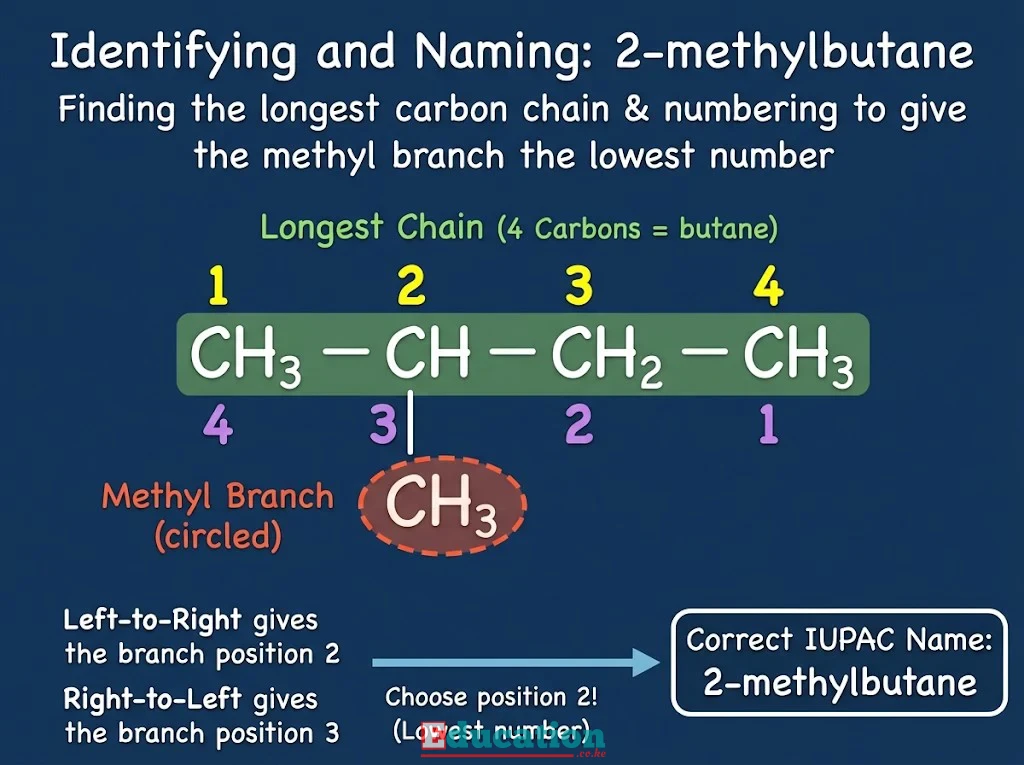
Worked Example: Name CH3–CH(CH3)–CH2–CH3.
The longest continuous chain contains four carbon atoms, so the parent is butane. Numbering from the nearer end places the methyl branch at carbon 2 rather than carbon 3. The name is 2-methylbutane.
Common errors include choosing a chain that is not the longest, numbering from the wrong end, forgetting a branch locant, and using a number without a hyphen. Check the parent chain first, then numbering, then substituents, then punctuation.
Check Your Understanding #
- Name 2-methylpropane from its structure.
- Explain why a four-carbon parent chain takes precedence over a shorter chain.
- Name CH3CH(CH3)CH2CH2CH3.
- Identify two common naming errors.
6. Isomerism in Alkanes #
Structural isomers have the same molecular formula but different arrangements of atoms. As the number of carbon atoms increases, the number of possible carbon skeletons generally increases. This is one reason organic chemistry contains many distinct compounds.
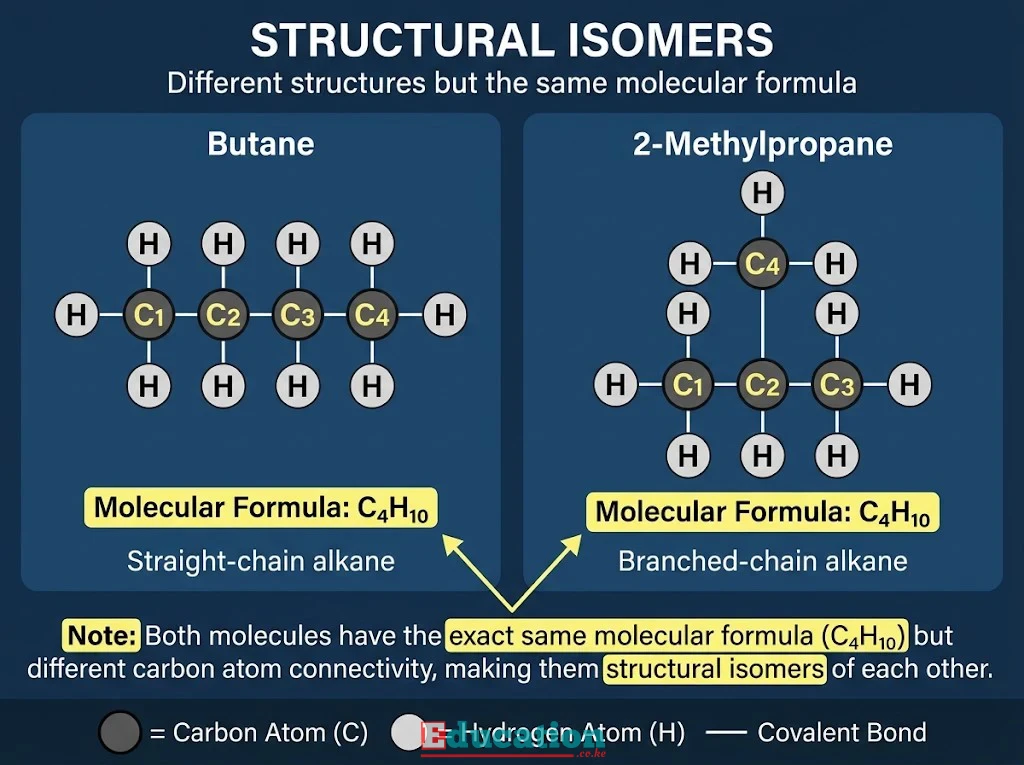
Butane (C4H10) has two structural isomers: butane and 2-methylpropane. Both contain four carbon atoms and ten hydrogen atoms. In butane, the carbon atoms form an unbranched chain; in 2-methylpropane, the carbon skeleton is branched. Their physical properties differ because molecular shape and surface contact influence intermolecular attractions.
Pentane (C5H12) has three structural isomers: pentane, 2-methylbutane, and 2,2-dimethylpropane. A reliable method for drawing isomers is to start with the longest possible chain, then shorten the parent chain and place branches in unique positions. Avoid drawing the same structure in a different orientation and counting it as a new isomer.
Isomer counting should preserve the molecular formula and valid carbon valency. For example, a carbon atom cannot be assigned five ordinary covalent bonds. Check that every proposed structure has the correct number of carbon atoms and hydrogen atoms.
Isomerism has practical significance. Different isomers may have different boiling points, volatility, ignition behaviour, and uses. In fuel chemistry, branching often changes combustion characteristics, which is one reason the structure of hydrocarbon mixtures matters.
Check Your Understanding #
- Define structural isomerism.
- Draw the two isomers of C4H10.
- List the three structural isomers of C5H12.
- Describe a systematic approach to finding isomers.
7. Physical Properties of Alkanes #
Alkanes are generally non-polar molecules. Their molecules attract one another mainly through London dispersion forces. These attractions are relatively weak compared with covalent bonds within the molecules, so boiling an alkane separates molecules without breaking the C–C and C–H covalent bonds.
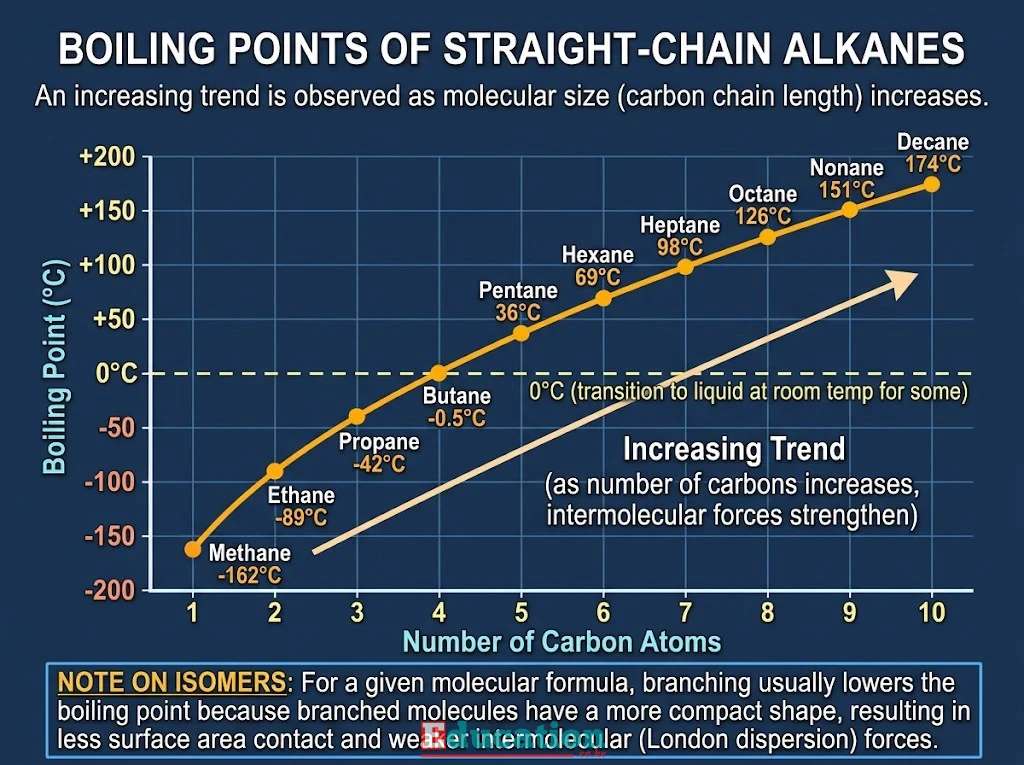
For a homologous series of straight-chain alkanes, boiling point generally increases as the number of carbon atoms increases. Larger molecules have more electrons and greater surface contact, leading to stronger dispersion attractions. More energy is therefore needed to separate the molecules.
Small alkanes such as methane, ethane, propane, and butane are gases at room temperature under ordinary pressure. Medium-sized alkanes are commonly liquids, while much larger alkanes can be waxy solids. These descriptions are approximate because physical state depends on temperature and pressure.
Alkanes are insoluble or only very slightly soluble in water because they are non-polar, while water is polar. They are more soluble in many non-polar organic solvents. Most alkanes are less dense than water, so a separate alkane layer generally floats on water, although safe laboratory practice should always guide handling.
Branching affects boiling point. For isomers with the same molecular formula, a more compact, highly branched molecule often has a lower boiling point than a straight-chain isomer because it has less surface contact. This is a useful trend, not a substitute for checking measured data.
Check Your Understanding #
- Explain the trend in boiling points down the alkane series.
- Why are alkanes poorly soluble in water?
- State the typical physical states of short- and long-chain alkanes.
- Explain how branching can affect boiling point.
8. Chemical Properties of Alkanes: Combustion #
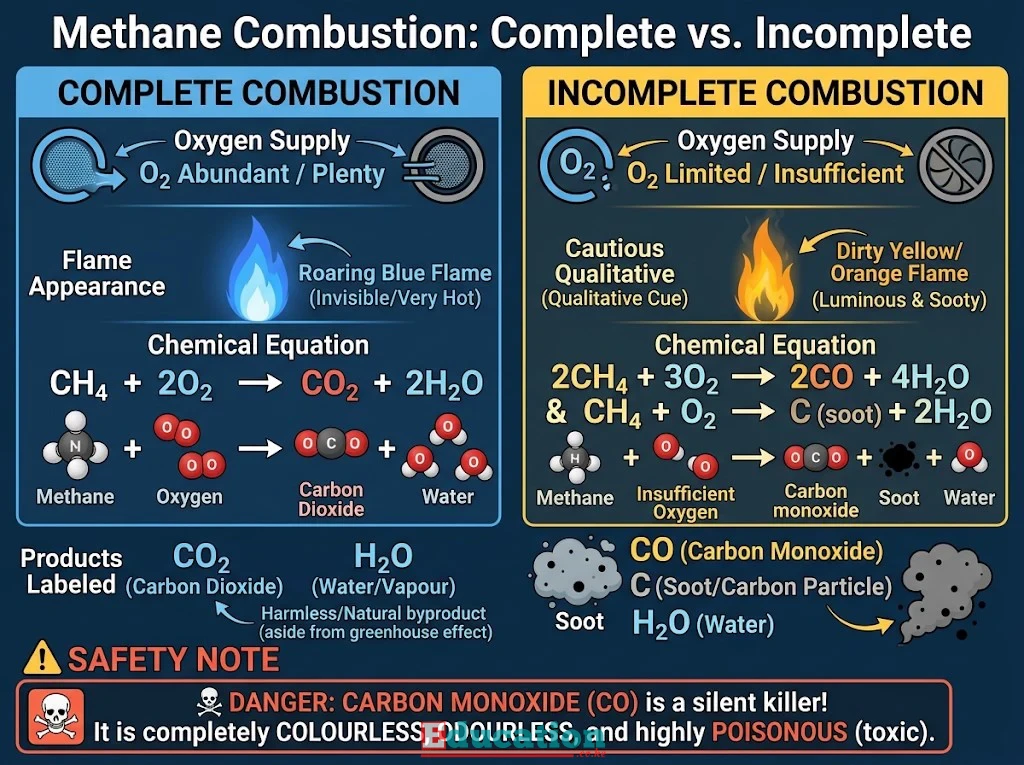
Combustion is a reaction with oxygen that releases energy. Complete combustion occurs when a hydrocarbon burns in sufficient oxygen, producing carbon dioxide and water. For example:
CH4 + 2O2 → CO2 + 2H2O
The equation is balanced because there is one carbon atom, four hydrogen atoms, and four oxygen atoms on each side.
To balance a hydrocarbon combustion equation:
- First balance carbon by placing the same number of CO2 molecules as carbon atoms in the fuel.
- Next balance hydrogen using H2O.
- Finally balance oxygen using O2. If an odd number of oxygen atoms is required, a fractional coefficient may be used temporarily, then all coefficients can be multiplied to obtain whole numbers.
Worked Example: Balance C3H8 + O2 → CO2 + H2O.
Three carbon atoms require 3CO2. Eight hydrogen atoms require 4H2O. The products contain 6 + 4 = 10 oxygen atoms, so 5O2 is needed. The balanced equation is C3H8 + 5O2 → 3CO2 + 4H2O.
In limited oxygen, incomplete combustion may produce carbon monoxide and/or carbon (soot), as well as water. Carbon monoxide is highly poisonous because it interferes with oxygen transport in the blood. Soot contributes to air pollution and can affect respiratory health.
Combustion is useful in heating, transport, and electricity generation, but it also releases carbon dioxide, a greenhouse gas. Safe appliances require adequate ventilation, correct maintenance, and suitable exhaust systems. Never operate a fuel-burning appliance in a poorly ventilated space.
Check Your Understanding #
- Balance the complete combustion of ethane.
- Distinguish complete from incomplete combustion.
- Explain why carbon monoxide is dangerous.
- State one benefit and two environmental concerns associated with hydrocarbon combustion.
9. Substitution Reactions of Alkanes #
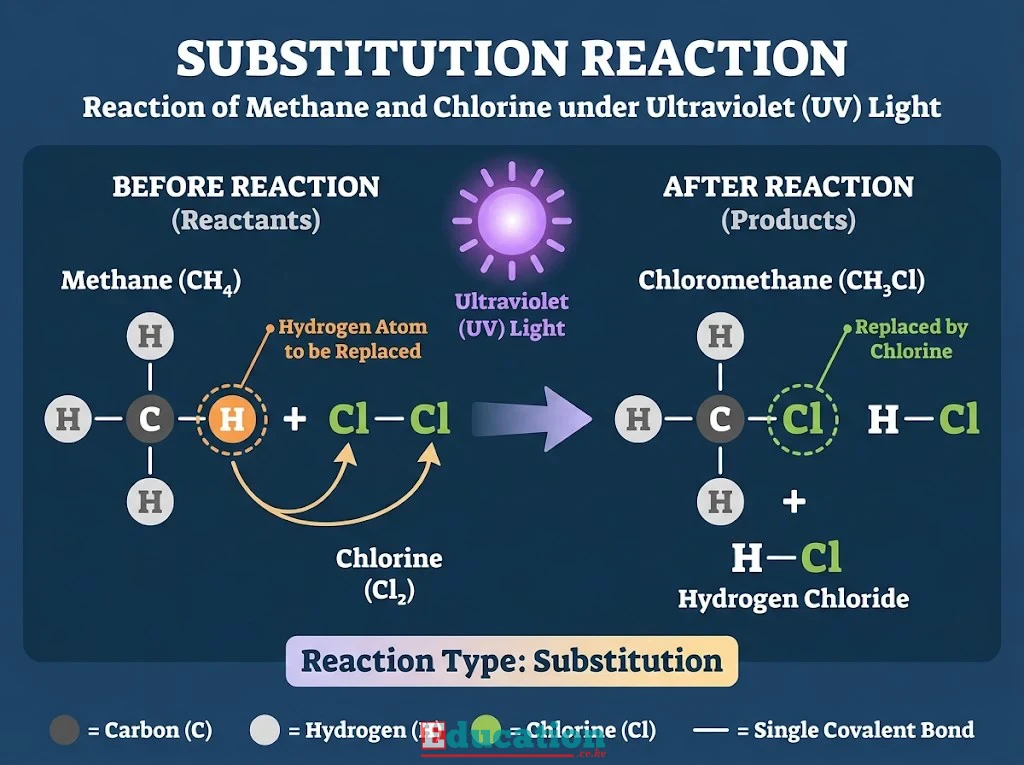
Alkanes are relatively unreactive under ordinary conditions because their C–C and C–H bonds are strong and non-polar. One characteristic reaction is substitution with a halogen, such as chlorine, in the presence of ultraviolet light. In substitution, one atom in the original molecule is replaced by another atom.
For example, methane reacts with chlorine under suitable photochemical conditions:
CH4 + Cl2 → CH3Cl + HCl
The products are chloromethane and hydrogen chloride. The reaction may continue, producing more highly substituted products if chlorine remains available and conditions permit.
Ultraviolet light supplies energy to initiate the reaction by splitting some chlorine molecules into reactive chlorine radicals. At school level, the key observable idea is that light is needed to initiate the reaction; detailed radical mechanisms may be treated as an extension where appropriate.
Substitution differs from addition. In substitution, one atom or group replaces another. In addition, atoms or groups add across a multiple bond, and the multiple bond becomes a single bond. This distinction is important when comparing alkanes, alkenes, and alkynes.
Halogenated hydrocarbons have industrial uses, but some are toxic or environmentally harmful. Do not attempt halogenation demonstrations without approved procedures, proper ventilation, risk assessment, and teacher supervision. Always follow laboratory safety and practical skills guidelines.
Check Your Understanding #
- Define substitution reaction.
- Write the equation for methane reacting with chlorine.
- State the role of ultraviolet light.
- Distinguish substitution from addition.
10. Alkenes: Structure and General Formula #
Alkenes are unsaturated hydrocarbons containing a carbon–carbon double bond. The simplest alkene is ethene (C2H4), with structural formula CH2=CH2. The double bond consists of two shared electron pairs and prevents free rotation in the same way as a single bond permits rotation.
The general formula for a simple open-chain alkene with one carbon–carbon double bond is CnH2n. For example, propene is C3H6 and butene is C4H8. This formula should not be applied blindly to cyclic compounds or molecules containing additional multiple bonds.
An alkene must contain at least two carbon atoms because a carbon–carbon double bond requires two carbon atoms. Alkenes with four or more carbon atoms may have the double bond in different positions or may have branched skeletons, creating structural isomers.
Alkenes are important industrial raw materials. Ethene is used to manufacture poly(ethene) and is involved in fruit ripening. Propene is used to make poly(propene). The double bond allows alkenes to undergo addition reactions that convert small molecules into products with new bonds.
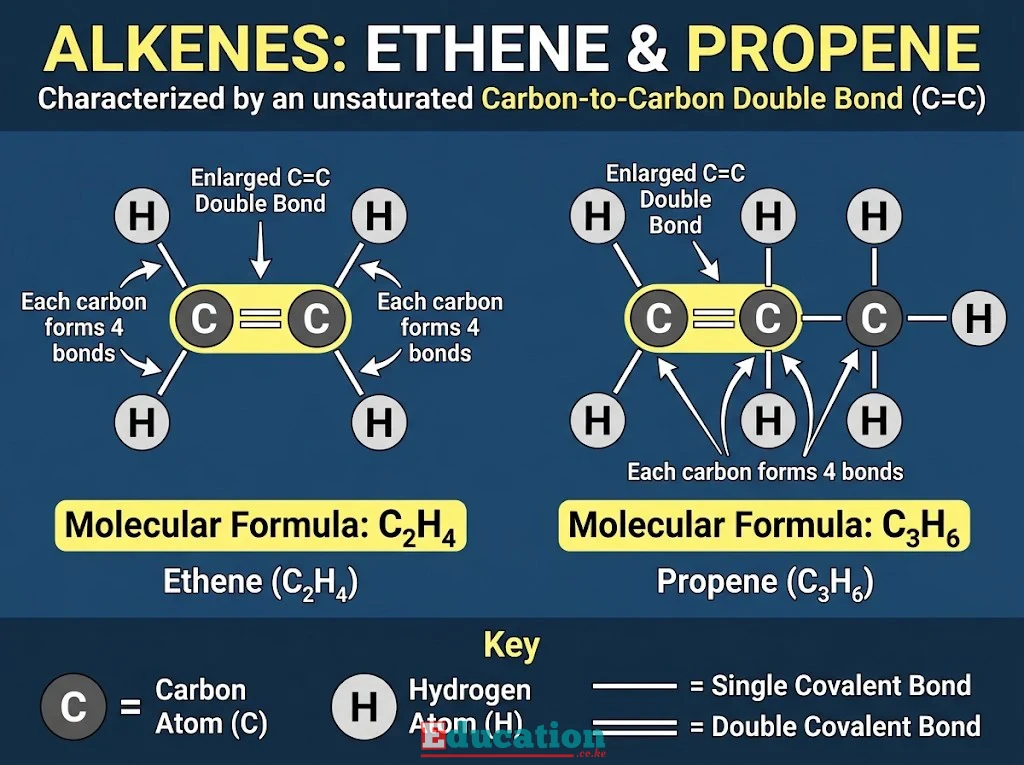
To recognise an alkene in a structural formula, look for C=C. A formula containing only C–C single bonds belongs to a different structure unless a ring or another feature changes the classification. Always check the displayed or condensed formula rather than relying only on the name. You will explore how to name these compounds in the next lesson on Naming Alkenes.
Check Your Understanding #
- Define an alkene.
- Write the general formula for a simple open-chain alkene with one double bond.
- Explain why ethene has two carbon atoms.
- Give two uses of alkenes.
Compiled and reviewed for Education.co.ke by Fred ArapToo (B.Ed. Physics & Chemistry, Egerton University; M.Ed. Education Administration candidate, University of Kabianga; Experience AI Certified Educator — Google DeepMind, Raspberry Pi Foundation & YSK, 2025; national KSEF facilitator, patron and evaluator; EdTech and open-access education platforms innovator; secondary school science educator with 15+ years of experience).
Looking for more resources?
- Revision & past papers: Teacher.co.ke | Education.co.ke | Teacher.ac
- Career pathways & university placement guide: CareerMap.co.ke
- School management systems & related digital applications: Contact us via Teacher.co.ke or ShuleMax.co.ke