In this Grade 11 Chemistry lesson under 3.0 Organic Chemistry, we cover how to name alkenes using IUPAC rules, explore structural and geometrical isomerism, examine the chemical test for unsaturation and addition reactions, and introduce the structure and naming of alkynes. If you need a refresher on saturated hydrocarbons, review 3.2 Naming Alkanes.
11. Naming Alkenes #
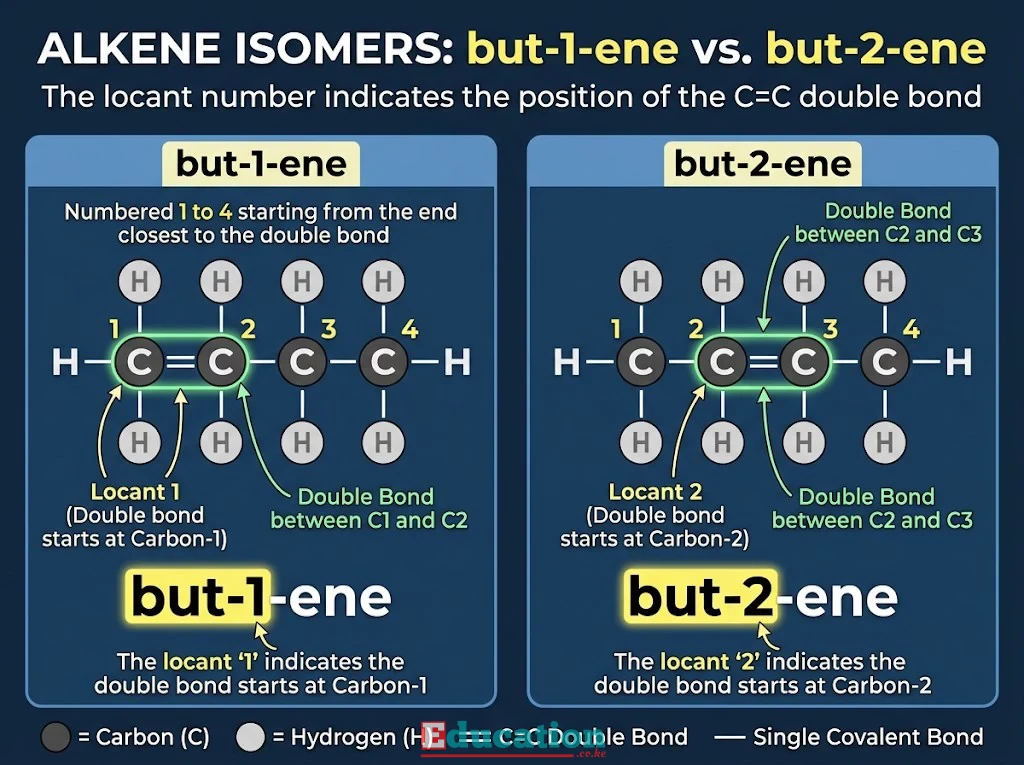
To name an alkene, choose the longest continuous carbon chain that contains the double bond. Use the appropriate carbon-chain root and the ending -ene. Number the parent chain from the end nearest the double bond so that the double bond receives the lowest possible locant.
For a double bond beginning at carbon 1 in a four-carbon chain, the name is but-1-ene. If the double bond begins at carbon 2, the name is but-2-ene. The locant indicates the first carbon atom in the double bond. Use consistent school-level IUPAC style, for example but-1-ene and pent-2-ene.
Branches are included as for alkanes. The parent chain must include the double bond, and numbering prioritises giving the double bond the lowest possible number before branch positions are considered. For example, a methyl branch on carbon 3 of but-1-ene is named 3-methylbut-1-ene when that structure is valid.
Worked Example #
Name CH₃–CH=CH–CH₃: The longest chain has four carbon atoms, so the root is but-. The double bond is between carbon 2 and carbon 3 whichever end is used. The name is but-2-ene.
Check the position of the double bond, carbon count, branch positions and punctuation. A common error is to choose a longer chain that does not contain the double bond. Another is to number from the end farthest from the double bond.
Check Your Understanding #
- Name CH₂=CH–CH₂–CH₃.
- Name CH₃–CH=CH–CH₃.
- Explain why the parent chain must contain the double bond.
- State how the double-bond position is indicated.
12. Isomerism in Alkenes #
Alkenes can exhibit structural isomerism because the carbon skeleton may be branched and because the double bond can occupy different positions. For example, but-1-ene and but-2-ene have molecular formula C₄H₈ but different double-bond positions. 2-methylpropene is another structural isomer of C₄H₈.
Geometrical isomerism can occur around a carbon–carbon double bond because rotation is restricted. For a pair of geometrical isomers to exist, each carbon of the double bond must be attached to two different groups. In but-2-ene, each double-bond carbon is attached to hydrogen and a methyl group, so two arrangements are possible.
In cis-but-2-ene, the two methyl groups lie on the same side of the double bond; in trans-but-2-ene, they lie on opposite sides. These arrangements have the same connectivity but different spatial arrangement. They can have different physical properties.
Do not assume every alkene has cis–trans isomers. In but-1-ene, one double-bond carbon has two hydrogen atoms, so the required pair of different groups is absent on that carbon. Therefore, the usual cis–trans distinction does not apply.
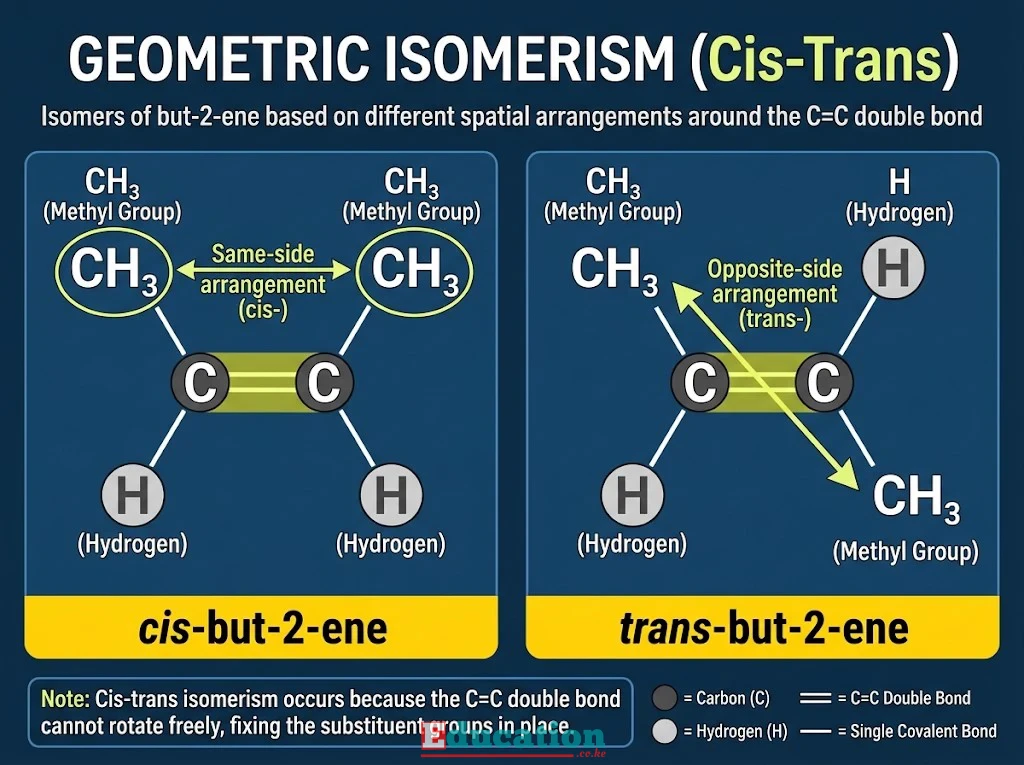
When drawing isomers, keep carbon valency correct and ensure the formula remains unchanged. For geometrical isomers, show the double bond clearly and place the groups on the correct sides. A simple two-dimensional drawing can communicate the distinction if it is carefully labelled.
Check Your Understanding #
- Give three structural isomers of C₄H₈ that are alkenes.
- Explain why rotation around a double bond is restricted.
- Distinguish cis-but-2-ene from trans-but-2-ene.
- Why does but-1-ene not show the usual cis–trans isomerism?
13. Chemical Test for Unsaturation #
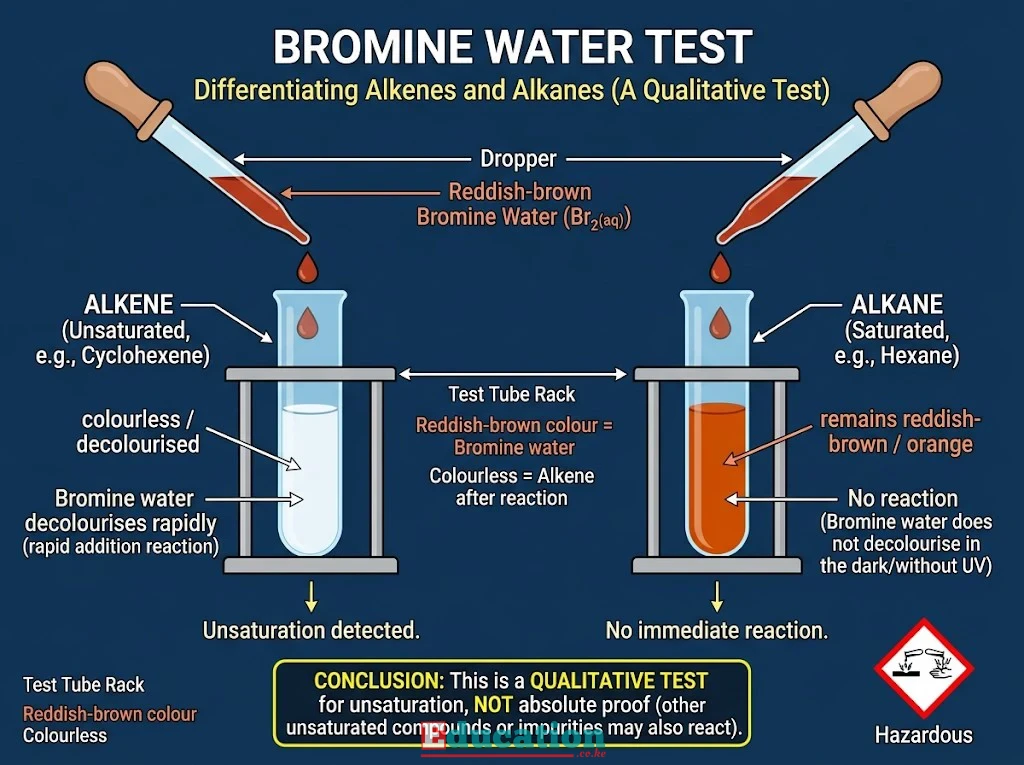
A common qualitative test for carbon–carbon double bonds uses bromine water. Under suitable classroom conditions, an alkene decolourises orange-brown bromine water as bromine adds across the double bond. The reaction converts an unsaturated compound into a saturated dibromoalkane.
For ethene, a simplified equation is CH₂=CH₂ + Br₂ → CH₂Br–CH₂Br. The bromine atoms add to the two carbon atoms that were joined by the double bond. This is an addition reaction. The observation is a colour change from orange-brown to colourless when enough alkene reacts.
Alkanes generally do not decolourise bromine water rapidly in the absence of ultraviolet light or other suitable conditions. This difference can help distinguish an alkane from an alkene, but a test must be interpreted cautiously: other reducing substances or reactive compounds may also affect bromine water.
Use small quantities, wear eye protection, avoid skin contact and follow the teacher’s instructions for chemical disposal. Bromine solutions are hazardous and should not be handled casually. The test should be conducted only in an approved educational setting with the appropriate safety controls. For more on safe practical conduct, see 3.5 Laboratory Safety and Practical Skills.
A good practical record includes the aim, apparatus, method, observations, conclusion and safety precautions. Record what is actually observed, not what you expected to see. If the colour does not disappear, discuss possible explanations such as insufficient sample, unsuitable conditions or an incorrect sample.
Check Your Understanding #
- Describe the bromine-water test for an alkene.
- Write the addition equation for ethene and bromine.
- Why is a negative test not always conclusive?
- List three precautions for a practical test.
14. Addition Reactions of Alkenes #
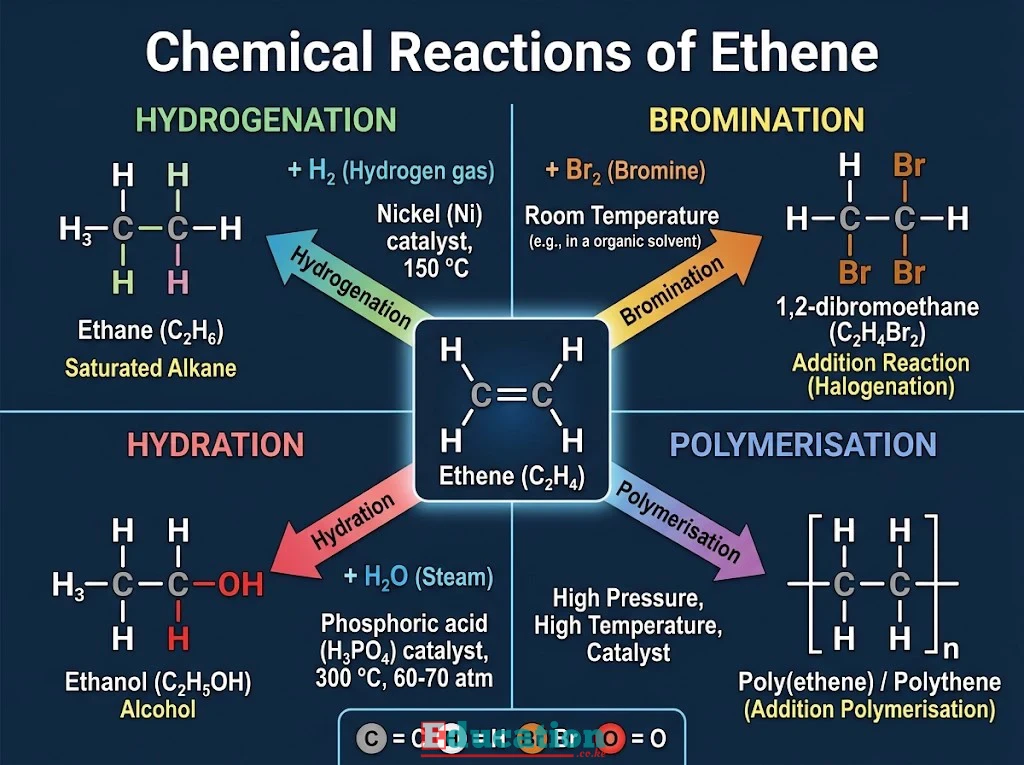
The carbon–carbon double bond in an alkene can react with small molecules to form products in which new atoms or groups attach to the carbon atoms. The double bond becomes a single bond as the reaction proceeds. These are addition reactions and are characteristic of unsaturated hydrocarbons.
- Hydrogenation: Adds hydrogen to an alkene in the presence of a suitable catalyst, often nickel under controlled industrial conditions. Ethene reacts with hydrogen to form ethane: C₂H₄ + H₂ → C₂H₆. Hydrogenation is used in industrial processing, including some transformations of oils, although food processing requires careful control of product composition.
- Halogen addition: Illustrated by the reaction of ethene with bromine to form 1,2-dibromoethane. The colour change in bromine water is linked to the consumption of bromine during addition. The exact conditions depend on the reactants and medium.
- Hydration: Adds water across the double bond to form an alcohol under suitable industrial conditions. Ethene can be converted to ethanol using steam and an acid catalyst at elevated temperature and pressure. The process is reversible and is managed to obtain a useful yield.
- Addition polymerisation: Another major reaction of alkenes. Many small alkene molecules (monomers) join to form a long-chain polymer. Ethene forms poly(ethene), widely used in packaging and many everyday objects. The polymer’s properties depend on its chain structure and manufacturing conditions.
Check Your Understanding #
- Define an addition reaction.
- Write the equation for hydrogenation of ethene.
- State the product of adding bromine to ethene.
- Explain the role of the double bond in addition reactions.
15. Alkynes: Structure and General Formula #
Alkynes are unsaturated hydrocarbons containing at least one carbon–carbon triple bond. Ethyne, C₂H₂, is the simplest member and is commonly called acetylene. Its condensed formula is HC≡CH. The triple bond contains three shared electron pairs between the carbon atoms.
The general formula for a simple open-chain alkyne with one triple bond is CₙH₂ₙ₋₂. For example, propyne is C₃H₄ and butyne is C₄H₆. This formula assumes an open chain with one triple bond and no additional rings or multiple bonds.
Because the triple bond needs two carbon atoms, an alkyne must contain at least two carbon atoms. With longer chains, the triple bond may occupy different positions and branches may occur, leading to structural isomers. The parent chain must include the triple bond when naming an alkyne.
Alkynes can undergo addition reactions because the multiple bond provides a site for reaction. Ethyne has been used as a fuel in oxy-acetylene welding and cutting because it can produce a very hot flame when burned with oxygen. This use requires purpose-designed equipment and strict safety procedures.
Do not attempt to generate, collect or ignite ethyne without formal laboratory supervision. Gas mixtures can be explosive, and pressurised gas cylinders require specialist handling. In this strand, focus on structure, formulae, naming and reaction equations rather than unsupervised gas preparation.
Check Your Understanding #
- Define an alkyne.
- Write the general formula for an open-chain alkyne with one triple bond.
- Give the formula of ethyne and propyne.
- State one use of ethyne and one associated safety concern.
16. Naming Alkynes #
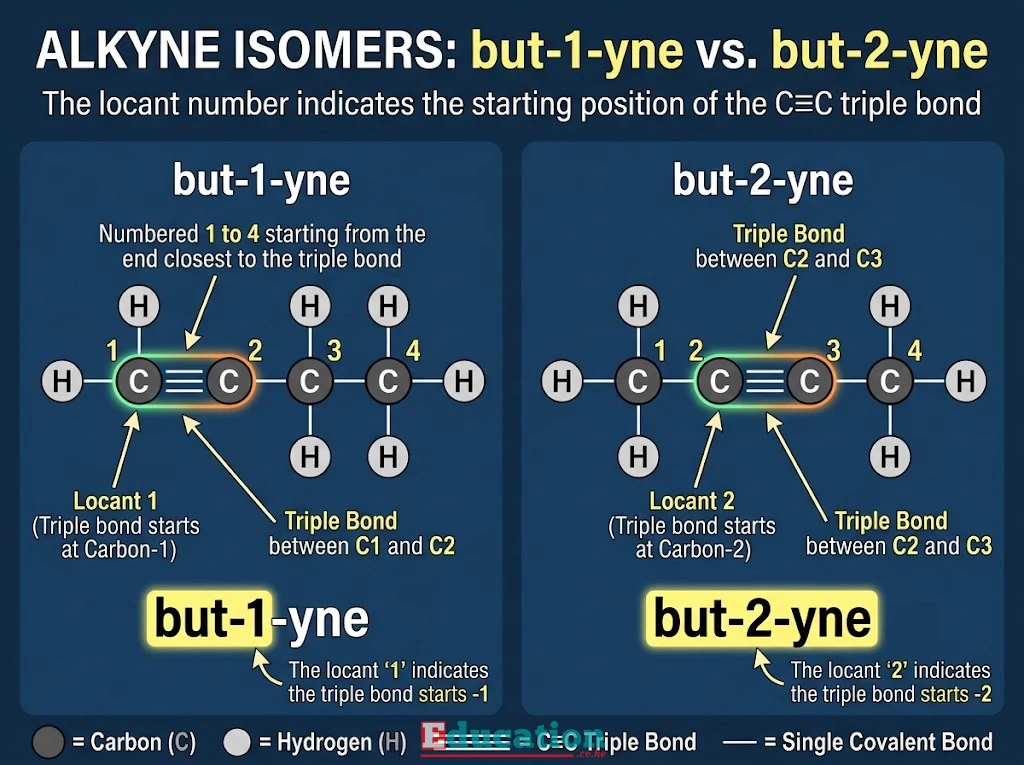
Alkynes are named using the same basic principles as alkenes, but the ending is -yne. Choose the longest continuous chain containing the triple bond, then number from the end nearest the triple bond. Indicate the position of the triple bond using the number of the first carbon atom in it.
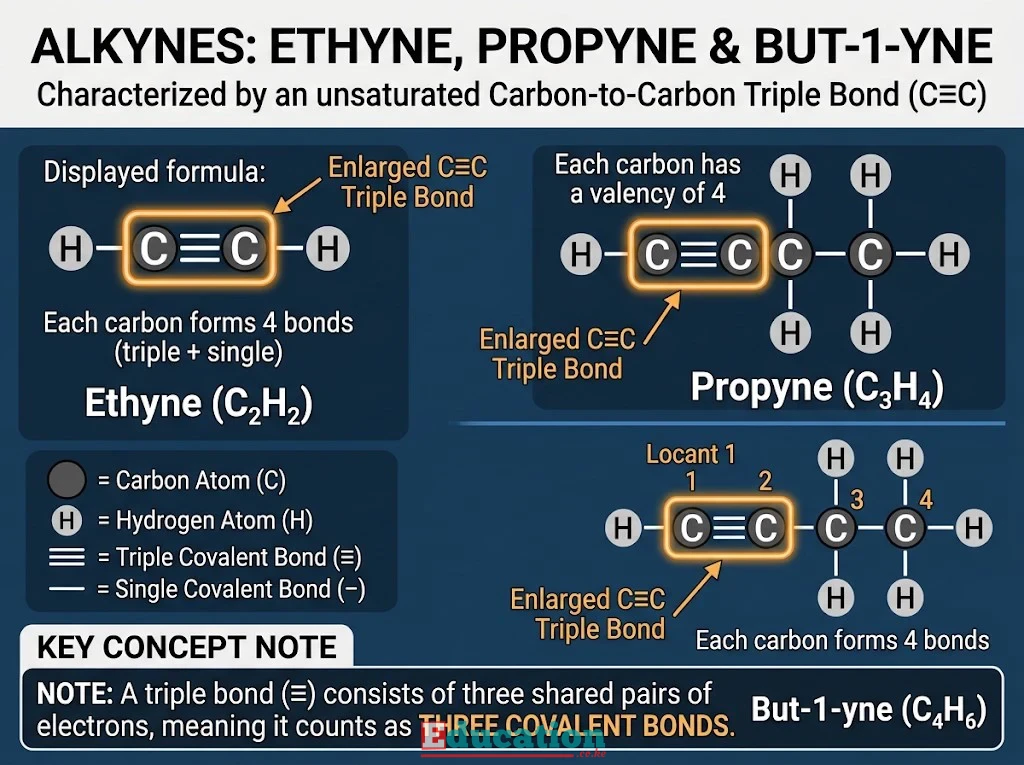
Examples include ethyne, propyne, but-1-yne and but-2-yne. In but-1-yne, the triple bond is between carbon 1 and carbon 2. In but-2-yne, it is between carbon 2 and carbon 3. The number must be as low as possible while the parent chain contains the triple bond.
Branches are named and numbered using the same approach used for alkanes and alkenes. When a branched structure is given, first identify the longest chain that contains the triple bond. Numbering must prioritise the triple bond location over branch locations.
Worked Example #
Name CH₃–C≡C–CH₃: The parent chain contains four carbon atoms, so it is a butyne. The triple bond begins at carbon 2 from either end. The correct name is but-2-yne.
Check the chain length, triple-bond position, branch locants and suffix. A common error is naming a compound as an alkane because the learner counts only the carbon atoms and overlooks the triple bond. Another error is using -ene for a triple bond. To compare all three homologous series, continue to 3.4 Comparing Alkanes, Alkenes and Alkynes.
Check Your Understanding #
- Name HC≡C–CH₂–CH₃.
- Name CH₃–C≡C–CH₃.
- Explain how the parent chain is selected for an alkyne.
- State the suffix used for alkynes.
Compiled and reviewed for Education.co.ke by Fred ArapToo (B.Ed. Physics & Chemistry, Egerton University; M.Ed. Education Administration candidate, University of Kabianga; Experience AI Certified Educator — Google DeepMind, Raspberry Pi Foundation & YSK, 2025; national KSEF facilitator, patron and evaluator; EdTech and open-access education platforms innovator; secondary school science educator with 15+ years of experience).
Looking for more resources?
- Revision & past papers: Teacher.co.ke | Education.co.ke | Teacher.ac
- Career pathways & university placement guide: CareerMap.co.ke
- School management systems & related digital applications: Contact us via Teacher.co.ke or ShuleMax.co.ke