This Grade 11 Chemistry lesson covers 3.5 Laboratory Safety and Practical Skills under 3.0 Organic Chemistry, alongside worked examples for formula identification, naming hydrocarbon structures, balancing equations, a revision summary, and practice questions.
23. Laboratory Safety and Practical Skills #
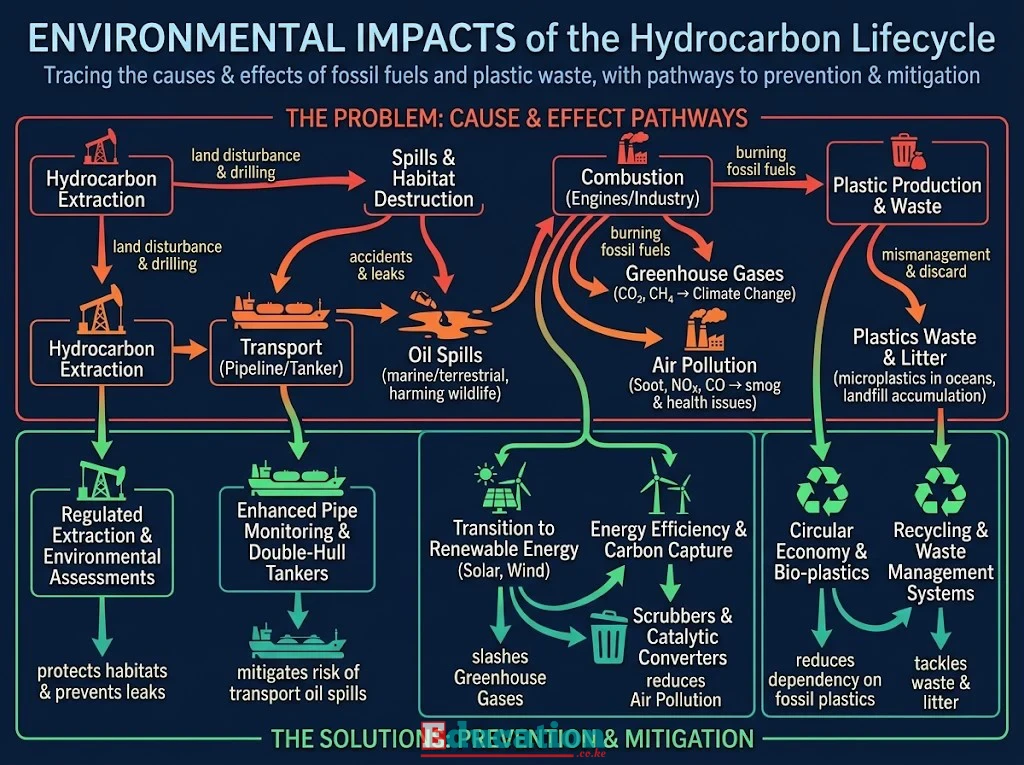
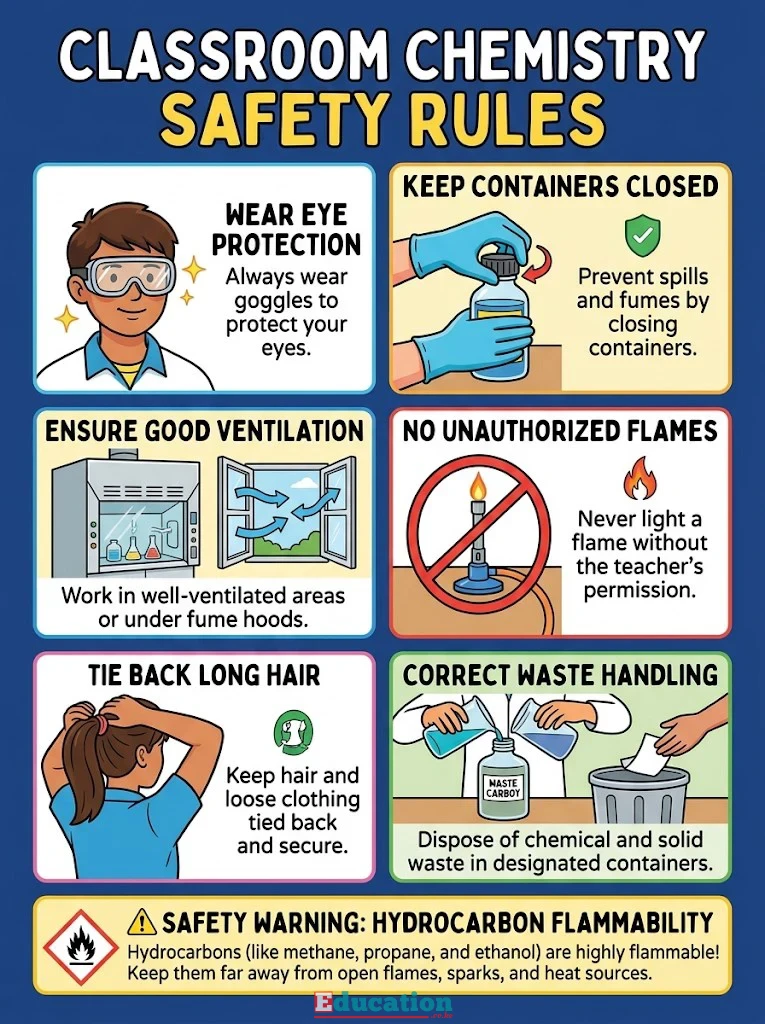
Practical chemistry requires risk assessment before work begins. Identify hazardous substances, likely exposure routes, ignition risks, glassware hazards and disposal requirements. Follow teacher instructions and the approved method. Use eye protection and any additional protective equipment specified by the risk assessment.
Hydrocarbons are often flammable and volatile. Keep containers closed when not in use, use the smallest practical quantities, avoid inhaling vapours, and keep materials away from uncontrolled flames or sparks. Never heat a sealed container because pressure may rise dangerously.
When investigating combustion, use a stable apparatus and a controlled flame under supervision. Do not lean over a flame, tie back long hair, keep loose clothing away from heat and ensure flammable materials are cleared from the work area. If a fire occurs, alert the teacher and follow the school’s emergency procedure.
For tests involving bromine water or other reagents, avoid skin and eye contact, use droppers carefully and dispose of waste as directed. Do not pour chemicals down a sink unless the approved procedure explicitly permits it. Clean spills only when instructed and equipped to do so.
A scientific report should separate observation from interpretation. For example, ‘the orange-brown colour disappeared’ is an observation; ‘the sample contained an unsaturated compound’ is a conclusion based on the test and its limitations. Include enough detail for another learner to understand what was done.
Check Your Understanding #
- List five steps in safe practical work.
- Why should hydrocarbon containers remain closed?
- Distinguish an observation from a conclusion.
- Explain why waste disposal must follow the approved method.
24. Worked Examples: Formulae and Family Identification #
Before applying general formulae, review the differences covered in Comparing Alkanes, Alkenes and Alkynes.
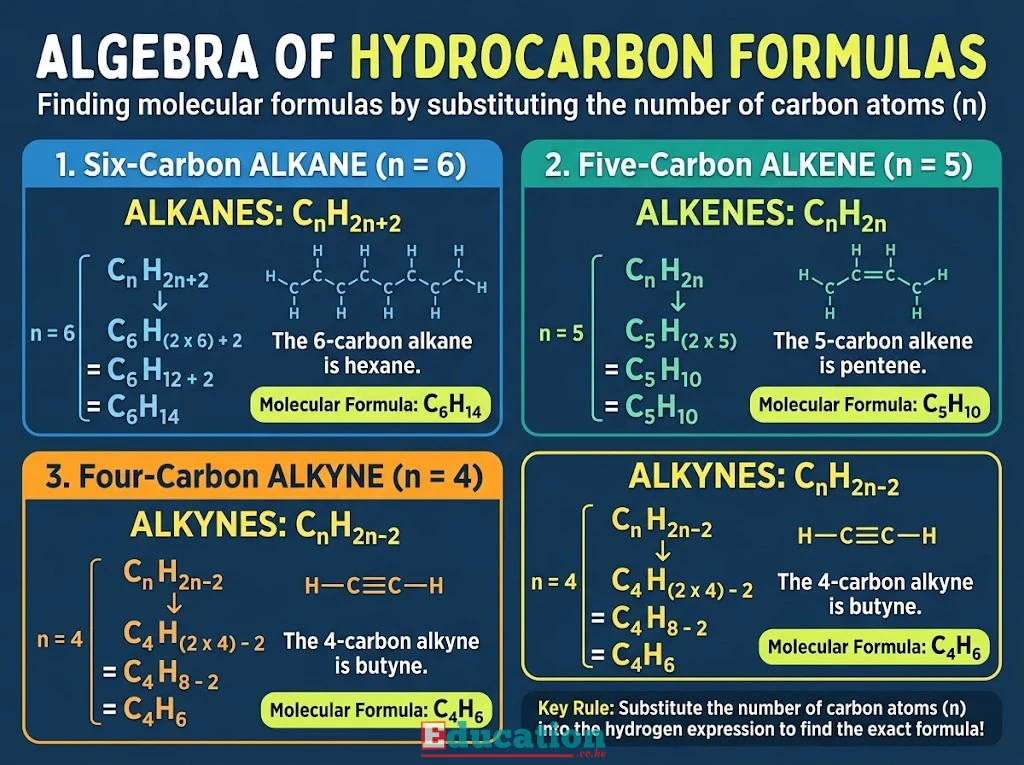
- Worked example 1: Determine the molecular formula of an open-chain alkane with six carbon atoms. The alkane formula is CₙH₂ₙ₊₂. Substituting n = 6 gives C₆H₁₄. This compound is hexane if the chain is unbranched.
- Worked example 2: Determine the formula of an open-chain alkene with one double bond and five carbon atoms. Use CₙH₂ₙ. Substituting n = 5 gives C₅H₁₀. Several structural isomers may share this formula, so the formula alone does not identify one exact structure.
- Worked example 3: Determine the formula of an open-chain alkyne with one triple bond and four carbon atoms. Use CₙH₂ₙ₋₂. Substituting n = 4 gives C₄H₆. The position of the triple bond or branching may differ among isomers.
- Worked example 4: Identify the family of C₃H₈. For n = 3, the alkane formula gives H = 2(3) + 2 = 8, so C₃H₈ fits propane, an alkane. Compare C₃H₆, which fits a simple alkene, and C₃H₄, which fits a simple alkyne.
Always state the assumptions used. The formula patterns given here apply to simple open-chain hydrocarbons with the specified number of multiple bonds. A cyclic compound or a compound with more than one multiple bond may have a different formula.
Check Your Understanding #
- Calculate the formula of heptane.
- Calculate the formula of hexene with one double bond.
- Calculate the formula of pentyne with one triple bond.
- Explain why C₆H₁₂ alone does not prove a sample is an alkene.
25. Worked Examples: Naming Structures #
For full naming rules, you can also revisit Naming Alkanes and Naming Alkenes.
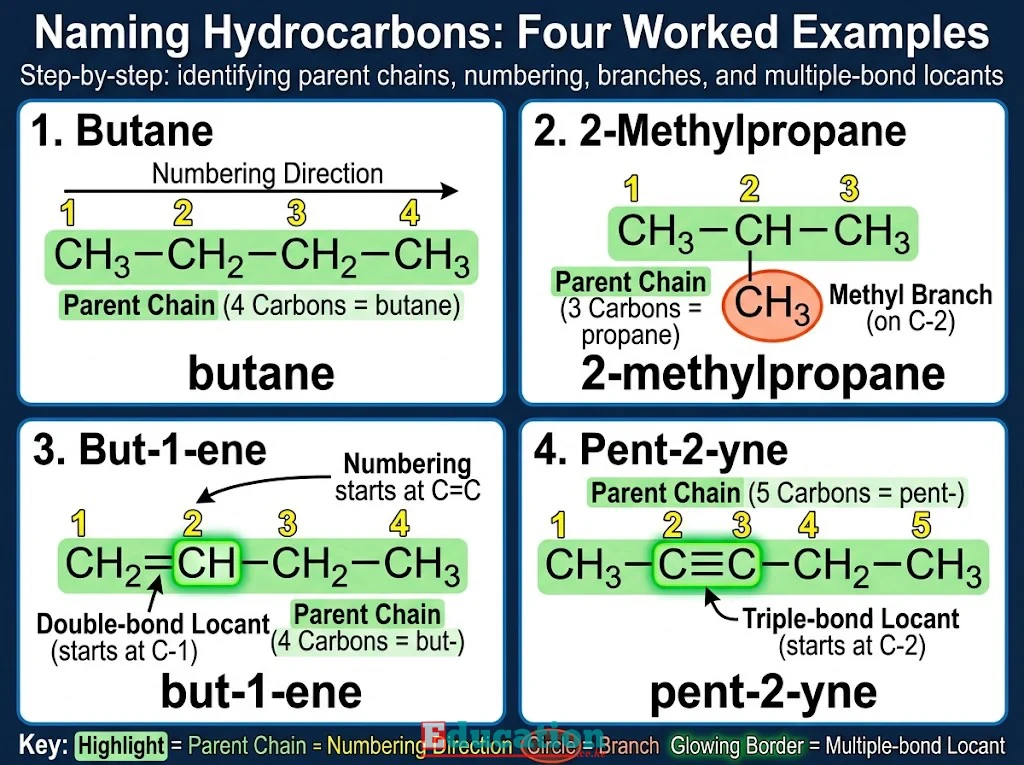
- Worked example 1: CH₃–CH₂–CH₂–CH₃ contains four carbon atoms in a continuous chain and only single bonds. Its name is butane. There are no branches or locants to add.
- Worked example 2: CH₃–CH(CH₃)–CH₃ has a three-carbon parent chain and a methyl branch on carbon 2. Numbering from either end gives the same locant. The name is 2-methylpropane.
- Worked example 3: CH₂=CH–CH₂–CH₃ contains four carbon atoms in a chain that includes the double bond. Number from the end nearest the double bond, placing it at carbon 1. The name is but-1-ene.
- Worked example 4: CH₃–C≡C–CH₂–CH₃ has five carbon atoms and a triple bond beginning at carbon 2. The name is pent-2-yne. The triple bond must be included in the parent chain.
An efficient naming checklist is: (1) identify the family and multiple bond; (2) select the longest chain that contains the required bond; (3) number from the correct end; (4) locate and name branches; (5) assemble the name with correct suffix, locants, commas and hyphens; (6) check the name against the structure.
Check Your Understanding #
- Name CH₃CH₂CH₂CH₂CH₃.
- Name CH₃CH(CH₃)CH₂CH₃.
- Name CH₃CH₂CH=CH₂.
- Name CH₃CH₂C≡CCH₃.
26. Worked Examples: Balancing Equations #
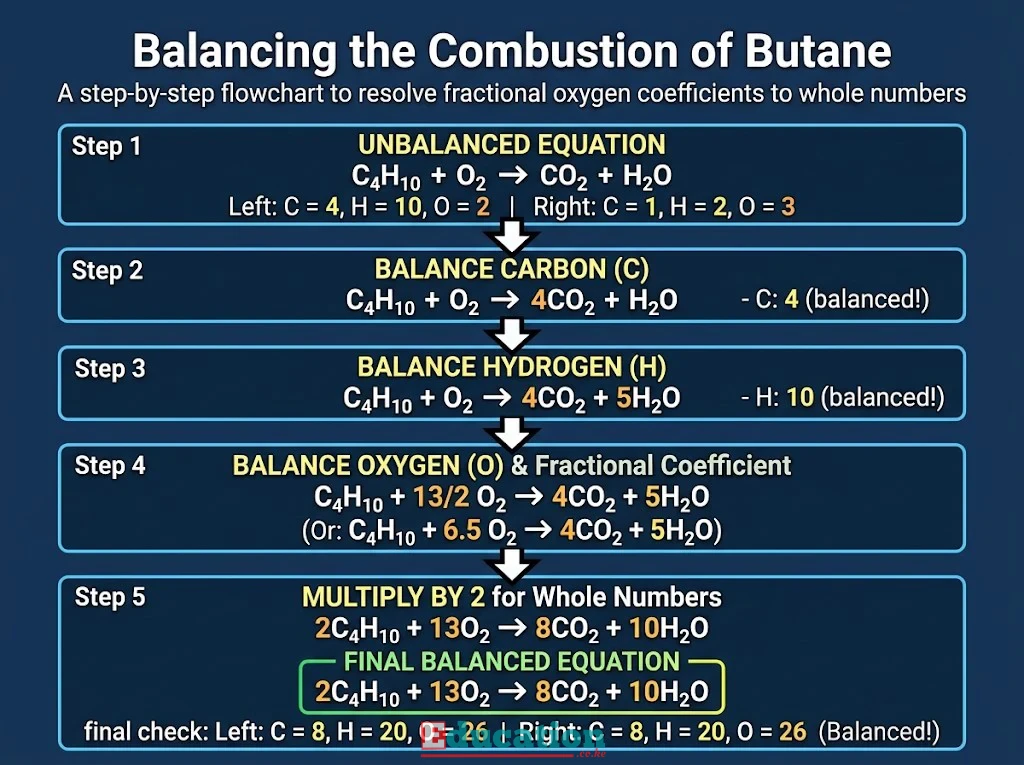
Combustion equations must conserve atoms. Begin by writing the correct products, then balance carbon, hydrogen and oxygen in that order. Do not change subscripts in chemical formulae to balance an equation; change only the coefficients placed in front of formulae.
- Worked example (Complete combustion of butane): Start with C₄H₁₀ + O₂ → CO₂ + H₂O. Balance carbon: C₄H₁₀ + O₂ → 4CO₂ + H₂O. Balance hydrogen: C₄H₁₀ + O₂ → 4CO₂ + 5H₂O. There are 8 + 5 = 13 oxygen atoms on the product side, so the oxygen coefficient is 13/2 O₂. Multiply all coefficients by 2 to obtain 2C₄H₁₀ + 13O₂ → 8CO₂ + 10H₂O.
- Worked example (Hydrogenation of propene): Propene is C₃H₆. Adding one molecule of hydrogen gives C₃H₆ + H₂ → C₃H₈. The atoms balance: three carbon atoms and eight hydrogen atoms on each side.
- Worked example (Addition of bromine to ethene): C₂H₄ + Br₂ → C₂H₄Br₂. The product is 1,2-dibromoethane. The equation represents addition across the carbon–carbon double bond.
After balancing, count each type of atom on both sides. Include state symbols only when known or requested. Reaction conditions may be written above or below the arrow, but they do not replace the need for a balanced equation.
Check Your Understanding #
- Balance the complete combustion of propane.
- Balance the complete combustion of pentane.
- Write the hydrogenation equation for but-1-ene.
- Explain why coefficients, not subscripts, are changed during balancing.
27. Revision Summary and Key Terms #
Hydrocarbons contain only carbon and hydrogen. Alkanes are saturated and contain only single carbon–carbon bonds. Alkenes contain at least one carbon–carbon double bond. Alkynes contain at least one carbon–carbon triple bond.
The simple open-chain formulae are CₙH₂ₙ₊₂ for alkanes, CₙH₂ₙ for alkenes with one double bond, and CₙH₂ₙ₋₂ for alkynes with one triple bond. These formulae are checks for specified structures, not universal formulae for every cyclic or multiply unsaturated hydrocarbon.
Naming depends on the longest appropriate parent chain, the position of multiple bonds, branch positions and the correct ending. Use -ane, -ene and -yne. Number the chain so that the multiple bond receives the lowest possible locant. Structural isomers share a molecular formula but differ in atom connectivity.
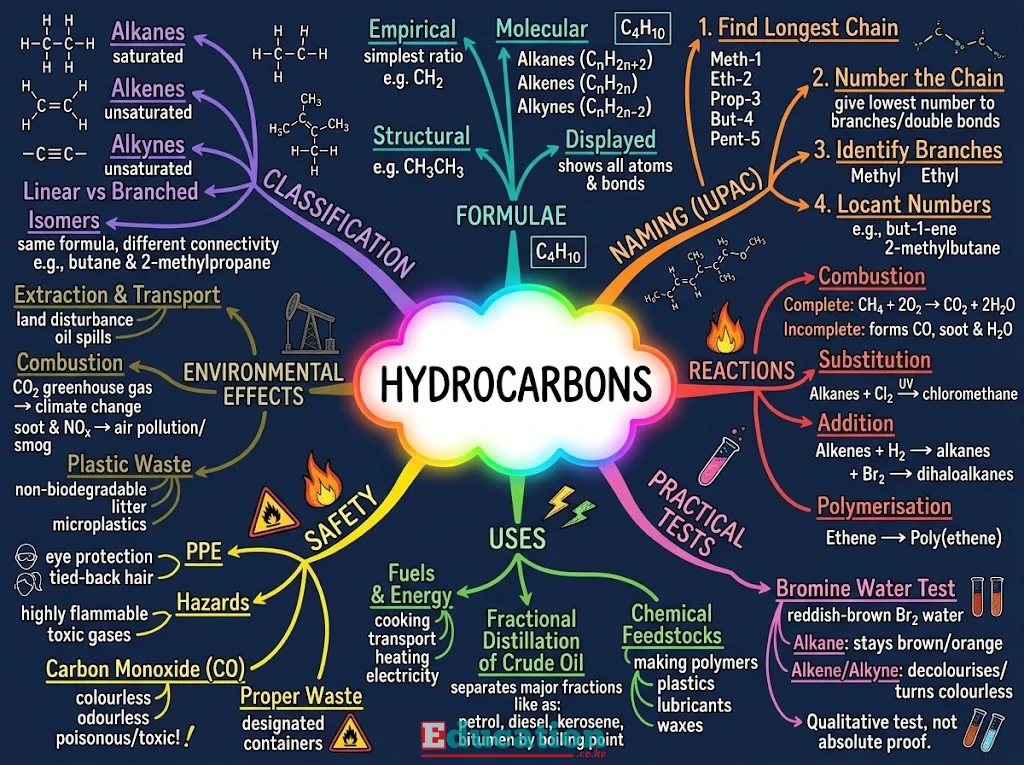
Complete combustion of a hydrocarbon forms carbon dioxide and water. Incomplete combustion can form carbon monoxide and soot. Alkanes can undergo substitution with halogens under suitable conditions, while alkenes and alkynes undergo addition reactions. Alkenes can also undergo addition polymerisation.
Hydrocarbons are valuable fuels and feedstocks, but their extraction, combustion and waste products create environmental and safety challenges. Scientific understanding supports safer handling, informed energy choices, waste reduction and responsible use of materials.
Check Your Understanding #
- Define hydrocarbon, saturated, unsaturated, isomer, monomer and polymer.
- State the three general formulae and their assumptions.
- Compare substitution, addition and polymerisation.
- Give three safety precautions and three environmental concerns.
28. Revision Questions: Short Answer #
- Define a hydrocarbon and explain why carbon can form many different compounds.
- Write the general formula for a simple open-chain alkane, alkene with one double bond and alkyne with one triple bond.
- Name the first six straight-chain alkanes.
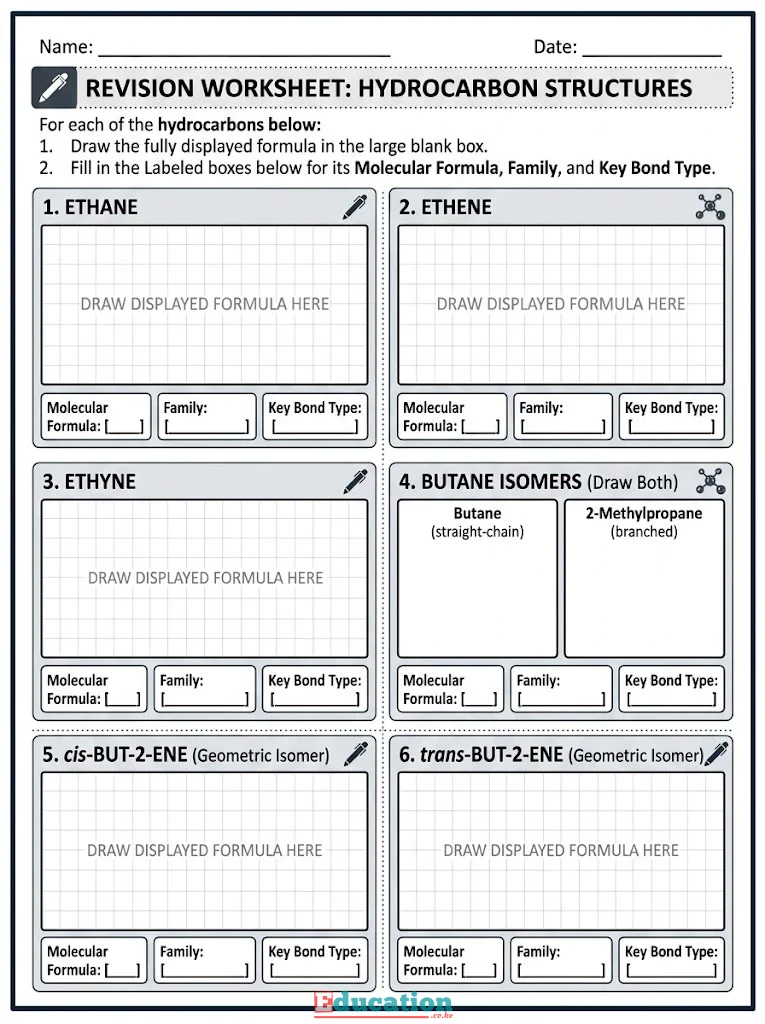
- Draw displayed formulae for ethane, ethene and ethyne.
- Explain the difference between a saturated and an unsaturated hydrocarbon.
- Name CH₃CH₂CH₂CH₃ and CH₃CH(CH₃)CH₃.
- Name CH₂=CHCH₂CH₃ and CH₃C≡CCH₃.
- Define structural isomerism and draw the isomers of C₄H₁₀.
- Explain why but-2-ene can have geometrical isomers but but-1-ene does not show the usual cis–trans isomerism.
- Describe the bromine-water test for unsaturation.
- Write balanced equations for complete combustion of methane and ethane.
- Explain the difference between substitution and addition reactions.
- Describe how crude oil is separated into fractions.
- Define cracking and explain one industrial benefit.
- Explain addition polymerisation using ethene.
- State three uses of hydrocarbons and three risks associated with their use.
- Explain why a fuel-burning appliance needs adequate ventilation.
- Give two reasons why the bromine-water test must be interpreted cautiously.
Check Your Understanding #
- Answer each question in complete scientific sentences.
- Draw and label structures clearly.
- Show working for all formula and balancing questions.
- Use equations where a reaction is requested.
29. Revision Questions: Structured Problems #
Question 1: A hydrocarbon has five carbon atoms and is an open-chain alkane. (a) Calculate its molecular formula. (b) Give its unbranched name. (c) Write a balanced equation for complete combustion. (d) Explain one danger of incomplete combustion.
Question 2: A compound has molecular formula C₄H₈ and decolourises bromine water. (a) Suggest the family it may belong to. (b) Draw two possible structural isomers. (c) Name one of the structures. (d) Explain why molecular formula alone may not identify one unique structure.
Question 3: An unknown compound has a carbon–carbon triple bond and four carbon atoms. (a) State its family. (b) Calculate the expected formula for an open-chain compound with one triple bond. (c) Draw but-1-yne and but-2-yne. (d) Explain the naming difference.
Question 4: Ethene is converted into a polymer. (a) Name the reaction type. (b) Draw the repeating unit. (c) Explain one useful property of the polymer. (d) Discuss one environmental challenge associated with plastic waste and one possible response.
Question 5: A learner tests two samples with bromine water. Sample A decolourises it quickly; sample B shows no rapid colour change under the same conditions. (a) State the likely distinction between the samples. (b) Explain the chemical basis of the test. (c) Identify one limitation. (d) State two precautions.
Check Your Understanding #
- Plan each answer before writing.
- Show calculations and balanced equations.
- Use labelled structural formulae rather than names alone.
- For discussion questions, give a reason for each point.
Compiled and reviewed for Education.co.ke by Fred ArapToo (B.Ed. Physics & Chemistry, Egerton University; M.Ed. Education Administration candidate, University of Kabianga; Experience AI Certified Educator — Google DeepMind, Raspberry Pi Foundation & YSK, 2025; national KSEF facilitator, patron and evaluator; EdTech and open-access education platforms innovator; secondary school science educator with 15+ years of experience).
Looking for more resources?
- Revision & past papers: Teacher.co.ke | Education.co.ke | Teacher.ac
- Career pathways & university placement guide: CareerMap.co.ke
- School management systems & related digital applications: Contact us via Teacher.co.ke or ShuleMax.co.ke