In Coaching (Strand 2.0), understanding how to organise players on the field or court is essential for effective team performance. This lesson covers Sub-strand 2.6: Formations in Games II, building on Tactical Skills (Sub-strand 2.5) to explore formations in Handball, Hockey, Baseball5, and Table Tennis.
2.6.1 Meaning and Purpose of Formations
A formation is the planned arrangement of players in a team or playing area. Formations help a team organise its attacking and defensive responsibilities, use space, support teammates, and respond to opponents. A formation is not a rigid pattern: players may move, exchange positions, and adapt according to the ball, the opponent, and the situation.
A coach selects formations according to the game, player strengths, opponent tactics, rules, available players, and the team’s level of experience. Learners should understand both their own role and how their movement affects teammates.
2.6.2 Principles That Guide Team Formations
- Width: Spread players across the available space to create passing options and stretch the defence.
- Depth: Position players at different distances to provide forward and backward support.
- Balance: Maintain enough players in useful positions to attack while remaining prepared to defend.
- Support: Provide teammates with safe passing options and cover.
- Compactness: Reduce dangerous gaps between defenders when protecting a goal or target.
- Communication: Use clear calls, gestures, and agreed signals.
- Transition: Move quickly and in an organised way when possession changes.
2.6.3 Handball Formations
Handball teams use attacking and defensive arrangements to create scoring opportunities and prevent opponents from shooting. The precise number of players on court and goalkeeper arrangements should follow the rules used in the competition. At school level, modified formats may be used to suit the number of learners and the available court.
A. Attacking Formations
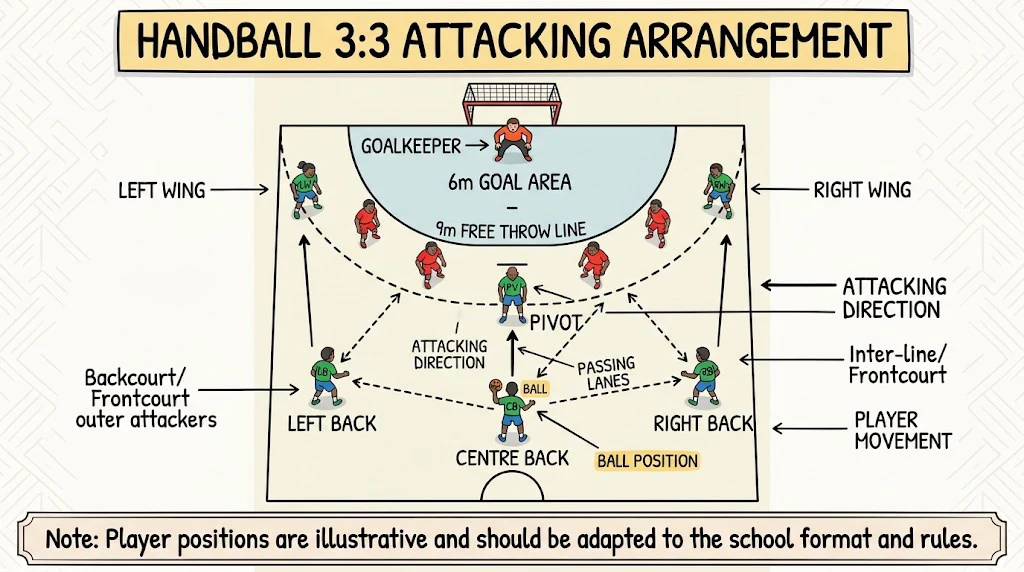
A common attacking arrangement is 3:3, in which three back-court players operate across the rear attacking line and three players occupy more advanced positions, often including the wings and pivot. The arrangement aims to create width, passing angles, and opportunities to penetrate defensive gaps.
A 2:4 arrangement uses two players in deeper positions and four more advanced players. It can increase pressure near the defence but may reduce space behind the advanced players and requires coordinated movement.
B. Defensive Formations
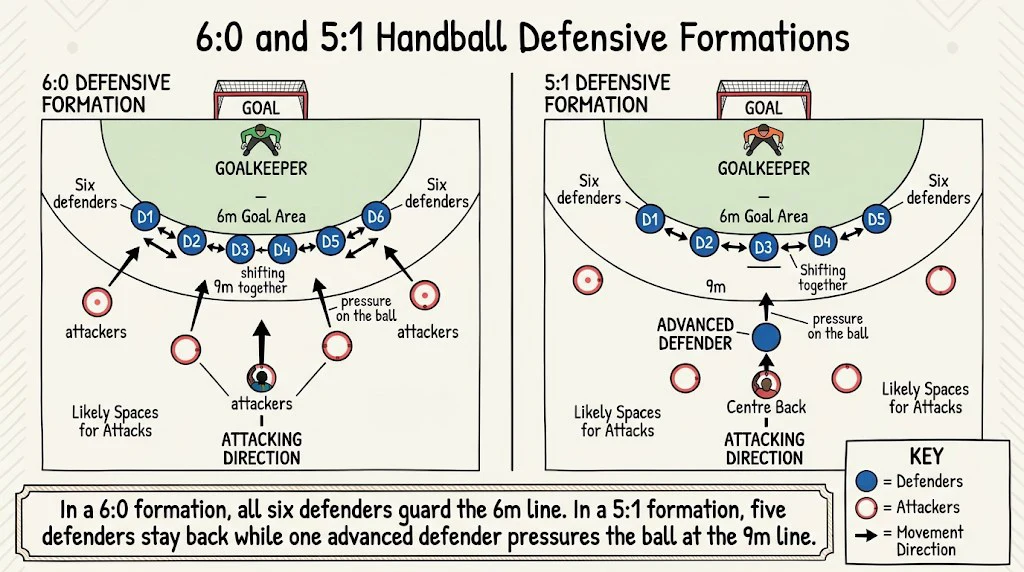
In a 6:0 defence, six court defenders form a relatively compact line in front of the goalkeeper. The formation protects central spaces and can make close-range penetration difficult. It may, however, allow opponents more room for outside shots if defenders do not pressure shooters effectively.
In a 5:1 defence, five defenders form a deeper line while one defender operates farther forward to pressure a key playmaker or disrupt passing. This can interfere with the opponent’s build-up but may create spaces behind the advanced defender.
2.6.4 Hockey Formations
Hockey formations organise players across defensive, midfield, and attacking areas. A formation should support ball circulation, provide passing options, protect the goal, and allow quick transition between attack and defence. The exact structure depends on the number of players and the format being played.
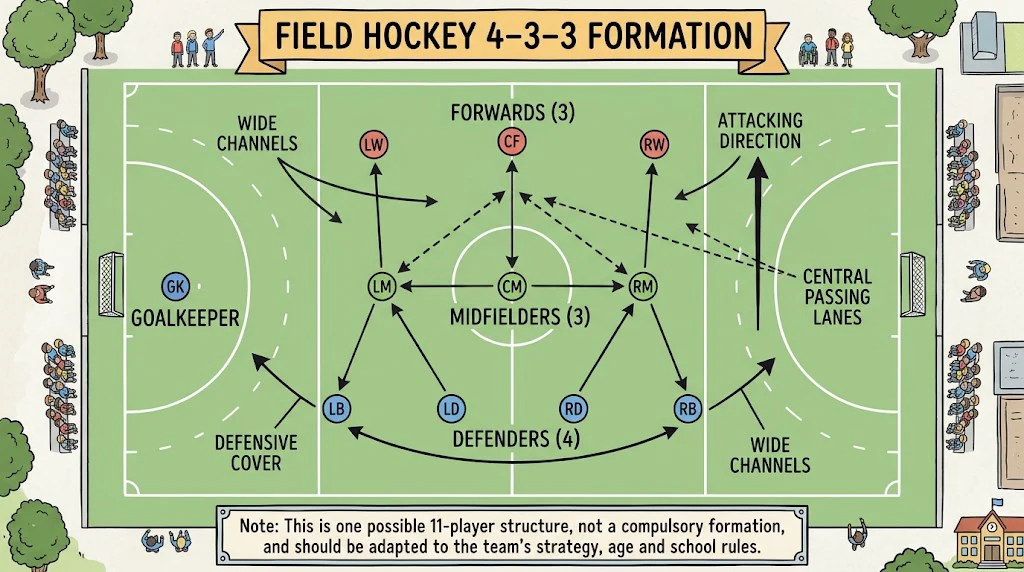
A simple school-level structure may use defenders, midfielders, and forwards. For example, a 3 – 3 – 3 arrangement in a modified nine-player game can provide three players in each line. In a full 11-a-side setting, a coach may use a 4 – 3 – 3 arrangement, but player roles and tactical details depend on the team’s level and rules.
A defensive shape should prevent opponents from advancing centrally and protect the circle. An attacking shape should create width, support the player in possession, and offer options ahead, behind, and to the side. Players should avoid crowding around the ball.
2.6.5 Baseball5 Formations
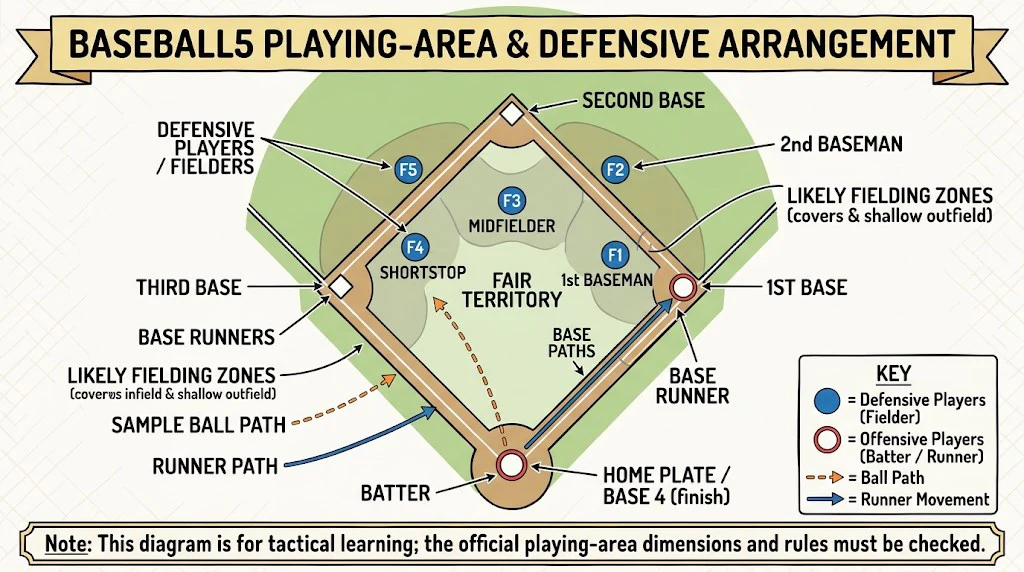
Baseball5 is a fast-paced bat-and-ball game in which players strike the ball by hand and move between bases while the opposing team fields. Its small playing area and rapid transitions require players to understand base positions, defensive coverage, and communication. The exact arrangement must follow the current Baseball5 rules and the school format.
In defence, players position themselves to cover likely hitting zones and bases. They must communicate who will field a ball, who covers each base, and how the defence will complete a play. In attack, the batter should consider safe placement and running opportunities rather than simply hitting as hard as possible.
2.6.6 Table Tennis Formations and Doubles Positioning
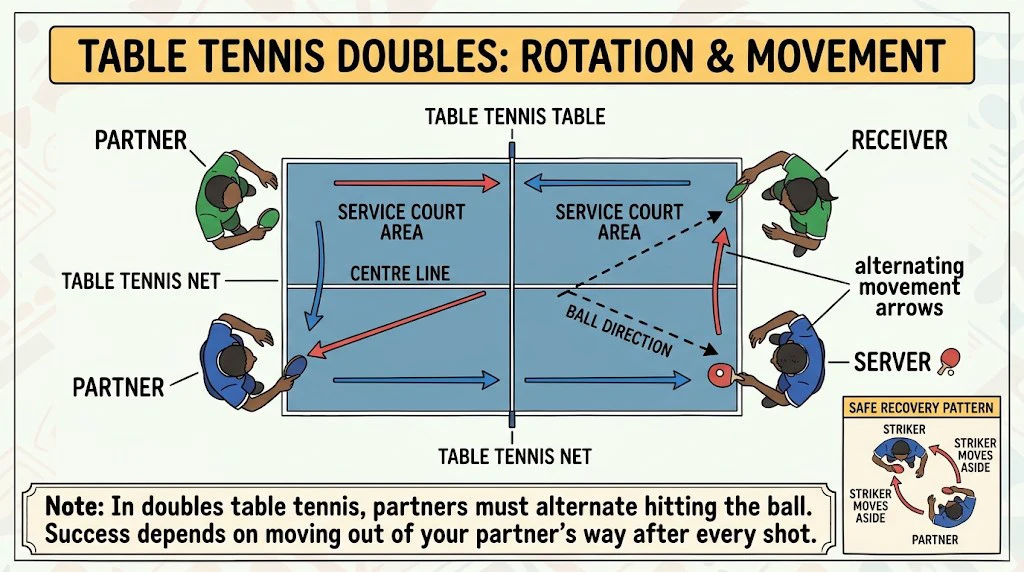
Table Tennis is usually played as singles or doubles. In singles, the player manages the whole table and uses positioning, footwork, and shot selection to control the rally. In doubles, the two partners must coordinate their positions and alternate shots according to the rules. The players commonly move in a pattern that allows one partner to strike and then clear space for the other.
Doubles partners should communicate before and during play. They can agree on serve placement, preferred receiving positions, and signals for tactical choices. After a shot, a player should move out of the partner’s hitting path and recover to a position that supports the next shot.
2.6.7 Comparing Formations Across Selected Games
Game |
Formation Focus |
What the Formation Helps the Team Do |
|---|---|---|
Handball |
Attacking 3:3 or 2:4; defensive 6:0 or 5:1. |
Create shooting opportunities, protect central spaces, and pressure ball circulation. |
Hockey |
Defender – midfielder – forward lines; e.g. illustrative 4 – 3 – 3. |
Maintain width, link defence to attack, and protect the goal area. |
Baseball5 |
Positioning around bases and likely hitting zones. |
Cover space, field the ball, protect bases, and communicate responsibilities. |
Table Tennis |
Singles court coverage; doubles partner rotation and positioning. |
Cover the table, create space for shots, and coordinate alternating strokes. |
2.6.8 Coaching a Team Using Formations
A coach should explain the purpose of a formation before asking players to use it. Players need to understand their starting positions, responsibilities, movement triggers, and communication. The coach should introduce one formation at a time and use a progression from walkthrough to practice and then game application:
- Identify the team’s needs and the tactical problem to be solved.
- Select a simple formation suitable for the players and the rules.
- Use a board, cones, or player demonstration to show starting positions.
- Explain each role and the movement expected when the ball or play changes.
- Walk through the formation without opposition.
- Practise with passive opposition, then introduce active pressure.
- Use a small-sided game to test the formation in realistic situations.
- Observe spacing, support, communication, and transitions; give specific feedback.
- Review whether the formation worked and make adjustments where needed.
Worked Example 1: Coaching a Handball 3:3 Attack
The coach places players in their starting positions and explains the role of the wings, back-court players, and pivot. First, players pass the ball around the back line without defenders. Next, the pivot moves to create a passing lane. A passive defence is added, followed by a small-sided game. The coach observes whether players maintain width, avoid crowding, and support the player with the ball.
2.6.9 Formation Changes During Play
A team may change formation when it gains or loses possession, when an opponent changes its defensive shape, when a player is substituted, or when the score and time influence the team’s strategy. A change should be communicated clearly. Players should know the trigger for switching and the responsibilities that follow.
- When attacking, spread out to create space and passing options.
- When defending, recover quickly and protect the most dangerous area.
- When possession changes, communicate and move together rather than individually chasing the ball.
- When a teammate is out of position, cover the space and restore team balance.
- When a formation is repeatedly exposed, identify the cause before changing the entire system.
2.6.10 Improvising Equipment and Modifying Facilities for Games
In line with Risk Management in Sports (Sub-strand 2.2), the same six appraisal criteria apply: durability, safety, suitability to skill, utility, aesthetic, and relevance. Examples of low-risk learning aids include clearly visible markers, soft balls for introductory catching tasks, boundary markers, and target zones made from safe reusable materials. Equipment must be appropriate to the sport and must not create a new hazard.
Game |
Possible Safe Learning Aid / Modification |
Safety Condition |
|---|---|---|
Handball |
Soft practice balls, flat marker cones, and clearly marked small-sided court zones. |
No sharp or unstable markers; goal frames must be secure. |
Hockey |
Soft training balls, safe marker cones, and modified practice channels. |
Sticks must be intact; no striking near faces; safe spacing. |
Baseball5 |
Soft practice ball and clearly marked base zones. |
Use a suitable ball; clear running paths and prevent collisions. |
Table Tennis |
Temporary floor markers for footwork zones and safe target areas. |
Keep walking paths clear; table must be stable; no slippery floor markers. |
Safety-critical items must not be improvised. A makeshift goal frame, unstable table, broken stick, or unsuitable playing surface should not be used simply because it is available. The coach should seek repair, replacement, or an alternative activity.
2.6.11 Peer and Self-Assessment of Formations
Observation Point |
Questions |
|---|---|
Starting positions |
Did players begin in the correct areas? |
Spacing |
Was there enough width and depth? Did players crowd the ball? |
Support |
Did teammates provide passing or defensive support? |
Communication |
Were calls and signals clear and timely? |
Transition |
Did the team reorganise quickly when possession changed? |
Role understanding |
Did each player understand their responsibilities? |
Adaptation |
Did players respond when the opponent changed tactics? |
Safety and fair play |
Did players follow rules and avoid dangerous contact? |
A learner can assess performance using ‘strength – evidence – next step’. For example: ‘Strength: the midfield line supported the attack. Evidence: two passing options were available on most possessions. Next step: the wide player should recover earlier after losing the ball.’
Summary: Formations in Games II
- Formations are planned arrangements that help teams organise attack, defence, and transitions.
- Useful principles include width, depth, balance, support, compactness, and communication.
- Handball uses attacking and defensive arrangements such as 3:3, 2:4, 6:0, and 5:1.
- Hockey formations organise players into defensive, midfield, and forward lines.
- Baseball5 formations focus on field coverage, base protection, and communication.
- Table Tennis doubles requires coordinated positioning and alternating shots.
- Coaches teach formations progressively and evaluate their effectiveness in game situations.
- Improvised equipment and modified facilities must meet the six appraisal criteria without compromising safety.
Quick Revision Questions
- Define a formation.
- Explain two principles of effective team formation.
- Distinguish between handball 6:0 and 5:1 defence.
- How do hockey lines support team play?
- Explain why Table Tennis doubles partners must coordinate movement.
Compiled and reviewed for Education.co.ke by Fred ArapToo (B.Ed. Physics & Chemistry, Egerton University; M.Ed. Education Administration candidate, University of Kabianga; Experience AI Certified Educator — Google DeepMind, Raspberry Pi Foundation & YSK, 2025; national KSEF facilitator, patron and evaluator; EdTech and open-access education platforms innovator; secondary school science educator with 15+ years of experience).
Looking for more resources?
- Revision & past papers: Teacher.co.ke | Education.co.ke | Teacher.ac
- Career pathways & university placement guide: CareerMap.co.ke
- School management systems & related digital applications: Contact us via Teacher.co.ke or ShuleMax.co.ke