Field events are athletics competitions conducted in designated areas rather than around a running track. This sub-strand focuses on officiating long jump, triple jump, high jump, and pole vault. Officials must understand the layout, equipment, safety requirements, attempt procedures, fouls, measurement, and result recording for each event.
3.3.1 General Principles of Officiating Jumping Events
The purpose of officials is to provide every athlete with a fair opportunity to compete under the same conditions and to ensure that each attempt is judged and recorded accurately. Jumping events require careful attention to take-off, flight, landing, bar clearance, equipment, and athlete safety.
- Inspect facility and equipment before warm-up and before competition.
- Explain order of competition, number of attempts, time allowed, and recording method.
- Ensure athletes compete in correct order and attempts are called consistently.
- Judge attempts using the relevant rule, not personal opinion or apparent quality.
- Measure valid performances accurately and record immediately.
- Maintain a safe landing area and keep unauthorised people away from active areas.
- Resolve questions and protests through the chief judge and competition procedures.
Common Officials and Their Duties
Official |
Main Responsibilities |
|---|---|
Chief judge |
Coordinates event, briefs team, resolves operational issues, and verifies results. |
Take-off / foul judge |
Observes take-off board or line and signals valid or foul attempts. |
Landing / pit judge |
Observes landing, identifies nearest mark, and ensures pit is ready. |
Measurer |
Measures valid performances using prescribed method. |
Recorder |
Records attempts, marks, failures, passes, and standings. |
Timekeeper / call-up official |
Controls attempt time and calls athletes in correct order. |
Safety Responsibilities
Proper risk management in sports is essential during field events to prevent injuries in sports and recreation:
- Keep runways free of loose objects, water, and unauthorised equipment.
- Ensure landing pits and mats are correctly positioned and in good condition.
- Check that bar supports, uprights, and vaulting equipment are stable.
- Do not allow an athlete to attempt a jump until the landing area is clear.
- Stop the event if weather, visibility, equipment failure, or another hazard makes participation unsafe.
- Place rakes, measuring tapes, and other tools safely away from active areas.
3.3.2 Long Jump
Long jump is a horizontal jumping event in which an athlete runs along a runway, takes off from a board or take-off area, and lands in a sandpit. The aim is to achieve the greatest legal horizontal distance. The official result is measured from the take-off line to the nearest mark made in the landing area by any part of the athlete’s body, according to the rules.
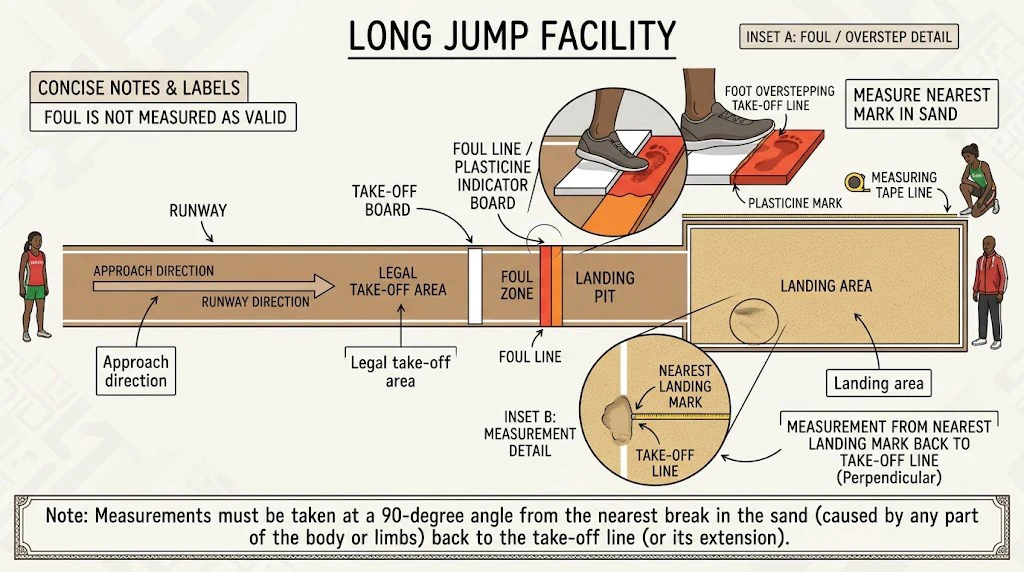
Facility and Equipment
Facility / Equipment |
Function and Inspection |
|---|---|
Runway |
Firm, level approach surface with adequate length and safe grip. |
Take-off board / line |
Defines legal take-off boundary; clearly visible and secure. |
Plasticine indicator board |
Shows whether athlete has overstepped take-off line where used. |
Sandpit |
Safe landing area; sand sufficiently deep, level, and hazard-free. |
Rake |
Levels sand after each attempt. |
Measuring tape / device |
Measures valid jump from correct reference point. |
Wind gauge |
Records wind conditions where required. |
Basic Rules and Regulations
- An athlete must take off from behind the take-off line; touching the ground beyond the line during take-off results in a foul.
- The athlete must not take off from outside the ends of the board or line in a way that breaches the rules.
- After landing, the athlete should leave the pit in the prescribed manner without making a nearer mark by walking back through the landing area.
- The jump is measured from the take-off line to the nearest mark in the landing area made by any part of the athlete’s body.
- A foul attempt is recorded as a failure and is not measured as a valid performance.
- In standard competitions, athletes are generally allowed three trials, with additional trials for leading athletes where the format provides them.
- The best valid jump determines the result; ties are resolved using next-best performances and applicable rules.
Judging and Measurement Procedure
- Confirm athlete identity and call the athlete when their turn arrives.
- Check runway and pit are ready and no person is in the landing area.
- Observe the take-off foot in relation to the take-off line.
- Signal a valid attempt or a foul using the agreed method.
- After a valid landing, identify the nearest mark made in the sand.
- Place zero end of measuring device at take-off line and measure to nearest mark, keeping tape perpendicular to the line.
- Read and announce result according to prescribed precision, then record it.
- Rake and level the pit before the next attempt.
Worked Examples: Long Jump
- Worked Example 1 (Measuring Long Jump): An athlete takes off legally. The nearest mark in the sand is 5.42 m from the take-off line when measured perpendicular to the line. The official records 5.42 m. A longer mark made by the athlete’s feet does not replace the nearer mark if the athlete’s hand or body has made a closer mark behind the feet.
- Worked Example 2 (Foul Take-Off): An athlete’s shoe touches beyond the take-off line during take-off. The foul judge signals a foul. The attempt is recorded as a failure and is not measured, even if the athlete lands far into the pit.
3.3.3 Triple Jump
Triple jump is a horizontal jumping event made up of three consecutive phases: hop, step, and jump. The athlete takes off and lands on the same foot for the hop, lands on the opposite foot for the step, and then performs the final jump into the sandpit. The sequence must be maintained.
Facility and Equipment
Triple jump uses a runway, take-off board or line, landing pit, rake, and measuring equipment similar to long jump. The take-off board is positioned at a distance appropriate to the competition category and athletes’ ability. Officials check that the board is visible, the runway is safe, and the landing pit is adequate.
Basic Rules and Regulations
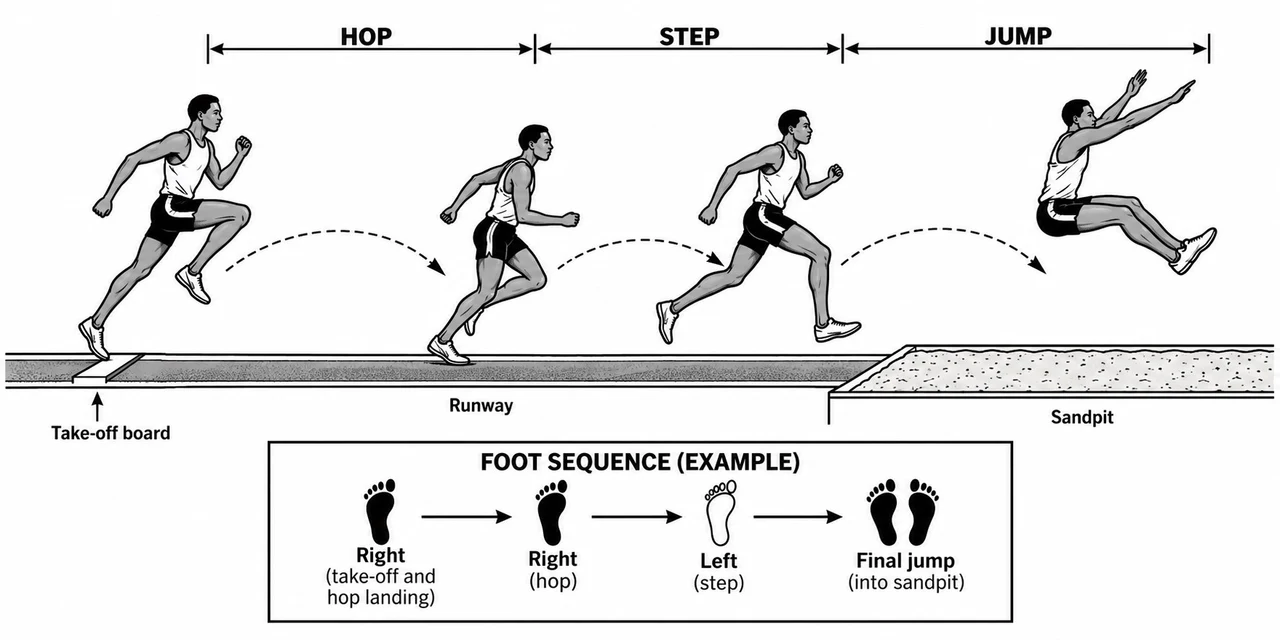
- The athlete must complete phases in the order hop, step, and jump.
- For the hop, the athlete takes off and lands on the same foot.
- For the step, the athlete lands on the opposite foot.
- The final jump ends in the landing area, usually the sandpit.
- The athlete must take off from behind the take-off line; crossing it during take-off is a foul.
- The athlete must not use unauthorised assistance or perform an action prohibited by the rules.
- Measurement is taken from the take-off line to the nearest mark in the landing area.
- A foul attempt is recorded as a failure and is not measured.
Judging Triple Jump
The take-off judge observes the take-off line, while another official may focus on the sequence of phases. The judge must distinguish a correct hop from a step. An incorrect sequence can invalidate an attempt even when the athlete lands safely.
- Worked Example 1 (Correct Sequence): An athlete takes off from the right foot, lands on the right foot for the hop, lands on the left foot for the step, and then jumps into the pit. The sequence is right-right-left-final jump and is correct.
- Worked Example 2 (Incorrect Sequence): An athlete takes off from the right foot and lands on the left foot for the first phase. The athlete has not completed the required hop landing on the take-off foot. The official records a failure under the applicable rule.
Practical Officiating Procedure for Triple Jump
- Inspect runway, take-off board, landing pit, and measuring equipment.
- Confirm correct board position and competition category.
- Brief judging team on phase sequence and foul signals.
- Observe take-off line and sequence of hop, step, and jump.
- Signal a foul if take-off or phase sequence breaches rules.
- Measure valid jump from take-off line to nearest landing mark.
- Record result and prepare pit for next athlete.
3.3.4 High Jump
High jump is a vertical jumping event in which athletes attempt to clear a horizontal crossbar supported by two uprights without dislodging it. Athletes usually use a curved approach and take off from one foot. The winner is the athlete who clears the greatest height, with ties resolved using competition rules.
Facility and Equipment
Facility / Equipment |
Function and Inspection |
|---|---|
Approach area |
Firm, level, and non-slippery surface for safe curved run-up. |
Uprights |
Stable vertical supports that hold the bar at required height. |
Crossbar |
Light bar resting on supports; check straightness and condition. |
Landing mat |
Adequate size, thickness, and secure arrangement to cushion landing. |
Measuring device |
Measures bar height from ground at prescribed points. |
Bar supports |
Allow bar to fall safely when displaced and are correctly positioned. |
Basic Rules and Regulations
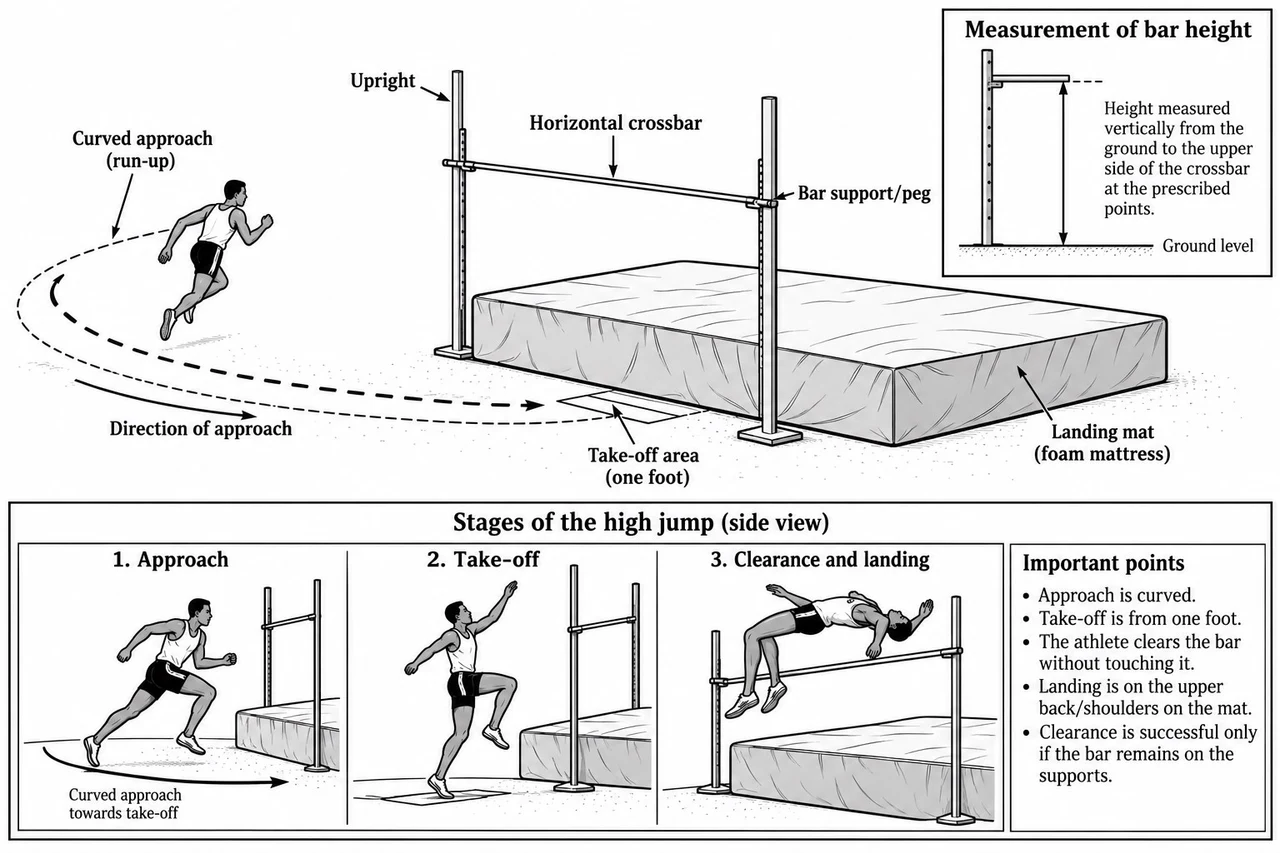
- An athlete must take off from one foot.
- An athlete has a specified number of attempts at each height; in standard rules, three consecutive failures lead to elimination.
- An athlete may pass a height and attempt a later height, subject to competition rules.
- A successful jump occurs when the athlete clears the bar and it remains on supports after the attempt.
- An attempt is a failure if the athlete dislodges the bar or commits another specified infringement.
- The bar is raised in predetermined increments as competition progresses.
- The winner is generally the athlete who clears the greatest height.
- Ties are resolved using count-back, considering failures at the height where the tie occurs and across the competition; a jump-off may be used where required.
Judging and Recording High Jump
Before the competition, officials agree on the starting height and increments by which the bar will be raised. The chief judge announces each height clearly. The recorder distinguishes a successful clearance, a failure, and a pass. A pass must not be recorded as a failure.
Symbol Commonly Used |
Meaning |
Recording Guidance |
|---|---|---|
O |
Successful clearance |
Athlete clears height and bar remains on supports. |
X |
Failed attempt |
Athlete fails to clear or commits a foul. |
– |
Pass |
Athlete chooses not to attempt that height. |
Worked Examples: High Jump
- Worked Example 1 (Three Failures): An athlete fails three consecutive attempts at 1.70 m. The athlete is eliminated. The highest previously cleared height remains the athlete’s result.
- Worked Example 2 (Passing a Height): An athlete chooses to pass 1.75 m and attempt 1.78 m instead. The recorder marks a pass at 1.75 m, not a failure. The later attempt is judged at 1.78 m.
- Worked Example 3 (Bar Dislodged): An athlete clears the bar with the body, but the bar falls from its supports as a result of the attempt. The attempt is recorded as a failure.
Practical Officiating Procedure for High Jump
- Inspect approach surface, uprights, bar, supports, and landing mat.
- Measure and announce starting height and agreed increments.
- Prepare order of competition and call each athlete.
- Watch that athlete takes off from one foot and assess whether bar remains on supports.
- Signal success or failure and record O, X, or pass accurately.
- Raise the bar only under authorised competition procedure.
- Verify final results and apply tie-break procedures where required.
3.3.5 Pole Vault
Pole vault is a vertical jumping event in which an athlete uses a flexible pole to propel themselves over a crossbar. The athlete runs along a runway, plants the pole in a box, swings and extends the body over the bar, releases the pole, and lands on a padded landing system. It requires specialised equipment, technical skill, and strict safety management.
Facility and Equipment
Facility / Equipment |
Function and Inspection |
|---|---|
Runway |
Firm, level approach surface with adequate length and grip. |
Vaulting box |
Recessed box into which pole is planted; secure and undamaged. |
Uprights / standards |
Support crossbar and allow adjustment of position and height. |
Crossbar |
Light bar that indicates whether athlete cleared the height. |
Vaulting pole |
Flexible pole suitable for athlete’s body weight, ability, and use. |
Landing system |
Specialised padded landing area covering required zones around box and standards. |
Measuring device |
Measures bar height accurately under the rules. |
Basic Rules and Regulations
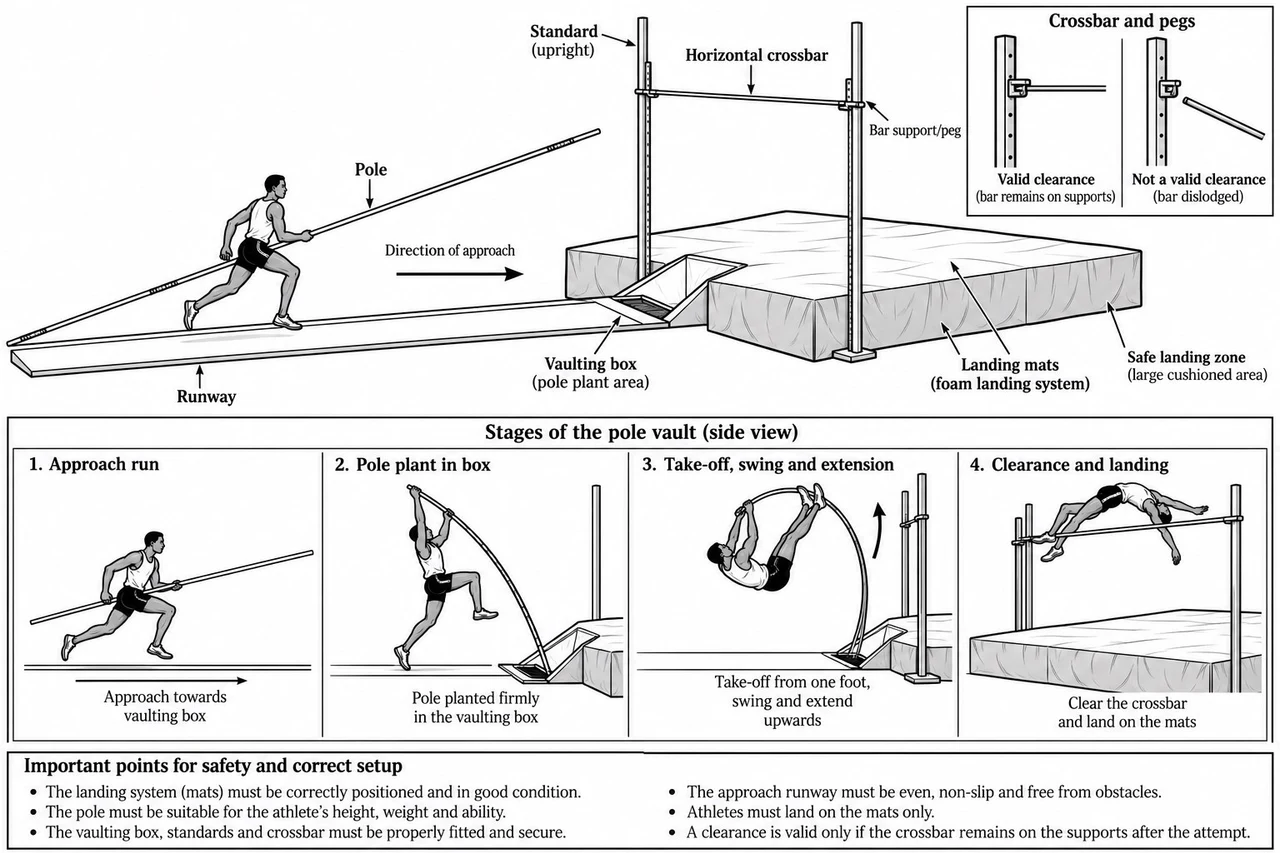
- An athlete uses a pole to assist the jump and takes off from the runway according to the rules.
- The pole must meet applicable equipment requirements and be suitable for the athlete; officials follow competition equipment checks.
- An attempt is a failure if the athlete dislodges the crossbar or commits another specified infringement.
- An athlete must not improperly steady or replace the crossbar during an attempt.
- The athlete must not touch the ground or landing area beyond the vertical plane through the back of the box with body or pole before clearing the bar in a way that constitutes a failure.
- The athlete is generally allowed three consecutive failures before elimination, subject to competition rules.
- The athlete may pass a height and attempt a later height according to competition procedure.
- The winner is the athlete who clears the greatest height, with ties resolved by applicable count-back rules.
Pole vault is a high-risk event. The chief judge should ensure that the landing system, box, standards, and runway are safe before the event begins. Officials should not allow an attempt if landing mats have shifted, the box is damaged, the pole is visibly unsafe, or the weather makes the area hazardous.
Judging Pole Vault
- Check the athlete’s pole and confirm that it is appropriate under competition rules.
- Observe approach, plant, take-off, clearance, and landing.
- Determine whether the crossbar remains on supports and whether another failure condition occurred.
- Signal success or failure and record the attempt accurately.
- Ensure the landing area is clear before the next athlete begins.
- Report equipment damage or safety concerns immediately.
Worked Examples: Pole Vault
- Worked Example 1 (Bar Clearance): A vaulter plants the pole, clears the crossbar, and lands safely. The bar remains on the supports. If no other failure condition occurred, the judge records a successful clearance.
- Worked Example 2 (Crossbar Falls): A vaulter passes over the bar, but the bar falls from its supports because of the athlete’s action. The attempt is a failure, even though the athlete’s body passed above the bar.
- Worked Example 3 (Unsafe Landing Area): Before an attempt, an official notices that a landing mat has separated, leaving a gap. The official stops the event and arranges for the landing system to be corrected. The athlete must not vault until the landing area is safe.
Practical Officiating Procedure for Pole Vault
- Inspect runway, box, standards, crossbar, pole-check procedure, and landing system.
- Confirm starting height, increments, attempt time, and order of competition.
- Ensure athletes are briefed on safe use and landing area is clear.
- Call athlete and observe the complete attempt from a suitable position.
- Signal success or failure based on rules and record result.
- Check bar and landing area before the next attempt.
- Verify final result and report equipment or safety incidents.
3.3.6 Comparing the Four Jumping Events
Feature |
Long Jump |
Triple Jump |
High Jump |
Pole Vault |
|---|---|---|---|---|
Type |
Horizontal |
Horizontal, three phases |
Vertical |
Vertical using pole |
Approach |
Runway sprint |
Runway sprint |
Curved approach |
Runway sprint |
Take-off |
One foot behind line |
One foot behind line |
One foot |
Pole planted in box with take-off action |
Landing |
Sandpit |
Sandpit |
Landing mat |
Specialised landing mats |
Validity |
Legal take-off and landing |
Correct sequence and legal take-off |
Bar cleared and remains on supports |
Bar cleared with no failure condition |
Result |
Distance |
Distance |
Height |
Height |
Safety focus |
Level sand and runway |
Level sand and runway |
Stable uprights and adequate mat |
Pole, box, standards, and landing system |
3.3.7 Measurement, Recording, and Results
Accurate measurement and recording are essential because small differences may determine final positions. Officials should use prescribed measuring equipment, check zero points, avoid parallax when reading a scale, and record results immediately. A result should be checked by a second official where competition procedure requires verification.
- Use the correct unit: metres and centimetres for distances or heights as required by the results system.
- Record failures and passes distinctly; do not leave blanks that could be misunderstood.
- Check that athlete name or number matches the result card.
- Keep attempt order and all valid performances in the record.
- Apply tie-break rules rather than deciding a tie informally.
- Have the chief judge verify final result before it is announced.
3.3.8 Managing Protests and Uncertainty
A protest may concern the validity of an attempt, application of a rule, order of competition, or result. Officials should remain calm, listen to the concern, and refer it to the chief judge or referee through the established procedure. They should not alter a result merely because an athlete or coach is unhappy.
Where an official is uncertain, they should seek clarification from the chief judge and consult the rulebook or competition instructions. They should preserve the original record and document any authorised correction. Decisions should be based on evidence and procedure, not pressure.
3.3.9 Practical Event Organisation and Teamwork
A school competition may use a small officiating team, but duties must still be allocated clearly. One person may perform more than one administrative role where safe and practical, but no official should attempt to observe an event from a position that makes accurate judgement impossible.
Before Event |
During Event |
After Event |
|---|---|---|
Prepare schedule, officials, equipment, and safety checks. |
Call athletes, judge attempts, measure, and record. |
Verify results, complete reports, and return equipment. |
Mark runways, take-off areas, landing zones, and restricted areas. |
Keep landing area clear and communicate decisions. |
Report hazards, damage, and incidents. |
Brief athletes on attempt order and local procedures. |
Maintain consistent time limits and signals. |
Debrief team and identify improvements. |
3.3.10 Worked Result Examples
- Worked Example 1 (Long-Jump Best Result): A learner records 4.21 m, 4.35 m, and a foul. The best valid result is 4.35 m. The foul is not counted as a distance and does not replace the earlier valid mark.
- Worked Example 2 (High-Jump Count-Back): Two athletes clear the same highest height. Officials compare failures at that height and then apply further count-back provisions. Ranking follows the rules; it is not decided by the chief judge’s personal preference.
- Worked Example 3 (Triple-Jump Phases): An athlete takes off from the left foot, lands on the left foot, then lands on the right foot, and completes the jump into the pit. The sequence is hop on left, step onto right, then jump. If take-off was legal and no other foul occurred, the attempt is valid.
- Worked Example 4 (Pole-Vault Safety): A pole has a visible crack near its lower section. Even if an athlete is willing to use it, the official should not ignore the defect. The pole must be assessed under equipment rules and the athlete should use safe, compliant equipment.
Summary: Sub-Strand 3.3
- Jumping-event officials inspect facilities and equipment, manage athlete order, judge attempts, measure performances, and record results.
- Long jump is a horizontal jump measured from take-off line to nearest mark in landing area.
- Triple jump consists of hop, step, and jump in that order; hop lands on take-off foot and step on opposite foot.
- High jump is a vertical event in which the athlete takes off from one foot and clears a crossbar without dislodging it.
- Pole vault uses a pole planted in a box to assist the athlete in clearing a crossbar; specialised equipment and safety checks are essential.
- Officials record valid attempts, failures, and passes correctly and apply tie-break procedures consistently.
- A dangerous runway, landing pit, mat, pole, box, or upright must be corrected before an attempt is allowed.
Revision Questions: Sub-Strand 3.3
- State five general responsibilities of officials in jumping events.
- Describe the facilities and equipment required for long jump.
- Explain how a long-jump performance is measured.
- Describe the correct sequence of phases in triple jump.
- Explain three situations that may result in a foul in horizontal jumping events.
- State the main rules governing attempts in high jump.
- Explain how a high-jump tie may be resolved.
- Describe the facilities and equipment required for pole vault.
- Explain why pole vault requires particularly careful safety inspection.
- Differentiate between a valid attempt, a failure, and a pass in high jump.
- Describe the duties of a recorder during a field event.
- Explain how officials should handle a protest about the validity of a jump.
Compiled and reviewed for Education.co.ke by Fred ArapToo (B.Ed. Physics & Chemistry, Egerton University; M.Ed. Education Administration candidate, University of Kabianga; Experience AI Certified Educator — Google DeepMind, Raspberry Pi Foundation & YSK, 2025; national KSEF facilitator, patron and evaluator; EdTech and open-access education platforms innovator; secondary school science educator with 15+ years of experience).
Looking for more resources?
- Revision & past papers: Teacher.co.ke | Education.co.ke | Teacher.ac
- Career pathways & university placement guide: CareerMap.co.ke
- School management systems & related digital applications: Contact us via Teacher.co.ke or ShuleMax.co.ke