Focus: Socialisation; equity, diversity and inclusivity in sports participation and representation.
1.1.1 Understanding Sport in Society
Sport is an organised or informal physical activity governed by agreed rules, skills and conventions. It may be competitive, recreational, educational or community-based. Society refers to people living together within a community and sharing institutions, relationships, responsibilities and cultural practices. Sport is therefore more than physical performance: it is also a social institution through which people meet, communicate, cooperate, compete and learn how to live with others.
In Kenya, sport is experienced in schools, estates, villages, community grounds, clubs, universities and national competitions. Football, athletics, volleyball, basketball, netball, rugby, traditional games and recreational walking groups bring together people who may otherwise have few opportunities to interact. The social value of sport depends on how activities are organised. A well-managed activity can build belonging and respect; an unfair or unsafe activity can reinforce exclusion.
1.1.2 Socialisation Through Sport
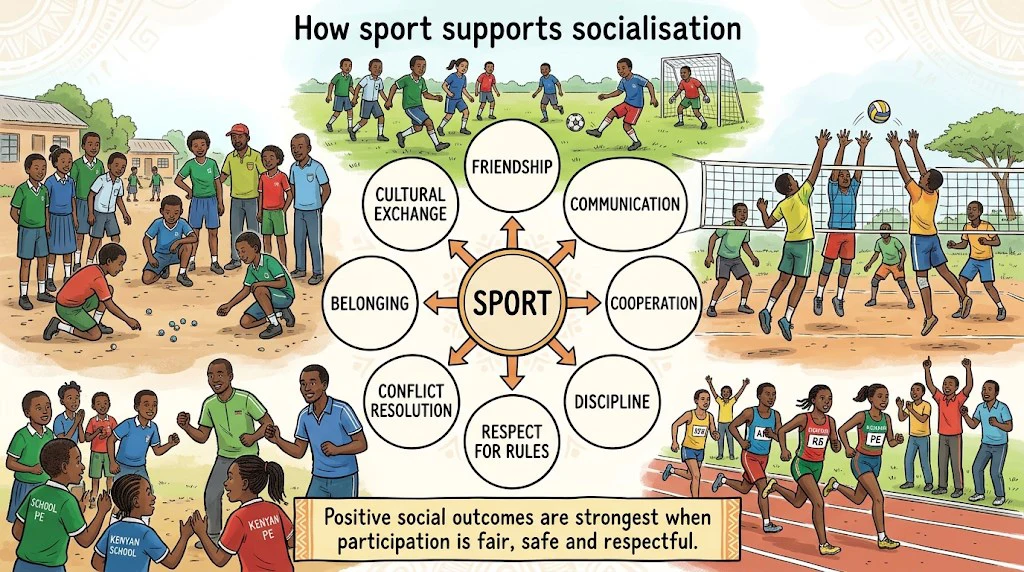
Socialisation is the lifelong process through which an individual learns the values, attitudes, rules, language and behaviours expected in a group or society. It begins in the family and continues through school, peer groups, cultural institutions, workplaces, media and community organisations. Sport contributes to socialisation because participants repeatedly interact in situations that require cooperation, communication, discipline and respect for shared rules.
A learner joining a school volleyball team, for example, learns how to communicate with teammates, accept the referee’s decisions, practise consistently and support others after mistakes. The learner also meets people from different classes, neighbourhoods or cultural backgrounds. These experiences can strengthen confidence and a sense of belonging.
Ways Sport Promotes Socialisation
- Interaction and friendship: training and playing create opportunities to meet people and maintain positive relationships.
- Communication: players learn to give instructions, listen, ask questions and resolve misunderstandings.
- Cooperation: team members coordinate their efforts and understand that success depends on everyone’s contribution.
- Respect for rules and authority: participants learn to follow rules, respect officials and accept fair decisions.
- Discipline and responsibility: regular practice encourages punctuality, commitment and care of shared equipment.
- Conflict management: sport provides structured opportunities to manage disagreement and control emotions.
- Identity and belonging: representing a class, school, county or country can strengthen a shared identity.
- Intergenerational interaction: community tournaments can bring together children, parents and older people.
- Cultural exchange: games and competitions expose participants to different traditions and perspectives.
1.1.3 Values Learnt Through Sports Participation
Values are principles that guide choices and behaviour. Sport helps learners practise values because the consequences of behaviour are visible to teammates and opponents. A player who passes the ball rather than attempting every move alone demonstrates teamwork. An athlete who reports a mistake honestly demonstrates integrity. A team that welcomes a new participant demonstrates respect and inclusion.
Value |
Meaning in sport |
Practical example |
|---|---|---|
Respect |
Recognising the dignity, rights and contributions of others. |
Listening to an official and treating opponents courteously. |
Teamwork |
Combining individual efforts towards a shared goal. |
Players cover positions and support a teammate. |
Fairness |
Applying rules consistently and giving participants a fair chance. |
Using transparent team-selection criteria. |
Integrity |
Being honest and acting according to accepted principles. |
Admitting that the ball touched one’s hand. |
Discipline |
Controlling behaviour and following expectations. |
Attending practice on time. |
Perseverance |
Continuing constructive effort despite difficulty. |
Practising a skill after unsuccessful attempts. |
Empathy |
Considering another person’s feelings or circumstances. |
Adapting a game so a learner with limited mobility can join. |
Leadership |
Guiding a group responsibly. |
A captain ensures every team member is heard. |
1.1.4 Equity, Diversity and Inclusion in Sport
Diversity describes the presence of differences among people, including gender, age, culture, language, disability, background and ability. Inclusion ensures that all participants are respected and able to participate meaningfully. Equity means recognising that people may face different barriers and providing fair support so that opportunities are not determined by those barriers.
Distinguishing the Three Ideas
- DIVERSITY: Who is represented? A school team includes learners from different communities and backgrounds.
- INCLUSION: Who can participate and feel they belong? Training is welcoming, accessible and free from humiliation.
- EQUITY: What support is needed for fair opportunity? The school provides adapted equipment, accessible routes or financial assistance where needed.
Equality and equity should not be confused. Equality may mean giving every participant exactly the same resource. Equity may mean providing different support according to need so that everyone has a fair opportunity. For instance, all learners may be invited to a sports day, but a learner who uses a wheelchair may need an accessible route, adapted event or suitable playing space to participate fully.
1.1.5 Promoting Gender Equity
Gender equity in sport means ensuring that girls, boys, women and men have fair opportunities to participate, develop skills, access facilities, receive coaching and take leadership roles. Barriers may include stereotypes about which sports are appropriate for particular genders, unequal access to playing time, inadequate changing facilities, harassment, unsafe transport, limited media coverage or unequal allocation of resources.
- Use fair, transparent selection criteria based on relevant skills, effort, interest and the activity.
- Provide girls and boys with comparable access to safe facilities, quality equipment, coaching and practice time.
- Encourage participation in a wide range of activities rather than assigning sports according to stereotypes.
- Establish clear rules against bullying, harassment, exploitation and discriminatory language.
- Ensure leadership roles, officiating opportunities and recognition are open to all learners.
- Consult participants about barriers such as timing, privacy, transport, uniform design and safety.
1.1.6 Cultural and Social Diversity
Kenya is culturally and linguistically diverse. Sport can create common ground while allowing communities to retain and share their identities. Traditional games, dance-based physical activities and community tournaments can introduce learners to local knowledge and practices. Organisers should avoid treating one culture as superior or using cultural differences as a basis for ridicule.
A school may organise a cultural games day in which groups demonstrate games from different Kenyan communities, explain their rules and invite classmates to participate. Such an activity should be planned with respect for cultural ownership and should avoid presenting a community as a stereotype. Learners should ask respectful questions and recognise similarities as well as differences.
1.1.7 Inclusion of Persons with Disabilities
Persons with disabilities have the right to take part in physical education, physical activity and sport. Inclusion requires attention to physical access, communication, equipment, rules, attitudes and the way activities are organised. A disability does not automatically prevent participation. The activity may need adaptation so that it remains meaningful, challenging and safe.
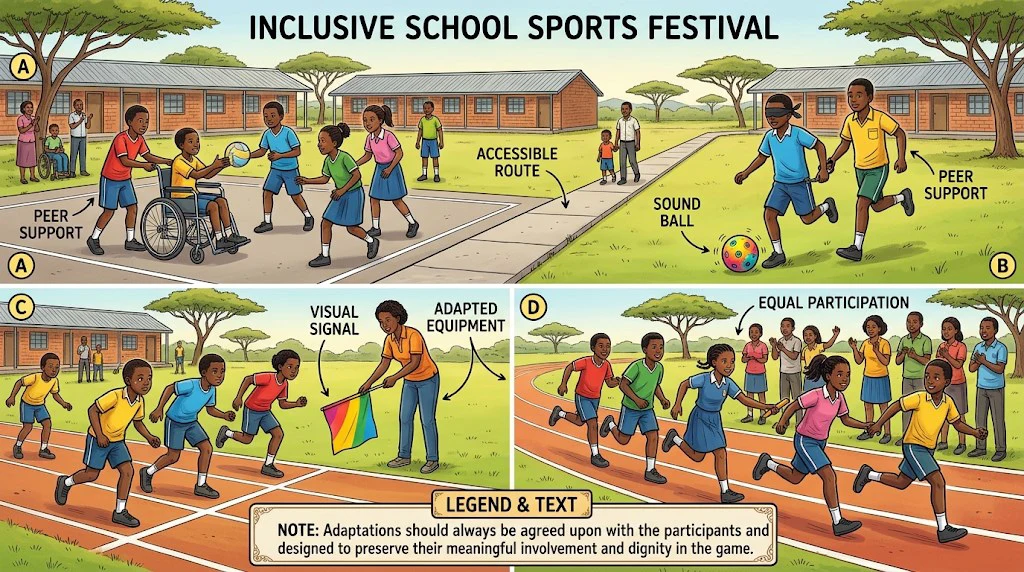
- Physical access: provide level routes, ramps where required, clear spaces and accessible facilities.
- Equipment: use lighter, larger, brighter or sound-producing balls where suitable; provide adapted grips where appropriate.
- Rules: adjust distance, time, team size, playing zones or permitted movement while preserving the activity’s purpose.
- Communication: use demonstrations, clear verbal instructions, visual cues, gestures or written instructions according to need.
- Attitudes: speak directly and respectfully, ask before assisting and avoid pity or assumptions.
- Consultation: ask participants what adaptations work for them instead of deciding without them.
- Safety: check surfaces, equipment, spacing and emergency access before the activity begins.
1.1.8 Inclusive Policies and Practices
An inclusive policy is a written or clearly communicated commitment to fair access, safety, dignity and participation. A policy is effective only when it is implemented, monitored and improved. Schools and clubs should make expectations clear to learners, coaches, parents, officials and volunteers.
Area |
Inclusive practice |
Evidence of implementation |
|---|---|---|
Registration |
Open and clear registration with no unfair exclusion. |
Participation records show wider representation. |
Selection |
Published criteria and consistent trials. |
Decisions can be explained and reviewed. |
Facilities |
Safe, accessible and maintained spaces. |
Participants can reach and use facilities. |
Training |
Different levels, adapted drills and supportive coaching. |
Different ability groups remain engaged. |
Equipment |
Suitable sizes, adaptations and maintenance. |
Equipment matches the activity and participants. |
Representation |
Fair access to leadership and recognition. |
Different groups are visible in decisions. |
Evaluation |
Collect feedback and participation data responsibly. |
Changes respond to identified barriers. |
1.1.9 Diversity in Training and Accessible Fitness Resources
A diverse training programme offers different activities, skill levels and ways of participating. It recognises that people have different interests, previous experiences, confidence levels and physical capacities. A school can provide walking clubs, dance, athletics, ball games, low-impact exercise, strength activities using body weight and adapted games. Variety reduces the risk that learners who do not enjoy one sport will be excluded from physical activity altogether. For more on structured training approaches, see Fitness Training Methods.
Accessible fitness resources include affordable equipment, safe public spaces, clear information, trained leaders and convenient schedules. Resources should be maintained and shared fairly. Where specialised equipment is unavailable, safe improvisation may be possible, but improvised equipment must be checked for stability, sharp edges, contamination and suitability before use.
1.1.10 Diverse Achievement and Representation
Achievement in sport should not be measured only by medals or elite performance. It can include improved personal skill, regular participation, teamwork, leadership, officiating, coaching, volunteering, fair play and overcoming barriers. Recognising a range of achievements helps learners understand that sport offers different pathways and that contribution matters.
Representation refers to who is visible and heard in sport. If only a narrow group is shown as athletes, coaches or leaders, others may feel that they do not belong. Schools can improve representation by displaying achievements from different sports, genders, communities and ability groups, and by inviting varied role models to speak.
1.1.11 Collaboration with the Community
Community collaboration is working with people and organisations outside the immediate school group to plan and deliver activities. Partners may include parents, local sports clubs, health workers, county sports officers, community leaders, youth groups, disability organisations and local businesses. Collaboration pools resources, skills and local knowledge.
For example, a school may work with a local health centre to organise a family wellness walk. Teachers coordinate learners, health workers provide general health education, parents help with supervision and community leaders assist with route planning. The event builds relationships while promoting physical activity. You can also explore how community events connect to Recreation and Wellness.
Planning a Community Sports Activity
- Identify the purpose, such as improving social connection, encouraging active living or promoting inclusion.
- Consult intended participants and partners about interests, access needs, timing and possible barriers.
- Choose an activity and venue appropriate to participants’ ages, abilities, resources and safety needs.
- Assign responsibilities for coordination, equipment, first aid, communication, safeguarding and route management.
- Publicise the event using clear, inclusive language and explain how participants can request support.
- Conduct a safety check and briefing before the activity begins.
- Run the activity, monitor participation and respond to emerging concerns.
- Collect feedback, review what worked and agree on improvements.
1.1.12 Monitoring and Evaluation of Inclusion
Monitoring is the regular collection of information while an activity is being implemented. Evaluation judges the activity’s quality, effectiveness and results. Both are necessary because an event may attract many participants but still fail to include some groups meaningfully.
Indicator |
Monitoring question |
Possible evidence |
|---|---|---|
Access |
Could participants reach and use the venue? |
Venue checklist and participant feedback. |
Participation |
Who registered and who took part? |
Attendance records using only necessary information. |
Engagement |
Did participants have meaningful roles? |
Observation and short interviews. |
Safety |
Were incidents or hazards recorded? |
Incident log and safety inspection. |
Fairness |
Were equipment, coaching and time shared fairly? |
Observation and allocation records. |
Enjoyment |
Did participants feel welcome and respected? |
Anonymous feedback or discussion. |
Improvement |
What should change next time? |
Review meeting and action plan. |
Worked Example: Evaluating an Inclusive School Tournament
A school organises a mixed-gender, multi-activity tournament. Organisers record attendance, ask whether participants could access the venue, observe whether every team member gets a role and review safety reports. Feedback reveals that the court is accessible but the registration desk is up a staircase. Organisers move registration to an accessible ground-floor area for the next event. Evaluation has identified and addressed a practical barrier.
1.1.13 Matrix: Sports, Socialisation, Values and Inclusion
A matrix organises information so that relationships can be compared. Identify the activity, the social interaction it encourages, the values it develops and the adaptations needed for inclusion.
Activity |
Socialisation role |
Values promoted |
Possible inclusion measures |
|---|---|---|---|
Football |
Teamwork and interaction across classes or neighbourhoods. |
Cooperation, discipline, respect. |
Mixed teams, adapted rules, accessible sidelines. |
Athletics relay |
Coordination and shared responsibility. |
Trust, perseverance, accountability. |
Different distances, varied roles, adapted movement. |
Volleyball |
Communication and coordinated play. |
Respect, teamwork, self-control. |
Adjust net height, court size, ball type or service rules. |
Walking group |
Informal conversation and community connection. |
Care, consistency, mutual support. |
Accessible routes, pace options and rest points. |
Traditional games |
Cultural exchange and intergenerational learning. |
Respect, curiosity, cooperation. |
Explain rules clearly and adapt movement demands. |
Dance aerobics |
Expression and group participation. |
Confidence, respect, enjoyment. |
Low-impact movements, visual cues and seated alternatives. |
1.1.14 Practical Activity: Community Wellness Festival
A wellness festival is a planned event in which participants engage in a range of inclusive activities. The model below can be adapted to available facilities and teacher guidance.
Station |
Activity |
Social purpose |
Inclusion and safety |
|---|---|---|---|
1 |
Group walking circuit |
Conversation and peer support. |
Flat route, pace options, water and supervision. |
2 |
Modified ball game |
Cooperation among mixed groups. |
Adapt ball, space and rules; remove obstacles. |
3 |
Traditional games corner |
Cultural exchange. |
Explain rules and invite voluntary participation. |
4 |
Low-impact movement |
Shared enjoyment and confidence. |
Demonstrate alternatives and avoid forced movements. |
5 |
Team challenge |
Problem-solving and leadership. |
Rotate roles so everyone contributes. |
1.1.15 Worked Examples and Examination Practice
Worked Example 1: How Sport Promotes Socialisation
Question: Explain four ways sport promotes socialisation among learners.
Model response:
- Sport creates opportunities for learners to interact and form friendships during training and competition.
- Team activities develop communication because players exchange information and coordinate decisions.
- Participants learn shared rules, respect officials and accept decisions, encouraging responsible behaviour.
- Sport brings learners from different backgrounds together, helping them appreciate diversity and develop belonging.
Each point identifies a distinct mechanism and explains its contribution to social relationships.
Worked Example 2: Equality and Equity
Question: A school gives every learner the same standard ball, although some learners need a larger or sound-producing ball. Explain the issue.
Model response: Giving everyone the same equipment is equality in distribution, but it may not create equal opportunity to participate. Equity requires the school to consider different needs and provide suitable adaptations so all learners can participate meaningfully.
Worked Example 3: An Inclusion Matrix
Question: Suggest a school activity and show how it promotes socialisation, values and inclusion.
Model response: A modified volleyball festival brings learners together in mixed teams. It promotes socialisation through communication and teamwork; values such as respect, discipline and fairness; and inclusion through adapted net height, a lighter ball, flexible team roles and clear demonstrations.
Revision Questions
- Define socialisation and explain five ways sport contributes to it.
- Differentiate diversity, inclusion and equity using school sports examples.
- Explain six values that learners can develop through sports participation.
- Describe practical ways a school can promote gender equity in sport.
- Explain how a sports activity can be adapted to include a learner with a disability.
- Prepare a matrix linking four sports activities to socialisation, values and inclusion.
- Outline the steps involved in planning an inclusive community sports activity.
- Differentiate monitoring from evaluation and give one example of each.
- Explain why community collaboration is important when organising a wellness event.
- Suggest indicators a school can use to evaluate inclusion during a sports festival.
Summary of Sub-Strand 1.1
- Sport is a social activity as well as physical exercise; it can connect individuals and groups.
- Socialisation occurs through interaction, communication, teamwork, shared rules, discipline and conflict management.
- Sport can develop respect, fairness, integrity, perseverance, empathy and leadership.
- Diversity describes differences; inclusion creates meaningful participation; equity addresses barriers and different needs.
- Inclusive sport requires fair policies, accessible facilities, suitable equipment, adapted activities, safeguarding and respectful attitudes.
- Community collaboration pools knowledge and resources and can strengthen social cohesion.
- Monitoring and evaluation identify barriers, measure participation and improve future activities.
Compiled and reviewed for Education.co.ke by Fred ArapToo (B.Ed. Physics & Chemistry, Egerton University; M.Ed. Education Administration candidate, University of Kabianga; Experience AI Certified Educator — Google DeepMind, Raspberry Pi Foundation & YSK, 2025; national KSEF facilitator, patron and evaluator; EdTech and open-access education platforms innovator; secondary school science educator with 15+ years of experience).
Looking for more resources?
- Revision & past papers: Teacher.co.ke | Education.co.ke | Teacher.ac
- Career pathways & university placement guide: CareerMap.co.ke
- School management systems & related digital applications: Contact us via Teacher.co.ke or ShuleMax.co.ke