Strand 1.0: Health and Fitness | Sub-Strand 1.2: Fitness Training Methods
Focus: Interval training, circuit training and Fartlek training.
1.2.1 Meaning and Purpose of Fitness Training
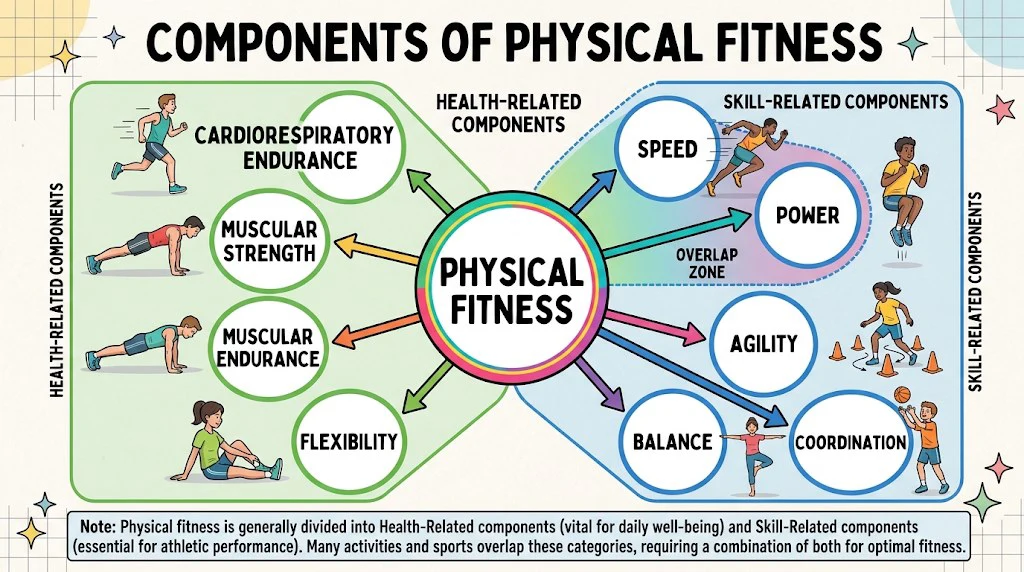
Fitness training is planned physical activity undertaken to improve or maintain one or more components of physical fitness. It uses selected exercises, an appropriate level of effort, a suitable duration and planned recovery. Training can develop cardiorespiratory endurance, muscular strength, muscular endurance, flexibility, speed, power, balance, agility and coordination.
Physical fitness is not identical for every person. A learner preparing for a middle-distance race needs a different programme from a learner whose goal is general health, posture or muscular endurance. Training should match the person’s age, current ability, goals, health status, available facilities and experience.
Benefits of Fitness Training
- Improves the efficiency of the heart, lungs and circulatory system when aerobic activities are performed regularly.
- Develops muscular strength and endurance, supporting posture and everyday tasks.
- Helps maintain healthy bones and joints when suitable weight-bearing and strengthening activities are included.
- Improves movement skills such as balance, coordination, agility and speed.
- Can support mood, stress management, sleep and confidence.
- Provides opportunities for teamwork, self-discipline and positive social interaction.
- Can reduce health risks associated with prolonged inactivity when practised safely and consistently.
For children and adolescents, WHO guidance recommends an average of at least 60 minutes per day of moderate-to-vigorous physical activity across the week, with vigorous aerobic and muscle- and bone-strengthening activities included on at least three days per week. This is a population-level guideline, not a demand to perform strenuous training continuously. Activity can be accumulated through play, physical education, active transport, sport and recreation. You can also explore Aerobics (1.4) for related endurance activities.
1.2.2 Components of Physical Fitness
Component |
Explanation |
Example Activity |
|---|---|---|
Cardiorespiratory endurance |
Ability of heart, lungs and circulation to supply oxygen during sustained activity. |
Jogging, brisk walking, cycling. |
Muscular strength |
Ability of a muscle or muscle group to exert force. |
Controlled squat or push-up. |
Muscular endurance |
Ability of muscles to repeat contractions or sustain effort. |
Repeated squats or plank hold. |
Flexibility |
Range of movement available at a joint. |
Appropriate mobility and stretching. |
Speed |
Ability to move the body or a body part quickly. |
Short sprint over a safe distance. |
Power |
Ability to apply force quickly. |
Controlled jump under supervision. |
Agility |
Ability to change direction quickly while maintaining control. |
Safe cone-change drill. |
Balance |
Ability to maintain body position while stationary or moving. |
Single-leg balance near support. |
Coordination |
Smooth integration of body movements. |
Skipping, catching or rhythmic movement. |
1.2.3 Principles Guiding Safe Training
Specificity means training should reflect the fitness goal. Overload means the body receives a suitable challenge to adapt. Progression means the challenge increases gradually. Recovery allows the body to repair and adapt. Individualisation recognises that people respond differently to the same activity. Reversibility means that gains may decline when training stops for a prolonged period. For deeper coverage, see Principles of Training (1.3).
REMEMBER: A harder session is not automatically a better session. Excessive intensity, inadequate recovery and poor technique can increase injury risk. Training should be challenging but manageable. Stop and report unusual pain, dizziness, chest discomfort or difficulty breathing.
1.2.4 Interval Training
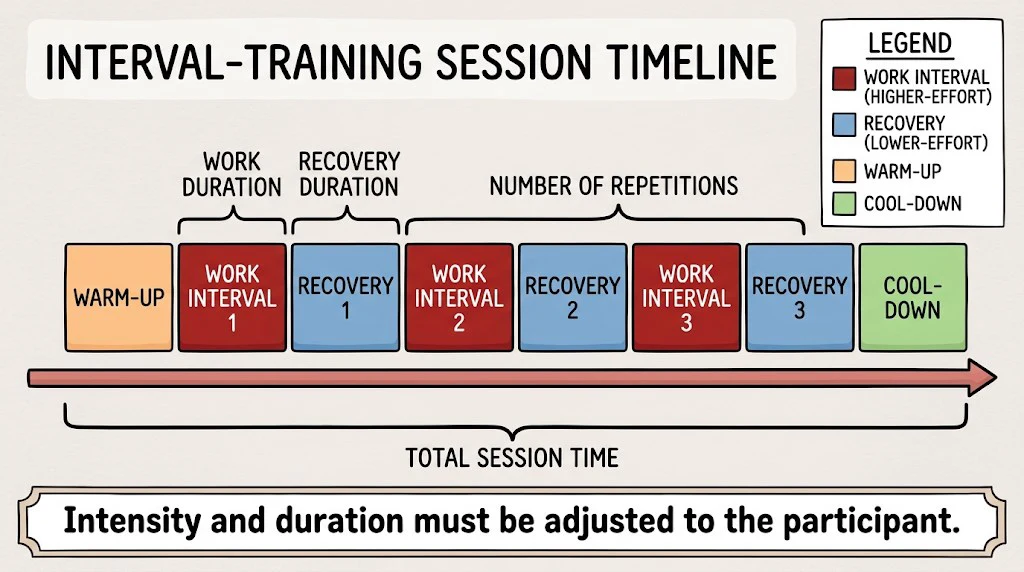
Interval training is a method in which periods of exercise alternate with planned periods of recovery or lower-intensity activity. Work intervals may be fast, moderate or otherwise challenging, while recovery intervals allow breathing and effort to settle before the next repetition. The structure can be adjusted to develop endurance, speed or the ability to repeat efforts.
For example, a learner may jog for one minute and walk for two minutes, repeating the cycle several times. A more trained learner may perform a controlled faster run for a shorter period followed by an easy jog. Appropriate intensity depends on experience and fitness.
Key Features of Interval Training
- Recovery intervals: rest or reduced effort between work intervals.
- Repetitions: the number of times a work-and-recovery cycle is completed.
- Total volume: the combined amount of work performed in the session.
- Intensity: the effort required during the work intervals.
- Recovery design: the duration and type of recovery, which may be active or passive.
Types of Interval Training
Type |
Description |
Example |
|---|---|---|
Short interval |
Short work periods with recovery; useful for practising repeated brief efforts. |
20 seconds brisk running followed by 60 seconds walking. |
Long interval |
Longer work periods at controlled effort with planned recovery. |
3 minutes steady running followed by 2 minutes easy walking. |
Aerobic interval |
Intervals designed mainly to challenge aerobic endurance. |
2 minutes moderate-to-brisk cycling, then 2 minutes easy cycling. |
Speed interval |
Shorter, faster efforts with sufficient recovery to preserve technique. |
Short acceleration over a marked distance followed by walking. |
Conducting a Basic Interval Session
- Select a safe, level training area and inspect it for holes, stones, traffic or other hazards.
- Explain the goal and demonstrate the movement at a manageable pace.
- Complete a gradual warm-up using easy movement and dynamic mobility.
- Set work and recovery intervals suitable for the group.
- Begin the first work interval while maintaining correct technique and controlled effort.
- Repeat the work-and-recovery cycle for the planned number of repetitions.
- Reduce effort gradually during the cool-down and reflect on the session.
Worked Example 1: Interval Calculation
A learner completes six cycles of 1 minute brisk jogging followed by 90 seconds walking. Calculate work time, recovery time and combined interval time.
- Work time = 6 × 1 = 6 minutes.
- Recovery time = 6 × 1.5 = 9 minutes.
- Combined interval time = 6 + 9 = 15 minutes.
If warm-up is 5 minutes and cool-down is 5 minutes, the full session lasts 25 minutes, excluding transitions.
Advantages and Limitations of Interval Training
Advantages |
Limitations and Precautions |
|---|---|
Allows work and recovery to be planned precisely. |
Fast intervals may be unsuitable for beginners if intensity is excessive. |
Can be adapted to different sports and goals. |
Requires timing and supervision to maintain safe effort. |
Develops the ability to repeat efforts. |
Insufficient recovery may reduce technique and increase fatigue. |
Can make sessions varied and motivating. |
Avoid unfair comparisons; individual effort should be emphasised. |
1.2.5 Circuit Training
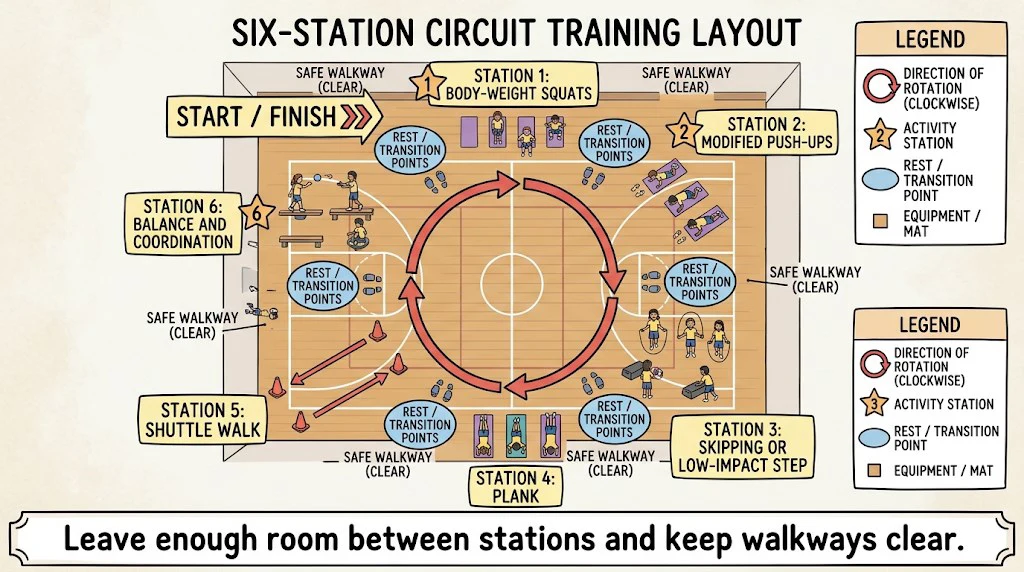
Circuit training is a method in which participants move through a series of exercise stations. Each station focuses on a movement or fitness component. Participants perform an exercise for a set time or number of repetitions, then move to the next station after a planned rest or transition. A circuit may be completed once or repeated for additional rounds.
A circuit can combine aerobic, strength, muscular endurance, balance and coordination exercises. School stations may include step-ups on a stable low platform, modified push-ups, skipping, body-weight squats, plank holds, shuttle walks and balance tasks. Exercises should be selected according to age, ability, equipment and safety.
Organisation of a Circuit
- Stations are clearly marked exercise locations arranged in a safe sequence.
- Each exercise has a simple instruction describing the movement and expected technique.
- Work periods may be set by time or repetition target.
- Rest or transition time allows recovery and safe movement to the next station.
- Rounds indicate how many times the circuit is completed.
- Supervision helps maintain technique, spacing and safe equipment use.
Planning a Circuit-Training Session
- Identify the goal, such as general endurance, muscular endurance or coordination.
- Choose exercises that match the goal and are appropriate for participants.
- Arrange stations so adjacent exercises do not create congestion or unsafe transitions.
- Demonstrate each exercise and explain common technique errors.
- Set a manageable work duration or repetition target and suitable rest.
- Begin with a warm-up and allow practice at low intensity.
- Run the circuit while monitoring technique, fatigue, spacing and equipment.
- Provide recovery between rounds and modify tasks for individual needs.
- Finish with a cool-down and evaluate the session.
Worked Example 2: Beginner Circuit
A beginner circuit has six stations. Each station lasts 30 seconds, followed by 30 seconds to change stations. The group completes two rounds.
- Work time per round = 6 × 30 seconds = 180 seconds = 3 minutes.
- Transition time per round = 6 × 30 seconds = 3 minutes.
- Total circuit time = 2 × (3 + 3) = 12 minutes.
Add warm-up and cool-down separately. Extend rest or reduce work time if technique deteriorates.
Benefits and Limitations of Circuit Training
Benefits |
Limitations and Precautions |
|---|---|
Several fitness components can be developed in one session. |
Poor station layout can cause collisions or confusion. |
Equipment can be simple and inexpensive. |
Exercises need clear demonstrations and modifications. |
Groups can work at different levels. |
Participants may rush and use poor technique. |
Stations make organisation and observation easier. |
The leader must monitor the whole circuit. |
1.2.6 Fartlek Training
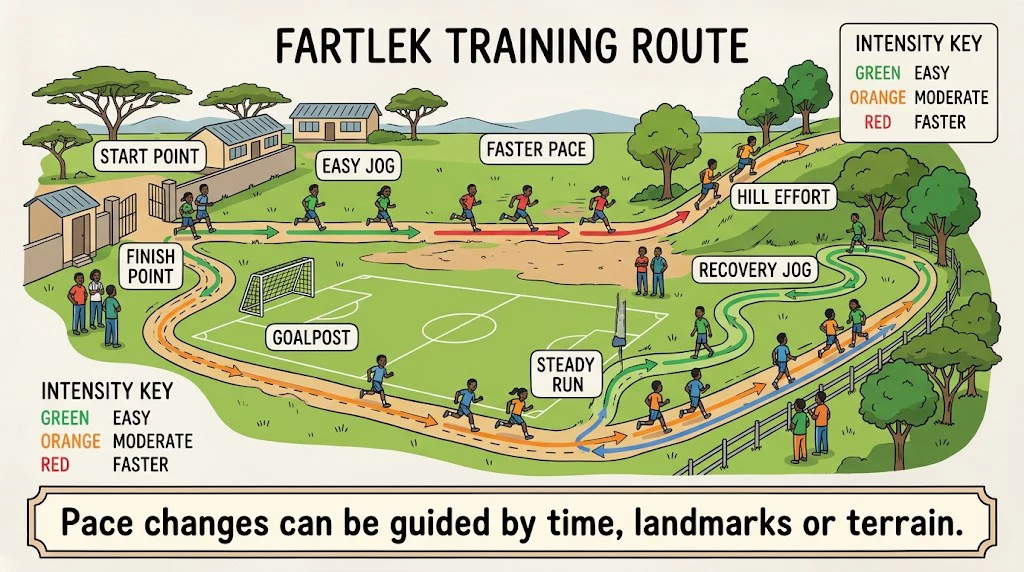
Fartlek is a form of continuous training that varies pace and effort during a session. The word comes from Swedish and means ‘speed play’. Unlike a strict interval session, changes of pace may be guided by landmarks, terrain, time, music or how the participant feels. It often combines easy movement with periods of faster running or other demanding activity, without stopping completely after every effort.
A learner jogging around a field may run faster from one goalpost to the next, return to an easy jog, accelerate up a gentle slope and then maintain a comfortable pace on level ground. The session remains continuous, although intensity changes.
Features of Fartlek Training
- Continuous movement: participants generally keep moving rather than taking complete rest after every faster effort.
- Variable intensity: pace changes between easier and harder periods.
- Flexible structure: route and pace changes can be adjusted to environment and goal.
- Natural landmarks: trees, cones, bends or goalposts can provide cues for pace changes.
- Individual control: participants adjust pace to maintain safe effort and technique.
Conducting a Fartlek Session
- Choose a safe route with a suitable surface and no uncontrolled traffic.
- Explain the route, pace cues and boundaries before beginning.
- Warm up with easy movement and dynamic mobility.
- Start with a comfortable continuous jog or brisk walk.
- Use a landmark or time cue to increase pace for a short, controlled period.
- Return to an easier pace while continuing to move.
- Repeat varied pace sections according to the planned duration and ability.
- Cool down gradually and discuss how participants managed changes in effort.
Worked Example 3: Fartlek Route
A learner plans a 15-minute session: 4 minutes easy jogging, 1 minute faster running, 3 minutes easy jogging, 1 minute faster running, 4 minutes easy jogging and 2 minutes brisk walking.
Total = 4 + 1 + 3 + 1 + 4 + 2 = 15 minutes.
The two faster sections total 2 minutes. The remaining 13 minutes are lower-intensity movement or recovery. Adjust the faster periods if breathing becomes uncontrolled or technique deteriorates.
1.2.7 Comparing the Three Training Methods
Feature |
Interval Training |
Circuit Training |
Fartlek Training |
|---|---|---|---|
Organisation |
Planned work and recovery periods. |
Sequence of exercise stations. |
Continuous activity with pace variation. |
Recovery |
Clearly planned recovery intervals. |
Rest or transition between stations and rounds. |
Usually active recovery at an easier pace. |
Main focus |
Repeated efforts and recovery capacity. |
Several fitness components through varied exercises. |
Endurance and ability to vary pace. |
Equipment |
May need timer, markers or equipment. |
May use cones, mats, ropes or body weight. |
Often only a safe route and landmarks. |
Flexibility |
Intervals usually set in advance. |
Stations and work periods can be adjusted. |
Pace changes can be flexible. |
Example |
Run 1 minute, walk 90 seconds. |
Complete six stations in sequence. |
Jog, speed up between landmarks, then ease off. |
HOW TO IDENTIFY EACH METHOD IN AN EXAMINATION: Alternating planned work and recovery periods = INTERVAL TRAINING. Moving from one exercise station to another = CIRCUIT TRAINING. Continuous movement with changing speed or effort = FARTLEK TRAINING.
1.2.8 Safety in Fitness Training
Safety is essential because exercise places demands on muscles, joints, the heart, lungs and other body systems. For related safety practices, see Risk Management in Sports (2.2).
- Check the environment for slippery surfaces, holes, sharp objects, traffic, poor lighting and extreme weather.
- Use suitable clothing and footwear and secure loose items that could cause trips.
- Warm up gradually and cool down rather than starting or stopping strenuous activity abruptly.
- Demonstrate correct technique and begin at a level participants can control.
- Increase training load gradually; avoid sudden large increases in duration, speed or repetitions.
- Allow sufficient rest and avoid training through significant pain or illness.
- Provide drinking water and suitable shade or ventilation.
- Use equipment that is stable, undamaged, clean and appropriate.
- Stop activity if a participant experiences chest pain, faintness, severe breathlessness, confusion or unusual symptoms; obtain help.
- Ensure a responsible adult or qualified instructor supervises school training.
1.2.9 Assessing Personal and Peer Performance
Performance appraisal is a structured review of how well a person performs an activity. It should focus on observable behaviour and improvement rather than insults or unfair comparisons. Feedback should be specific, respectful and actionable.
Area Assessed |
What to Observe |
Constructive Feedback |
|---|---|---|
Technique |
Posture, alignment, control and safe movement. |
Keep knees aligned with feet during the squat. |
Effort |
Effort matches the task and remains controlled. |
Your pace was steady; maintain it through the final interval. |
Consistency |
Participant follows the planned task. |
You completed each station and changed safely. |
Safety |
Awareness of space, equipment and personal limits. |
Leave more space before starting the next shuttle. |
Cooperation |
Communication and support for peers. |
You encouraged your partner and shared equipment fairly. |
Revision Questions
- Define fitness training and state six benefits of regular participation.
- Explain five components of physical fitness and give an activity for each.
- Describe interval training and distinguish work intervals from recovery intervals.
- A learner completes eight cycles of 45 seconds running and 75 seconds walking. Calculate work, recovery and combined time.
- Explain how a circuit-training session is organised and identify five possible stations.
- Describe Fartlek training and explain why it is called speed play.
- Compare interval, circuit and Fartlek training under organisation, recovery and equipment.
- Explain why warm-up, cool-down, hydration and progressive training are important.
- Suggest five ways a teacher can assess a learner’s performance during training.
Summary of Sub-Strand 1.2
- Fitness training is planned activity intended to maintain or improve fitness.
- Fitness includes cardiorespiratory endurance, strength, muscular endurance, flexibility and skill-related components.
- Interval training alternates planned work periods with recovery periods.
- Circuit training uses a sequence of exercise stations and can develop several fitness components.
- Fartlek training involves continuous movement with changes in pace or effort.
- Training must be appropriate, progressive, individualised and supported by adequate recovery.
- Safety checks, correct technique, hydration, supervision and feedback are essential.
Compiled and reviewed for Education.co.ke by Fred ArapToo (B.Ed. Physics & Chemistry, Egerton University; M.Ed. Education Administration candidate, University of Kabianga; Experience AI Certified Educator — Google DeepMind, Raspberry Pi Foundation & YSK, 2025; national KSEF facilitator, patron and evaluator; EdTech and open-access education platforms innovator; secondary school science educator with 15+ years of experience).
Looking for more resources?
- Revision & past papers: Teacher.co.ke | Education.co.ke | Teacher.ac
- Career pathways & university placement guide: CareerMap.co.ke
- School management systems & related digital applications: Contact us via Teacher.co.ke or ShuleMax.co.ke