Focus: Step aerobics; phases of a session — warm-up, conditioning and cool-down.
1.4.1 Meaning of Aerobics
Aerobics refers to rhythmic physical activity that uses large muscle groups continuously or repeatedly and places a demand on the cardiorespiratory system. Aerobic activity requires the body to use oxygen to help release energy for movement. Examples include brisk walking, jogging, cycling, swimming and aerobic dance.
Step aerobics is a form of aerobic exercise in which participants repeatedly step up onto and down from a raised platform while following rhythmic movement patterns. It combines footwork, coordination, balance and sustained movement. The platform creates a change in level and can increase physical demand compared with performing similar steps on the floor.
1.4.2 How Step Aerobics Differs from Other Forms
Feature |
Step aerobics |
Other aerobic activities |
|---|---|---|
Movement base |
Uses a raised step platform. |
May use floor, road, water, bicycle or dance space. |
Movement pattern |
Repeated stepping up, across or down in controlled patterns. |
Walking, running, cycling, swimming or dance steps. |
Equipment |
Requires a stable step platform or safe approved alternative. |
Some forms need no equipment; others need bicycles or pools. |
Coordination |
Foot placement and rhythm are important. |
Coordination demands vary with activity. |
Impact |
Can be low or higher impact depending on height and choreography. |
Impact varies; swimming is low impact while running is higher. |
Space |
Needs a clear area around each platform. |
Space needs depend on the activity. |
1.4.3 Benefits of Step Aerobics
- Can improve cardiorespiratory endurance when performed regularly at appropriate intensity.
- Engages muscles of the legs and hips through repeated stepping.
- Develops coordination, rhythm and movement memory.
- Challenges balance and control during changes in direction and level.
- Can be performed in groups, supporting enjoyment and social interaction.
- Can be adapted by changing step height, pace, movement complexity and impact.
Benefits depend on session design, participant effort and consistency. Step aerobics does not automatically develop every component of fitness equally. For balanced fitness, it can be combined with suitable strength, flexibility, balance and other activities, as explored in Fitness Training Methods.
1.4.4 Equipment and Facilities
The main equipment is a purpose-built step platform designed for exercise. It should be stable, non-slip, strong enough for the participant and free from cracks or damage. Some platforms have adjustable risers. The height should be appropriate to the participant’s ability and should not be increased merely to make exercise look more difficult.
Equipment / facility |
Purpose |
Safety and selection considerations |
|---|---|---|
Step platform |
Provides a stable raised surface. |
Use purpose-built platform; check stability, grip and condition. |
Exercise footwear |
Supports feet and provides grip. |
Use secure, comfortable footwear for the surface. |
Comfortable clothing |
Allows free movement and helps manage temperature. |
Avoid loose clothing that may catch. |
Water supply |
Supports hydration. |
Provide safe drinking water and suitable breaks. |
Music / sound system |
Provides rhythm and helps coordinate movement. |
Keep volume low enough for instructions to be heard. |
Open floor area |
Allows safe movement around platforms. |
Provide spacing and remove obstacles. |
Ventilation / shade |
Helps participants remain comfortable. |
Avoid overcrowding and excessive heat. |
First-aid supplies |
Supports response to incidents while help is arranged. |
Keep accessible and ensure a responsible person knows procedures. |
1.4.5 Improvising Step Aerobics Equipment
Where purpose-built platforms are unavailable, learners may discuss possible alternatives, but an improvised object should not be used unless a teacher or qualified instructor has checked and approved it. Many household objects are unstable, slippery, too high or not designed to bear repeated impact. A box may collapse or slide when stepped on.
Never use loose bricks, stacked books, plastic crates, chairs, stools, overturned buckets or other unstable objects as step platforms. The safest option is a purpose-built exercise step. If a suitable platform is unavailable, practise footwork on a flat floor rather than taking a risk.
1.4.6 Selecting and Modifying Facilities
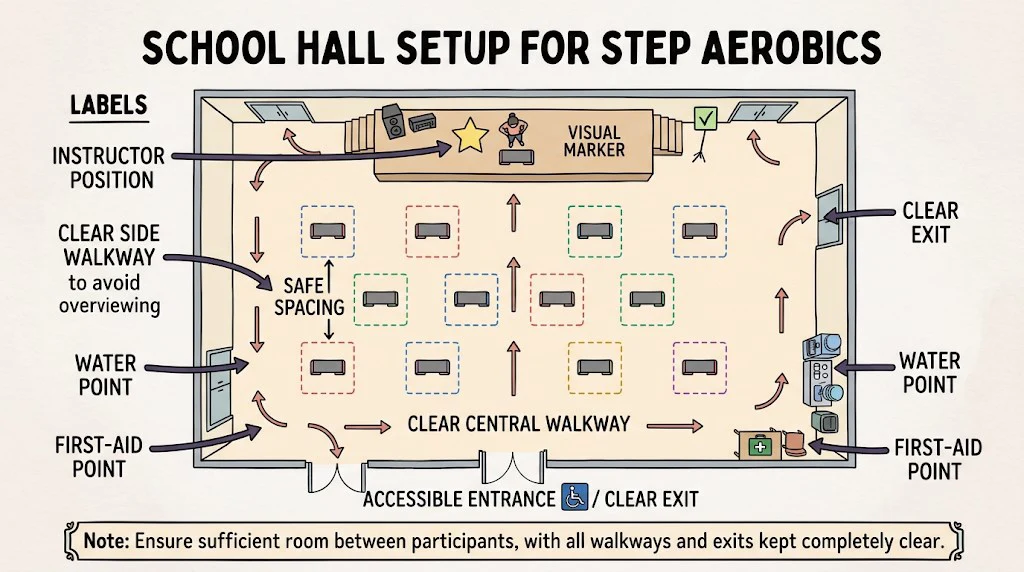
A suitable facility has a level, clean, non-slip floor, enough space for participants to move without colliding and adequate ventilation. Outdoor practice requires attention to weather, surface condition, shade and nearby traffic. Arrange platforms in rows or staggered positions so participants can see demonstrations and have a safe movement area.
1.4.7 Basic Step Aerobics Movements
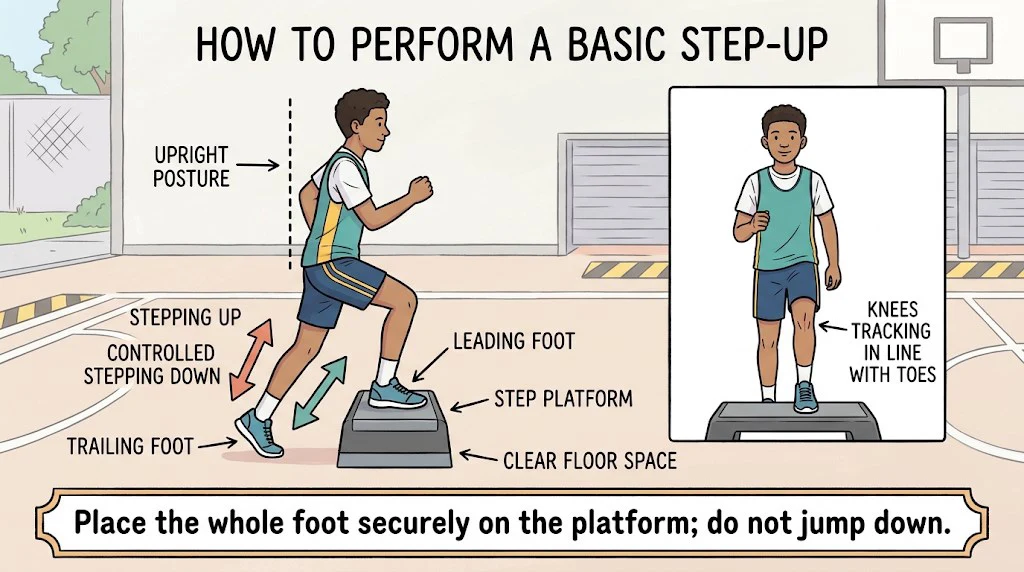
Step aerobics routines use repeated foot patterns. Learners should first master basic movements at a slow pace on a low platform or flat floor. The instructor should demonstrate the sequence and allow practice before combining movements.
Movement |
Description |
Teaching cue |
|---|---|---|
Basic step |
Step one foot onto the platform, bring the other foot up, then step down in a controlled sequence. |
Place the whole foot on the platform and step down carefully. |
V-step |
Step one foot towards a front corner and the other towards the opposite front corner, then return towards the centre. |
Make a controlled V shape and stay within the platform area. |
Knee lift |
Step onto the platform and lift the opposite knee in a controlled manner, then step down. |
Lift only as high as balance allows. |
Corner-to-corner |
Travel diagonally across the platform using a planned foot pattern. |
Look ahead and avoid rushing the turn. |
Tap-up / tap-down |
Step onto or near the platform and tap the other foot, then return. |
Use a light controlled tap; do not stamp. |
1.4.8 Technique and Posture
- Face the platform and approach it with controlled movement.
- Place the whole foot securely on the platform rather than allowing the heel to hang over the edge.
- Keep knees aligned with the direction of the toes.
- Maintain an upright but relaxed trunk and look forward.
- Step down gently and avoid jumping backwards from the platform.
- Begin with simple patterns and increase complexity only after technique is consistent.
- Keep arms controlled and avoid movements that disturb balance.
- Stop if the platform moves, becomes unstable or the participant feels pain or dizziness.
1.4.9 Phases of a Step Aerobics Session
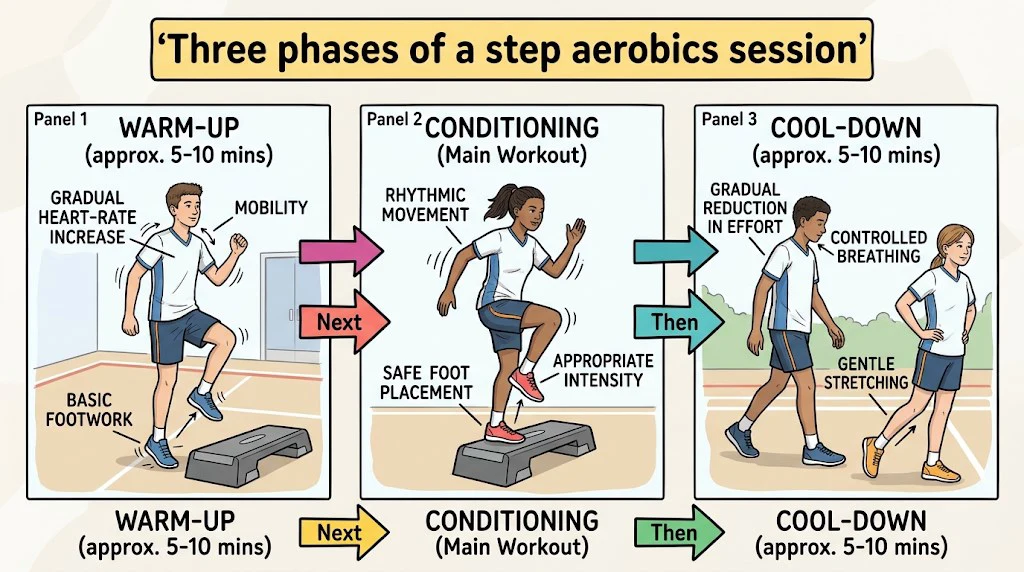
A well-organised step aerobics session has three main phases: warm-up, conditioning and cool-down. Each phase has a different purpose. Omitting the warm-up or stopping abruptly after vigorous activity can make the session less safe and less comfortable.
A. Warm-up Phase
The warm-up prepares the body and mind for the main activity. It gradually increases heart rate, breathing, blood flow and muscle temperature. It also gives learners time to practise simple movement patterns and become familiar with the platform.
- Begin with easy walking or marching on the spot.
- Add gentle shoulder rolls, arm movements and controlled mobility exercises.
- Practise basic step patterns at a slow pace, initially without complex arm movements.
- Gradually increase rhythm while maintaining control.
- Use the warm-up to check spacing, footwear, platform stability and readiness.
B. Conditioning Phase
The conditioning phase is the main exercise period. Participants perform planned step patterns continuously or in short combinations at an appropriate intensity. The instructor monitors technique, effort, breathing, spacing and signs of fatigue. The routine should be challenging enough to provide a training effect but not so difficult that participants lose control.
- Start with familiar basic steps before adding more complex patterns.
- Use a pace that allows safe foot placement.
- Vary movement combinations to sustain interest without unnecessary complexity.
- Offer lower-impact options, such as reducing arm movement or stepping on the floor.
- Allow brief recovery when needed and encourage participants to work within their limits.
C. Cool-down Phase
The cool-down gradually reduces the body’s level of activity. Participants slow the stepping rhythm, move to easy marching or walking and then perform gentle stretches where appropriate. It allows heart rate and breathing to return gradually towards resting levels.
- Reduce the pace rather than stopping suddenly.
- Move from step patterns to easy marching or walking on the floor.
- Perform gentle stretches for muscles used during the session.
- Breathe normally and avoid bouncing or forcing a stretch.
- Check how participants feel and provide time for hydration.
1.4.10 Applying FITT to Step Aerobics
FITT can be used to plan a step aerobics routine, building on the Principles of Training. Frequency describes how many sessions are scheduled; intensity describes effort or pace; time describes duration; and type describes step aerobics and the movement patterns selected. Adjust the programme to learners’ experience and include all three session phases.
FITT element |
Application |
Example planning statement |
|---|---|---|
Frequency |
Number of sessions in a week. |
One or two introductory sessions weekly, adjusted to the wider activity programme. |
Intensity |
Effort, pace and complexity. |
Begin at light-to-moderate effort and use the talk test as a guide. |
Time |
Duration of whole session and phases. |
Include gradual warm-up, controlled conditioning and cool-down. |
Type |
Step aerobics movements and variations. |
Basic step, V-step and controlled knee lifts on a stable platform. |
Worked Example: Beginner Step Session
A teacher plans a 25-minute introductory session. Warm-up: 5 minutes. Conditioning: 15 minutes. Cool-down: 5 minutes. Total = 5 + 15 + 5 = 25 minutes. Conditioning uses basic step and V-step patterns at a controlled pace. Learners may use floor-level alternatives. The teacher checks platform stability and spacing first.
1.4.11 Assessing Equipment and Peer Performance
When evaluating equipment, learners should consider stability, surface grip, height, strength, condition, suitability and trip hazards. A platform that looks attractive but slides across the floor is unsafe. When evaluating a peer’s performance, focus on foot placement, posture, rhythm, control and ability to follow the sequence.
Assessment area |
Positive evidence |
Improvement needed |
|---|---|---|
Platform condition |
Stable, non-slip and undamaged. |
Platform shifts or has a damaged edge. |
Foot placement |
Whole foot lands securely. |
Foot lands partly off the platform. |
Posture |
Trunk controlled and knees aligned. |
Learner leans excessively or knees collapse inward. |
Rhythm |
Movement matches pace without rushing. |
Learner loses control while trying to keep up. |
Safety awareness |
Maintains personal space and follows instructions. |
Learner steps into another participant’s area. |
Revision Questions
- Define aerobics and explain what makes step aerobics distinct.
- State six benefits of step aerobics.
- Describe equipment and facilities required for a safe session.
- Explain why unstable household objects should not be used as step platforms.
- Describe correct technique for a basic step.
- Explain the purpose of warm-up, conditioning and cool-down.
- Develop a simple step aerobics session and allocate time to each phase.
- Show how FITT can be applied when planning step aerobics.
- Identify five safety considerations when organising a group class.
- Explain how a teacher can assess technique and platform safety.
Summary of Sub-Strand 1.4
- Step aerobics is rhythmic aerobic exercise performed using a raised step platform.
- It can develop cardiorespiratory endurance, leg endurance, coordination, rhythm and balance.
- A safe session requires a stable platform, suitable footwear, adequate space and supervision.
- The three phases are warm-up, conditioning and cool-down.
- Technique includes secure foot placement, controlled stepping, knee alignment and safe descent.
- FITT helps organise frequency, intensity, time and type.
- Improvised equipment must not be used unless checked and approved as safe.
Continue your revision by exploring Recreation and Wellness.
Compiled and reviewed for Education.co.ke by Fred ArapToo (B.Ed. Physics & Chemistry, Egerton University; M.Ed. Education Administration candidate, University of Kabianga; Experience AI Certified Educator — Google DeepMind, Raspberry Pi Foundation & YSK, 2025; national KSEF facilitator, patron and evaluator; EdTech and open-access education platforms innovator; secondary school science educator with 15+ years of experience).
Looking for more resources?
- Revision & past papers: Teacher.co.ke | Education.co.ke | Teacher.ac
- Career pathways & university placement guide: CareerMap.co.ke
- School management systems & related digital applications: Contact us via Teacher.co.ke or ShuleMax.co.ke