Focus: FITT principles — Frequency, Intensity, Time and Type.
1.3.1 Why Training Principles Are Important
Training principles provide a logical basis for selecting, organising and progressing physical activity. Without principles, a programme may be too easy to produce improvement, too demanding to be safe, or poorly matched to the intended goal. FITT helps a learner describe the main features of a programme and make adjustments in a planned way.
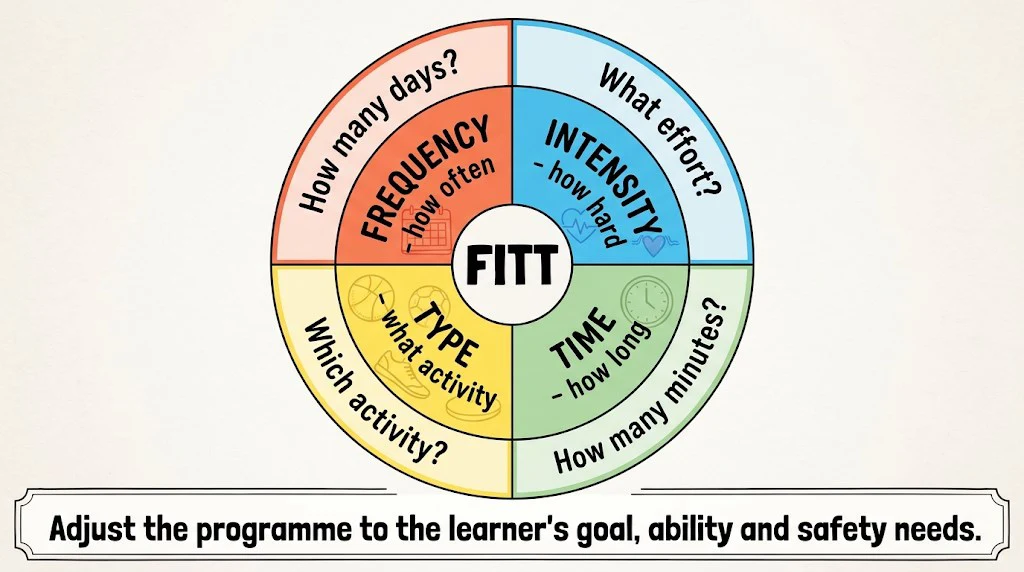
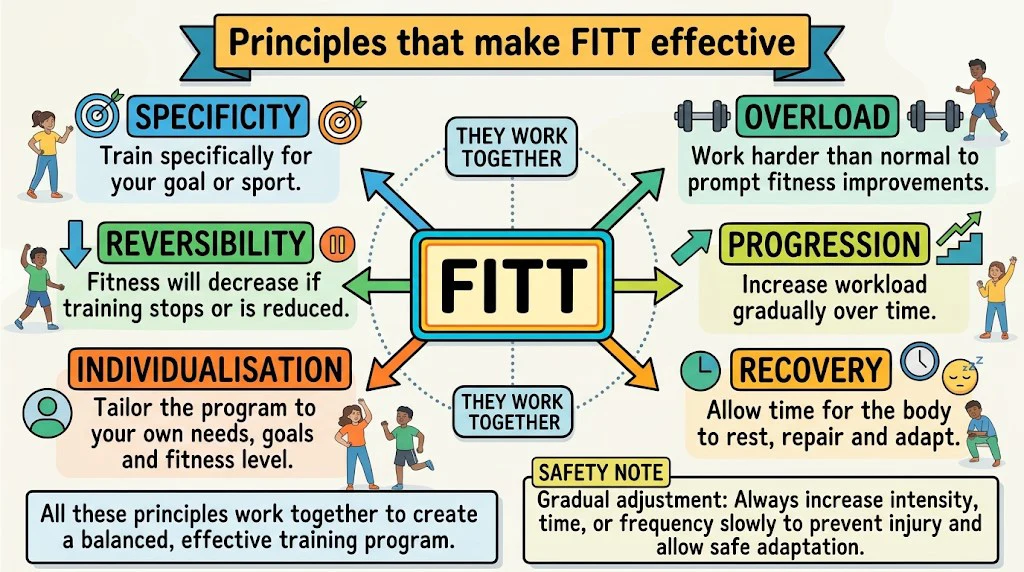
FITT stands for Frequency, Intensity, Time and Type. These elements work together. A programme should also consider progression, overload, specificity, recovery and individual differences. The same programme will not be equally suitable for every learner. Understanding these principles builds directly on Fitness Training Methods (Sub-Strand 1.2).
1.3.2 Frequency
Frequency refers to how often a person performs a particular exercise or training activity within a specified period, commonly expressed as sessions or days per week. Frequency should be appropriate to the activity, the person’s current fitness and the amount of recovery needed.
For example, a learner may participate in aerobic activity on three days of the week and perform suitable strengthening activities on two of those days. This is a description of frequency, not a universal prescription. A beginner may start with fewer sessions and increase gradually, while a learner involved in several sports may need to balance training with recovery.
Factors Affecting Frequency
- Training goal: endurance, strength, flexibility and skill development may require different schedules.
- Intensity and duration: harder or longer sessions may require more recovery.
- Current fitness and experience: beginners may need shorter or less frequent sessions initially.
- Age and health status: the programme must be appropriate to the learner’s circumstances.
- Other demands: school workload, sleep, competitions and daily activity influence recovery.
- Access and preference: a realistic schedule is more likely to be maintained.
Worked Example: Identifying Frequency
A learner cycles on Monday, Wednesday and Friday. The frequency of cycling is three sessions per week. If the learner also attends a dance class on Tuesday, dance frequency is one session per week. State the activity and frequency clearly so different activities are not confused.
1.3.3 Intensity
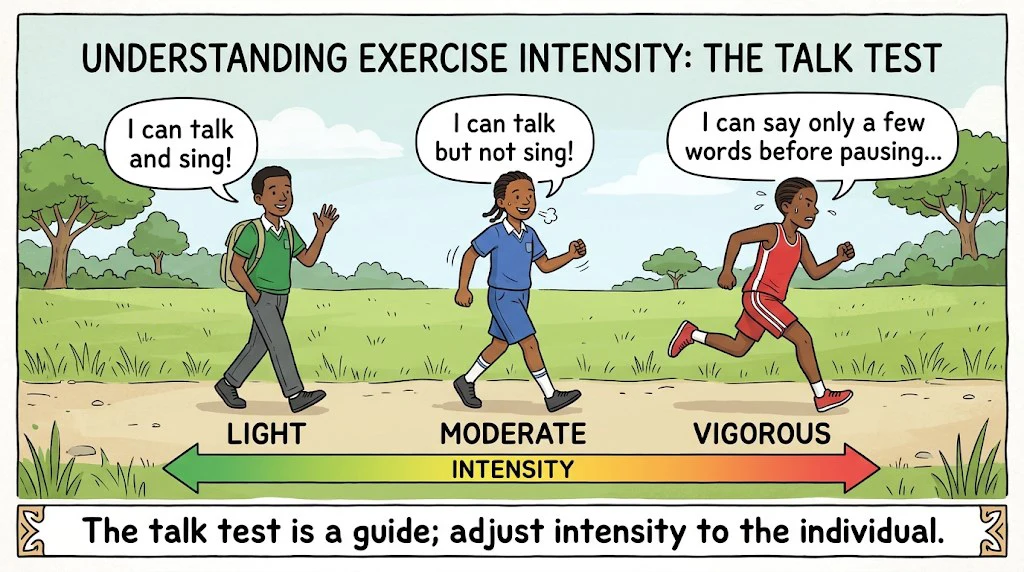
Intensity refers to how hard the body works during exercise. It may be described as light, moderate or vigorous, or measured using heart rate, perceived exertion, workload or the talk test. Intensity should match the purpose of the session and the learner’s capacity.
During moderate-intensity activity, a person can generally talk but not sing comfortably. During vigorous activity, speaking more than a few words without pausing for breath becomes difficult. The talk test is a simple guide, not a medical diagnostic test. Some medicines and health conditions affect heart-rate responses, so heart-rate targets should be used with appropriate guidance.
Ways of Assessing Intensity
Method |
How it works |
Strengths and limitations |
|---|---|---|
Talk test |
Observe whether the participant can talk comfortably. |
Simple and needs no equipment; subjective. |
Perceived exertion |
Participant rates how hard effort feels using an agreed scale. |
Includes personal experience; requires understanding and honest reporting. |
Heart rate |
Measure pulse or use a monitor and compare with an appropriate target. |
Numerical feedback; affected by age, heat, stress and medicines. |
Workload |
Use speed, distance, resistance or repetitions. |
Useful for tracking; same workload may feel different to different people. |
1.3.4 Time
Time refers to the duration of an exercise session or the length of time spent performing a particular activity. It may be expressed in minutes per session, seconds per interval or total weekly activity. Time should be considered together with intensity and frequency. A long session at high intensity may be unsuitable for a beginner.
For example, a learner may begin with 15 minutes of brisk walking and gradually increase duration as the activity becomes manageable. The purpose is not to increase time as quickly as possible, but to build a sustainable routine.
1.3.5 Type
Type refers to the kind or mode of exercise selected. The activity should match the intended fitness outcome. Walking, running, cycling and dancing can develop aerobic endurance. Suitable resistance exercises can develop muscular strength. Mobility and stretching activities can support flexibility. Games and movement drills can develop coordination, agility and balance.
Goal |
Possible activity type |
Important consideration |
|---|---|---|
Aerobic endurance |
Brisk walking, jogging, cycling, swimming or dance. |
Choose sustainable activity and suitable intensity. |
Muscular strength |
Body-weight exercises or suitable resistance training. |
Use correct technique and appropriate resistance. |
Muscular endurance |
Repeated controlled squats or modified push-ups. |
Maintain form rather than rushing repetitions. |
Flexibility and mobility |
Gentle range-of-motion activities and stretches. |
Avoid forcing a joint or stretching into pain. |
Balance and coordination |
Single-leg balance, catching, rhythmic steps. |
Use a safe space and support where needed. |
1.3.6 Applying All Four FITT Elements Together
A useful training plan does not list FITT elements separately without showing how they relate. Frequency, intensity, time and type should form one coherent programme. A learner whose goal is to improve general aerobic fitness might choose brisk walking as the type, complete it on three days per week, work at a moderate intensity and begin with 20 minutes per session. The plan can then be reviewed and adjusted, and can also be applied to structured routines like Aerobics (Sub-Strand 1.4).
Worked Example: Complete FITT Description
Goal: improve general aerobic fitness.
F — Frequency: 3 days per week.
I — Intensity: moderate; the learner can talk but not sing comfortably.
T — Time: 20 minutes per session initially.
T — Type: brisk walking on a safe, level route.
This is an example of how to write a FITT plan, not a prescription for every learner. A real plan should reflect personal ability, health, schedule and available support.
1.3.7 Other Principles That Support FITT
Specificity
Specificity means that training adaptations are related to the activities performed. A learner who wants to improve running endurance should include appropriate aerobic running or similar activities. Practising only flexibility exercises will not fully develop running endurance.
Overload
Overload means placing a body system under a greater but manageable demand than it is accustomed to, so that adaptation can occur. Overload can be introduced by adjusting frequency, intensity, time or type. It must be appropriate and gradual. Excessive overload can cause fatigue, poor technique and injury.
Progression
Progression is the gradual increase or adjustment of training demand as the learner adapts. A learner may first increase a walking session from 15 to 18 minutes, then later increase the pace if the previous level is comfortable. Avoid increasing several demanding elements sharply at the same time.
Recovery
Recovery is the time and process through which the body restores and adapts after training. It includes adequate sleep, nutrition, hydration, rest and appropriate lower-intensity activity. Recovery is part of training, not a sign of laziness.
Individualisation
Individualisation means that a programme should be adjusted to the person. Learners differ in fitness, movement experience, health, confidence, body size, access to facilities and personal goals. A group can share an activity while using different distances, repetitions, resistance or rest periods.
Reversibility
Reversibility means that improvements may gradually decline when training is reduced substantially or stopped for a long period. Maintaining a realistic routine helps preserve adaptations. Temporary breaks may be necessary during illness or injury, and return to training should be gradual.
1.3.8 Designing a Fitness Training Programme
A training programme is a planned schedule of activities designed to achieve specific fitness goals. It should be realistic, safe, measurable and flexible enough to respond to progress and changing circumstances.
- Identify the goal, such as improving aerobic endurance, strength or general wellness.
- Consider participants’ age, activity level, experience, interests, access needs and relevant health considerations.
- Select suitable activities that directly support the goal and are available in the school or community.
- Apply FITT by specifying how often, how hard, how long and what type of activity will be performed.
- Plan warm-up, cool-down and recovery, including rest between sessions.
- Set a manageable starting level that allows correct technique and confidence.
- Identify equipment and facilities and check that they are safe and accessible.
- Assign responsibilities for leading, supervising, recording progress and managing safety.
- Monitor and evaluate participation, perceived effort, technique, enjoyment and progress.
1.3.9 Sample Four-Week School Fitness Programme
The following is an illustrative programme for a general school fitness group, not a universal prescription. A teacher should adjust it to learners’ abilities, timetable, facilities and safety needs. Sessions should include warm-up and cool-down.
Week |
Frequency |
Intensity |
Time |
Type / activity |
|---|---|---|---|---|
1 |
2 sessions |
Light to moderate |
15 – 20 min main activity |
Brisk walking, mobility and basic body-weight movement. |
2 |
2 – 3 sessions |
Mostly moderate |
20 min main activity |
Brisk walking, easy jog intervals or low-impact dance. |
3 |
3 sessions |
Moderate, with short controlled faster sections if suitable |
20 – 25 min main activity |
Interval walk-jog, simple circuit and mobility. |
4 |
3 sessions |
Moderate; maintain technique |
25 min main activity |
Aerobic activity, body-weight strength and flexibility. |
Worked Example: Weekly Training Volume
A learner walks briskly for 20 minutes on Monday, Wednesday and Friday. Weekly brisk-walking time = 20 × 3 = 60 minutes. If the learner adds a 10-minute warm-up and 5-minute cool-down to each session, total session time is 35 × 3 = 105 minutes. State whether a reported figure refers to the main activity or the whole session.
1.3.10 Leading a Group Fitness Session
A group fitness leader communicates clearly, demonstrates exercises, manages time, observes participants and creates a supportive environment. The leader should not pressure participants to work beyond safe limits. Group sessions should offer alternatives so that different ability levels can participate.
- Welcome participants and explain the objective of the session.
- Check the activity area, equipment, weather and access arrangements.
- Explain the structure, work periods, rest periods and expected effort.
- Demonstrate each movement from a position where everyone can see.
- Offer easier and more challenging options without shaming participants.
- Observe posture, breathing, coordination and signs of excessive fatigue.
- Encourage hydration and appropriate rest.
- Cool down and invite participants to reflect on the session.
1.3.11 Giving and Receiving Constructive Feedback
Feedback should be timely, specific and focused on behaviour that can be changed. It should recognise what was done well and identify one or two practical improvements. Avoid comments about appearance, body shape or personal worth.
Feedback Model
What went well: ‘You explained the circuit clearly and demonstrated each station.’
What to improve: ‘The transition between stations was crowded; increase the space and mark a one-way route.’
Next action: ‘Before the next session, arrange the cones and test the route.’
Revision Questions
- Explain the meaning of each letter in FITT.
- Differentiate frequency and time using one exercise programme.
- Explain three ways of assessing exercise intensity.
- A learner cycles for 25 minutes on four days per week. Identify frequency, time and type.
- Explain specificity, overload, progression and recovery.
- Describe the steps involved in designing a fitness programme.
- Develop a one-week FITT programme for a learner who wants to improve aerobic endurance.
- Explain why a programme should be individualised.
- Describe the responsibilities of a learner leading a group fitness session.
- Explain how constructive feedback can improve a training programme.
Summary of Sub-Strand 1.3
- FITT stands for Frequency, Intensity, Time and Type.
- Frequency describes how often activity is performed; intensity describes how hard; time describes duration; type identifies the activity.
- FITT should be applied with specificity, overload, progression, recovery, individualisation and reversibility.
- A good programme begins with a clear goal and considers participants, facilities, safety and available time.
- Training should start at a manageable level and progress gradually.
- Group leaders demonstrate, supervise, adapt and evaluate activities while giving constructive feedback.
For broader lifestyle context, see Recreation and Wellness (Sub-Strand 1.5).
Compiled and reviewed for Education.co.ke by Fred ArapToo (B.Ed. Physics & Chemistry, Egerton University; M.Ed. Education Administration candidate, University of Kabianga; Experience AI Certified Educator — Google DeepMind, Raspberry Pi Foundation & YSK, 2025; national KSEF facilitator, patron and evaluator; EdTech and open-access education platforms innovator; secondary school science educator with 15+ years of experience).
Looking for more resources?
- Revision & past papers: Teacher.co.ke | Education.co.ke | Teacher.ac
- Career pathways & university placement guide: CareerMap.co.ke
- School management systems & related digital applications: Contact us via Teacher.co.ke or ShuleMax.co.ke