In Strand 2.0: Coaching, Sub-strand 2.5 focuses on Tactical Skills in Athletics II, specifically examining jumping events. Understanding how to apply technique, manage competition attempts, and maintain safety is essential for both athletes and coaches.
2.5.1 Meaning of Tactical Skills in Jumping Events
Tactical skills in athletics are planned decisions and performance strategies that help an athlete use technique, physical ability, and competition conditions effectively. In jumping events, tactics include controlling the approach, selecting a suitable take-off strategy, managing attempts, responding to the competition situation, and using equipment and facilities safely.
The selected jumps are long jump, triple jump, high jump, and pole vault. They require different movement patterns:
- Horizontal jumps: Long jump and triple jump, in which distance is measured.
- Vertical jumps: High jump and pole vault, in which the athlete aims to clear a height.
2.5.2 Long Jump
The long jump is a horizontal jumping event in which the athlete runs along a runway, takes off from one foot before the foul line, travels through the air, and lands in a sand pit. Performance depends on a controlled fast approach, accurate take-off, effective flight movement, and a landing that avoids losing distance.
Phases and Tactical Considerations
Phase |
What the athlete does |
Tactical / technical focus |
|---|---|---|
Approach run |
Accelerates along the runway towards the board. |
Use a repeatable run-up and controlled acceleration; maintain rhythm. |
Preparation / final strides |
Adjusts posture and prepares for take-off. |
Avoid reaching or shortening steps excessively; maintain speed. |
Take-off |
Pushes forcefully from one foot at the board. |
Coordinate the take-off leg, free leg, and arms while keeping the body controlled. |
Flight |
Uses a suitable flight technique. |
Maintain balance and manage forward rotation; techniques include hang, sail, and hitch-kick. |
Landing |
Brings legs forward and lands in the sand. |
Extend legs, bring trunk forward, and avoid falling backwards. |
Tactical decisions include selecting a run-up length that the athlete can repeat, checking wind and runway conditions, adjusting the start mark during practice, and deciding when to take a safe valid jump rather than risking a foul. The athlete should not change several technical variables at once.
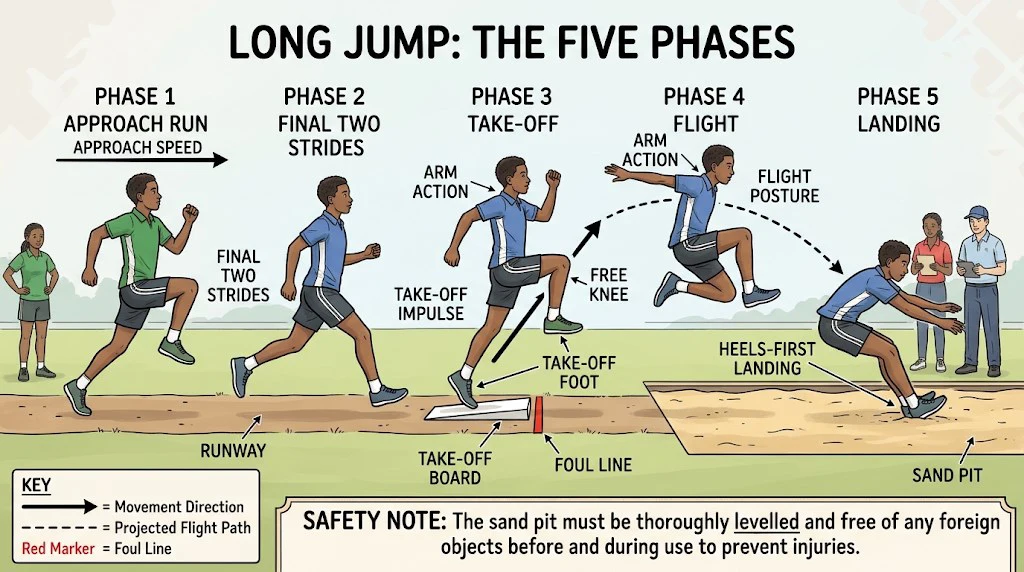
Worked Example 1: Improving Board Accuracy
A learner repeatedly fouls because the final stride is too long. The coach marks the learner’s usual starting point and records where the take-off foot lands in several controlled run-throughs. The coach then adjusts the starting mark slightly and repeats the approach without jumping. The aim is a consistent approach rhythm and a take-off close to, but not beyond, the foul line.
2.5.3 Triple Jump
The triple jump is a horizontal jumping event performed in the sequence hop, step, and jump. The athlete runs along the runway, takes off from one foot, lands on the same foot for the hop, takes off again and lands on the opposite foot for the step, then takes off from that foot into the final jump and lands in the pit.
Phase |
Foot action |
Coaching focus |
|---|---|---|
Approach |
Accelerate towards the board. |
Build controlled speed and maintain rhythm. |
Hop |
Take off from one foot and land on the same foot. |
Maintain balance and avoid an excessively high hop that loses forward speed. |
Step |
Take off from the same foot that landed the hop and land on the opposite foot. |
Transfer smoothly while controlling posture and momentum. |
Jump |
Take off from the opposite foot and land in the pit. |
Drive forward, prepare both legs, and land safely. |
The athlete’s strategy is to preserve speed while maintaining control across all three phases. A very high hop may reduce forward momentum and make the step difficult. The coach should develop the phases progressively and ensure the learner has adequate strength, coordination, and landing skills before full approach jumps.
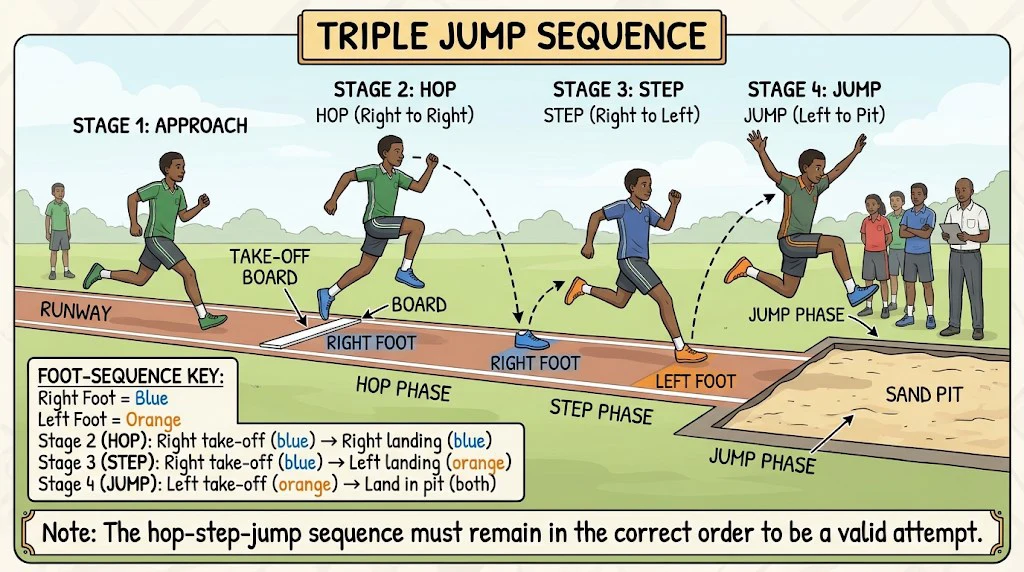
Worked Example 2: Correcting a Poor Triple-Jump Sequence
A learner performs a strong hop but lands with the wrong foot for the step. The coach returns to low-speed, short-distance drills. First, the learner practises the hop and same-foot landing. Next, the learner practises the hop-step sequence at a controlled pace. Only when the sequence is consistent does the learner add the final jump and a longer approach.
2.5.4 High Jump
The high jump is a vertical jumping event in which an athlete attempts to clear a horizontal crossbar supported by two uprights without dislodging it. The athlete takes off from one foot. The Fosbury Flop is the most commonly used elite technique, in which the athlete approaches on a curved path, takes off, and passes over the bar back-first.
Phases of the Fosbury Flop
Phase |
Description |
Important coaching points |
|---|---|---|
Approach |
The athlete accelerates along a curved approach path. |
Use a consistent curve, controlled speed, and correct take-off foot. |
Take-off |
The athlete plants one foot and drives the free knee and arms upwards. |
Create vertical lift while maintaining balance and safe body alignment. |
Bar clearance |
The athlete arches the back and shoulders over the bar, then lifts the hips and legs. |
Coordinate body segments; avoid twisting into the bar. |
Landing |
The athlete lands on the upper back and shoulders on a suitable landing mat. |
Use a purpose-made, correctly positioned mat; never practise the flop onto hard ground. |
A high jumper’s competition tactics include selecting an opening height that is realistic, deciding whether to pass a height, conserving attempts, and maintaining concentration after a failed attempt. Under standard competition rules, three consecutive failures at a height or across a combination of heights lead to elimination; school competitions should follow the rules announced by the organiser (see Competition Formats in Sports).
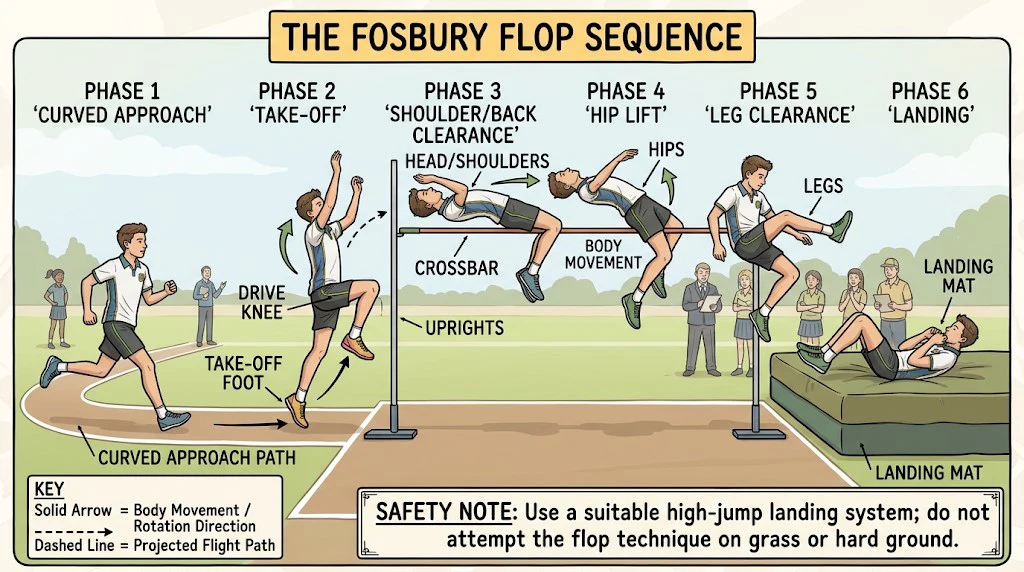
Worked Example 3: Managing Attempts
A learner has cleared 1.30 m and the bar is raised to 1.35 m. The learner has missed the first attempt. The coach reminds the learner to reset, review one technical cue, and avoid rushing. The learner should not make several changes at once. If the learner has a reason to pass a height, the decision must follow the competition rules and should be discussed before the attempt sequence.
2.5.5 Pole Vault
Pole vault is a vertical jumping event in which an athlete uses a flexible pole to assist in clearing a crossbar. The event requires a runway, a pole selected for the athlete, a planting box, uprights, crossbar, and a purpose-built landing area. It is a highly specialised event and must only be taught with appropriate facilities, equipment, qualified supervision, and progressive instruction.
Phase |
Description |
Performance focus |
|---|---|---|
Approach run |
The vaulter carries the pole and accelerates along the runway. |
Controlled acceleration, consistent steps, and secure grip. |
Pole plant and take-off |
The pole tip is placed into the planting box as the athlete takes off. |
Accurate plant, correct take-off timing, and safe body position. |
Swing-up |
The athlete swings the body upwards while supported by the pole. |
Maintain control and coordinate the legs and trunk. |
Extension and turn |
The athlete extends and rotates to move above the bar. |
Timing, body control, and safe release from the pole. |
Bar clearance and landing |
The athlete moves over the bar and lands on the pole-vault mat. |
Clear the bar without contacting it and land within the designated safe area. |
Pole vault is not suitable for unsupervised experimentation or improvised school equipment. Unlike simple low-risk practice aids, the pole, planting box, and landing system must meet appropriate technical and safety requirements. Learners should only participate where the school has the correct facilities and competent instruction.
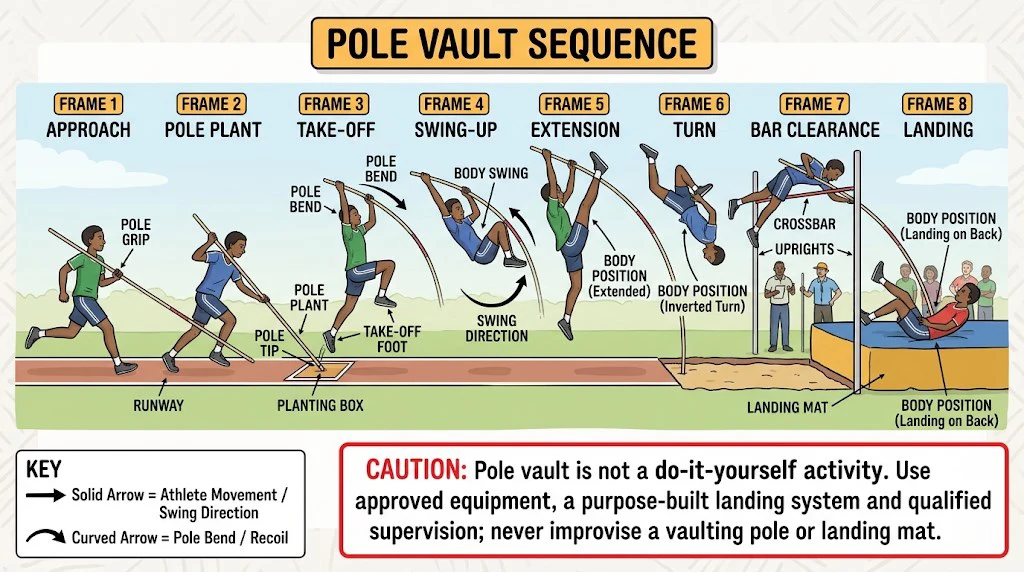
2.5.6 Comparing the Selected Jumps
Event |
Main objective |
Approach |
Take-off |
Landing |
|---|---|---|---|---|
Long jump |
Achieve maximum horizontal distance. |
Straight runway acceleration. |
One-foot take-off near board. |
Feet-first into sand pit. |
Triple jump |
Achieve maximum horizontal distance through hop-step-jump. |
Straight runway acceleration. |
One-foot take-off followed by alternating phase sequence. |
Feet-first into sand pit. |
High jump |
Clear the greatest height. |
Curved approach for common Flop technique. |
One-foot take-off. |
Back/shoulders onto suitable mat. |
Pole vault |
Clear the greatest height using a pole. |
Runway carrying pole. |
Pole plant and one-foot take-off. |
Purpose-built vault landing mat. |
2.5.7 Improvisation of Equipment and Modification of Facilities
Equipment improvisation is the careful creation or adaptation of suitable learning aids when standard equipment is unavailable. Facility modification involves adjusting an existing area so that it can be used more effectively for a selected activity. Both must be guided by risk management and safety and the intended skill.
The curriculum identifies six criteria for appraising improvised equipment and modified facilities:
Criterion |
Meaning |
Example of appraisal question |
|---|---|---|
Durability |
Can the item withstand repeated appropriate use? |
Will the marker remain stable during repeated drills? |
Safety |
Can it be used without creating unacceptable hazards? |
Are there sharp edges, splinters, unstable parts, or trip hazards? |
Suitability to skill |
Does it support the movement or skill being taught? |
Does the target help learners practise accurate approach rhythm? |
Utility |
Is it useful, practical, and easy to use? |
Can it be moved, stored, and used by the intended group? |
Aesthetic |
Is it neat, clearly visible, and appropriately finished? |
Can learners see the marker clearly against the background? |
Relevance |
Does it meet the actual needs of the activity? |
Does the aid help teach the selected jump rather than distract from it? |
Safe examples may include soft, visible markers made from reusable materials, low cones made from safe recycled containers, or clearly marked approach zones. Any improvised item must be stable, free of sharp edges, and used only for a suitable low-risk purpose. A homemade object must never replace a certified pole-vault pole, high-jump mat, crossbar support, or other safety-critical equipment.
2.5.8 Modifying a School Facility Safely
- Identify the jump to be practised and the technical requirements of that event.
- Inspect the available area, surface, boundaries, access, and surrounding hazards.
- Decide what can be modified safely and what specialist equipment is essential.
- Obtain school approval and involve competent personnel where construction or repair is required.
- Use safe, suitable materials and ensure modifications do not create trip, impact, or collapse hazards.
- Test and inspect the area before learners use it.
- Explain the modified layout and safety rules to all participants.
- Monitor the facility during use and stop activity if a defect develops.
2.5.9 Practical Coaching and Feedback
Effective coaching feedback is specific, brief, and connected to the learner’s immediate task. For example, ‘Keep your approach rhythm steady over the final steps’ is more useful than ‘Jump better’. Coaches should focus on one or two important cues, allow practice, and observe whether performance changes.
- Demonstrate the movement at a speed learners can understand.
- Break a complex skill into manageable parts before combining them.
- Use safe progressions from standing drills to short approaches and then full approaches.
- Give feedback about observable actions rather than personal traits.
- Encourage learners to reflect on what they felt and what they need to adjust.
- Use mini-games or challenges only when they reinforce correct technique and safe behaviour.
Summary: Tactical Skills in Athletics II
- Long jump has approach, take-off, flight, and landing phases.
- Triple jump uses the correct hop, step, and jump sequence.
- High jump requires a controlled approach, one-foot take-off, bar clearance, and safe landing on a suitable mat.
- Pole vault is a specialised event requiring approved equipment and qualified supervision.
- Tactical decisions include approach consistency, attempt management, and adapting to conditions.
- Improvised equipment and modified facilities must be durable, safe, suitable, useful, aesthetically clear, and relevant.
Quick Revision Questions
- Name the phases of long jump.
- Explain the foot sequence in triple jump.
- Why is a suitable landing mat essential in high jump?
- State the phases of pole vault.
- Explain the six criteria used to appraise improvised equipment.
Compiled and reviewed for Education.co.ke by Fred ArapToo (B.Ed. Physics & Chemistry, Egerton University; M.Ed. Education Administration candidate, University of Kabianga; Experience AI Certified Educator — Google DeepMind, Raspberry Pi Foundation & YSK, 2025; national KSEF facilitator, patron and evaluator; EdTech and open-access education platforms innovator; secondary school science educator with 15+ years of experience).
Looking for more resources?
- Revision & past papers: Teacher.co.ke | Education.co.ke | Teacher.ac
- Career pathways & university placement guide: CareerMap.co.ke
- School management systems & related digital applications: Contact us via Teacher.co.ke or ShuleMax.co.ke