In 2.0 Coaching, understanding how to structure tournaments is essential for effective organisation of sports. This lesson covers Sub-strand 2.4: Competition Formats in Sports.
2.4.1 Meaning of a Competition Format
A competition format is the system used to determine how participants or teams are matched, how results are recorded and how a winner or final ranking is decided. A suitable format depends on the number of teams, time, facilities, officials, equipment, purpose and the desired amount of participation.
The selected games in this sub-strand are Handball, Hockey, Baseball5 and Table Tennis. The same broad competition formats can be adapted to these games, but match duration, rules, court or field arrangements and player numbers must follow the relevant school or governing-body rules.
2.4.2 League Format
In a league competition, each team plays against every other team, either once (single round robin) or twice (double round robin). Teams earn points according to the competition rules. The team with the highest points total at the end is usually placed first. If teams tie, organisers use pre-announced tie-break rules such as head-to-head result, goal or point difference, goals or points scored, or a play-off.
For a single round robin with n teams, the number of matches is n(n−1)/2. This formula counts each unique pairing once.
Worked Example 1: Calculating League Matches
A class competition has 6 teams. Number of matches = 6 × (6 − 1) ÷ 2 = 6 × 5 ÷ 2 = 15 matches. Each team plays 5 matches. If the school has only one court, organisers must allow enough time for all 15 matches and any delays.
Advantages |
Limitations |
|---|---|
Every team gets several matches. |
Requires more time and officials than a short knockout. |
Results reflect performance across multiple games. |
A team may have little to play for near the end if the leader is far ahead. |
Suitable for developing experience and comparing consistency. |
Requires careful scheduling and score recording. |
Can accommodate teams of different ability levels. |
Unequal rest periods can occur if the schedule is poorly designed. |
2.4.3 Drawing a Single Round-Robin Fixture
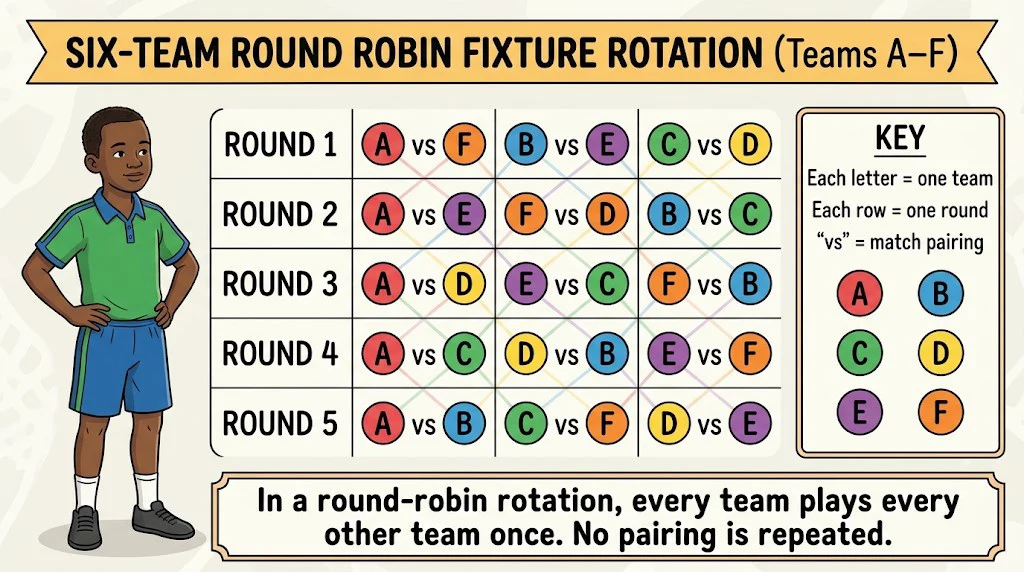
For an even number of teams, a common method is the rotation method. Fix one team in position and rotate the others after each round. Each round contains half as many matches as there are teams. For an odd number of teams, add a BYE position; the team paired with BYE rests in that round.
Round |
Fixture 1 |
Fixture 2 |
Fixture 3 |
|---|---|---|---|
1 |
A vs F |
B vs E |
C vs D |
2 |
A vs E |
F vs D |
B vs C |
3 |
A vs D |
E vs C |
F vs B |
4 |
A vs C |
D vs B |
E vs F |
5 |
A vs B |
C vs F |
D vs E |
This is an illustrative six-team single round-robin schedule. Check that every team plays every other team exactly once. The organiser should also review venue availability, rest periods and the order of matches.
2.4.4 League Points Table
A league table records performance after each match. A common school scoring system awards 3 points for a win, 1 for a draw and 0 for a loss, but the organiser must state the actual rules before the competition begins. Some sports or school formats do not permit drawn results.
Team |
Played |
Won |
Drawn |
Lost |
Points for |
Points against |
Points |
|---|---|---|---|---|---|---|---|
A |
5 |
4 |
0 |
1 |
42 |
25 |
12 |
B |
5 |
3 |
1 |
1 |
38 |
29 |
10 |
C |
5 |
3 |
0 |
2 |
35 |
31 |
9 |
D |
5 |
2 |
1 |
2 |
30 |
32 |
7 |
E |
5 |
1 |
0 |
4 |
27 |
39 |
3 |
F |
5 |
0 |
0 |
5 |
20 |
36 |
0 |
The figures above are illustrative and show how a table may be arranged. In sports where draws are possible, points are calculated from the announced scoring system. For Table Tennis, a match may be decided by games and points under the competition rules; a school league should state how match wins and ties in team standings are treated.
2.4.5 Knockout Format
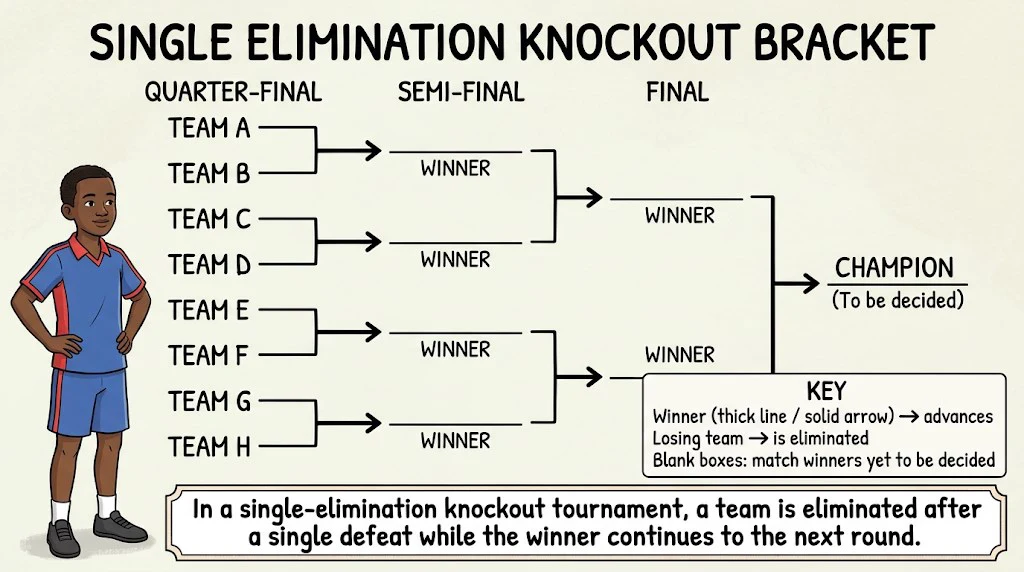
In a knockout competition, a team or player is eliminated after losing a match. Winners progress to the next round until the final determines the champion. A single-elimination competition with n entrants requires n−1 matches to produce one winner, assuming each match produces a winner.
Worked Example 2: Number of Knockout Matches
If 8 teams enter a single-elimination tournament, the total number of matches is 8 − 1 = 7. The rounds are quarter-finals (4 matches), semi-finals (2 matches) and final (1 match). Total = 4 + 2 + 1 = 7.
Advantages |
Limitations |
|---|---|
Produces a winner quickly. |
A strong team may be eliminated after one poor performance. |
Suitable when time or facilities are limited. |
Some teams receive very little playing time. |
Easy for spectators to follow. |
A bye or seeding decision may be necessary when entrant numbers are not a power of two. |
Creates high-stakes matches. |
Can be less suitable when the main goal is broad participation and learning. |
2.4.6 Byes and Seeding
A bye is an automatic advancement to the next round when the number of entrants does not fill a complete bracket. For a standard knockout bracket, the next power of two is identified. The number of byes is the bracket size minus the number of entrants.
Worked Example 3: Byes in a Knockout
There are 10 teams. The next power of two is 16. Number of byes = 16 − 10 = 6. Six teams receive byes into the round of 16, while four teams play two preliminary matches. The six bye teams plus the two preliminary winners make eight teams for the quarter-final stage. The organiser should allocate byes fairly, preferably using transparent seeding or a draw.
Seeding is the process of placing selected strong teams or players in different parts of the bracket so that they are less likely to meet in the earliest rounds. Seeding should use clear, fair and pre-announced criteria.
2.4.7 Drawing a Knockout Fixture
A knockout bracket should show the first round, later rounds and final. Where teams are not evenly divisible into a power of two, byes are inserted. The bracket should be checked to ensure that winners advance to the correct next fixture.
2.4.8 League-cum-Knockout Format
A league-cum-knockout competition combines a preliminary league stage with a knockout stage. Teams are divided into groups. Within each group, teams play a league or round-robin schedule. The top team or top teams from each group qualify for the knockout stage.
This format gives participants more than one match while still producing a champion within a manageable period. It is useful when there are many teams but limited time for a complete league.
Worked Example 4: Eight Teams in Two Groups
Divide eight teams into Group A (A1, A2, A3, A4) and Group B (B1, B2, B3, B4). Each group plays a single round robin: 4 × 3 ÷ 2 = 6 matches per group, giving 12 group matches. The top two from each group qualify for semi-finals: A1 vs B2 and B1 vs A2. The winners play the final. Total matches = 12 + 2 + 1 = 15.
Stage |
Matches |
Purpose |
|---|---|---|
Group league |
12 |
Each team plays three group matches. |
Semi-finals |
2 |
Top two from each group compete for a place in the final. |
Final |
1 |
Semi-final winners decide the champion. |
Total |
15 |
A manageable alternative to a full eight-team league of 28 matches. |
2.4.9 Table Tennis Ladder Tournament
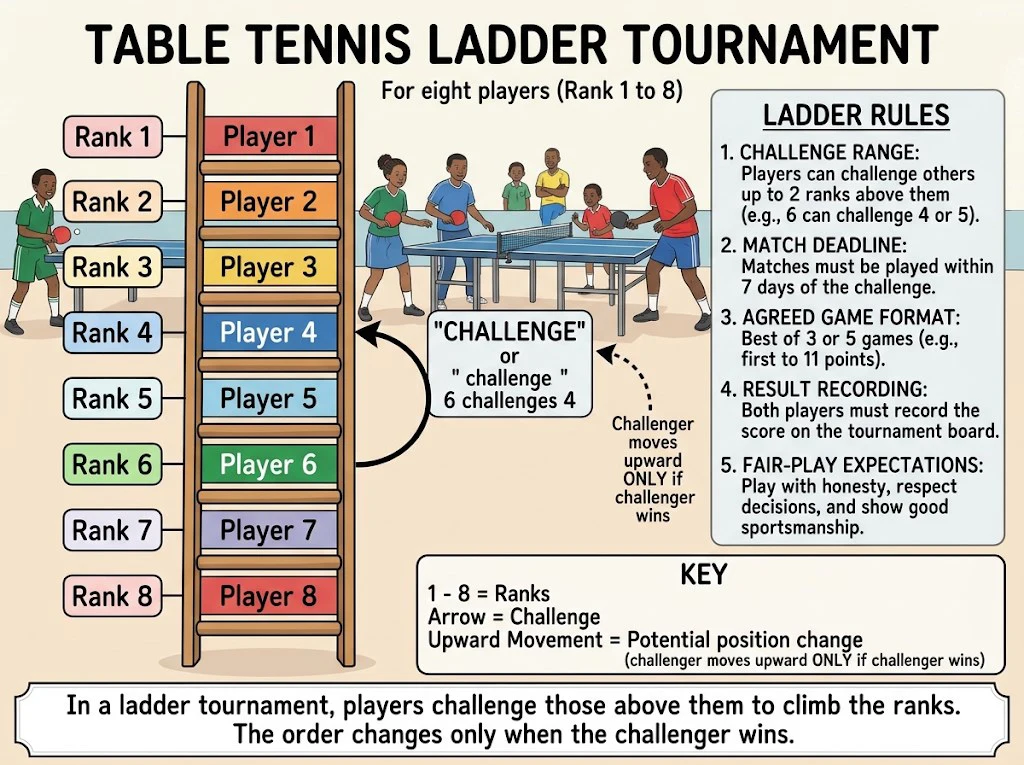
A ladder tournament is a challenge-based competition in which players are arranged in a ranked list or ‘ladder’. A player may challenge another player who is placed above them, usually within a defined number of positions. If the challenger wins, the players exchange positions or the challenger moves above the opponent according to the agreed rules.
- Publish the ladder and the permitted challenge range.
- Set a time limit for accepting and completing challenges.
- State the match format, such as best of three or best of five games, according to the school rules.
- Record the result immediately and update the ladder consistently.
- Prevent repeated challenges that unfairly disadvantage one player.
- Provide clear procedures for absence, injury, withdrawal and disputes.
2.4.10 Selecting a Suitable Format for the Selected Games
Game |
Possible format |
Factors to consider |
|---|---|---|
Handball |
League, knockout or league-cum-knockout |
Team numbers, court availability, match duration, officials, player recovery and injury risk. |
Hockey |
League, knockout or league-cum-knockout |
Pitch size, team numbers, equipment, officials, surface and time available. |
Baseball5 |
League, knockout or league-cum-knockout |
Safe playing area, team numbers, match schedule, scoring system and suitable rest periods. |
Table Tennis |
League, knockout, league-cum-knockout or ladder |
Number of tables, match duration, player availability, scoring format and access to practice time. |
A coach or organiser should not choose a format only because it is familiar. The format should match the purpose. If the aim is to maximise participation and learning, a league or ladder may be suitable. If the aim is to complete a short event and identify a champion, knockout may be appropriate. If both participation and a final champion are important, league-cum-knockout may be preferable.
2.4.11 Worked Comparison: Choosing a Format
Worked Example 5: Selecting a Format for an Inter-Class Event
A school has 12 Table Tennis players, two tables and only one afternoon. A full single league requires 12 × 11 ÷ 2 = 66 matches, which may be too many. A knockout requires 11 matches and is quicker, but some players may play only once. A practical compromise is to divide players into four groups of three. Each group plays a mini-league of three matches (six matches across all groups), then group winners enter semi-finals and a final. This gives each learner at least two group matches while keeping the event manageable.
2.4.12 Fairness and Quality of Competition
Maintaining fairness also aligns with risk management in sports by ensuring participant safety and proper recovery:
- Publish the format, scoring system, tie-break rules and schedule before play begins.
- Use qualified or appropriately briefed officials.
- Allow reasonable recovery between matches.
- Ensure equipment and playing conditions are consistent.
- Apply rules consistently and provide a process for resolving disputes.
- Record results accurately and display updated standings.
- Consider participant safety, access and inclusion when scheduling.
Summary: Competition Formats
- A league gives each team or player repeated opportunities to compete against others.
- A single round-robin with n teams has n(n−1)/2 matches.
- A knockout eliminates the loser of each match and needs n−1 matches to produce a winner.
- A bye allows an entrant to advance when a bracket is not full.
- League-cum-knockout combines group league matches with elimination rounds.
- A Table Tennis ladder uses ranked positions and challenges under agreed rules.
- The best format depends on numbers, time, facilities, purpose, fairness and safety.
Quick Revision Questions
- Calculate the number of matches in a single league of seven teams.
- How many matches are needed for a knockout of 16 teams?
- Explain the purpose of a bye.
- Design a league-cum-knockout format for 12 teams.
- Explain how a Table Tennis ladder works.
Compiled and reviewed for Education.co.ke by Fred ArapToo (B.Ed. Physics & Chemistry, Egerton University; M.Ed. Education Administration candidate, University of Kabianga; Experience AI Certified Educator — Google DeepMind, Raspberry Pi Foundation & YSK, 2025; national KSEF facilitator, patron and evaluator; EdTech and open-access education platforms innovator; secondary school science educator with 15+ years of experience).
Looking for more resources?
- Revision & past papers: Teacher.co.ke | Education.co.ke | Teacher.ac
- Career pathways & university placement guide: CareerMap.co.ke
- School management systems & related digital applications: Contact us via Teacher.co.ke or ShuleMax.co.ke