In Grade 11 Sports and Recreation under Strand 1.0 Health and Fitness, Sub-Strand 1.5: Recreation and Wellness focuses on the cognitive, physical, and social dimensions of wellness, as well as the six pillars of health. This lesson builds on concepts from Aerobics (Sub-Strand 1.4) and prepares learners for Injuries in Sports and Recreation (Sub-Strand 1.6.1).
1.5.1 Meaning of Recreation
Recreation refers to activities people choose during free or discretionary time for enjoyment, relaxation, personal development, or social connection. Recreation may be active or quiet, individual or group-based, indoor or outdoor. Examples include playing a game, walking, dancing, reading, gardening, cycling, swimming, visiting a park, doing crafts, or participating in cultural activities.
Recreation is not necessarily competitive. A person may play football for enjoyment without entering a tournament. A family may walk together in a public park, while friends may play board games. The value of recreation depends on whether the activity is safe, meaningful, and appropriate for the participant.
1.5.2 Meaning of Wellness
Wellness is an active process of making choices and developing habits that support a balanced and healthy life. It is broader than the absence of illness. It includes physical functioning, thinking and learning, emotional balance, relationships, and the ability to participate meaningfully in daily life. Wellness changes over time and is influenced by personal choices as well as social, economic, and environmental conditions.
1.5.3 Difference Between Recreation and Wellness
Recreation |
Wellness |
|---|---|
Chosen leisure activities for enjoyment, relaxation, or personal development. |
A broader state and ongoing process of supporting health and quality of life. |
May be a particular event or activity. |
Develops through habits and conditions over time. |
Examples: hiking, games, dance, reading, and gardening. |
Examples: balanced activity, adequate sleep, healthy relationships, and stress management. |
Can contribute to wellness. |
Can be supported by recreation when activities are safe and appropriate. |
Worked Example: Recreation and Wellness
A learner joins a weekend walking group. The walk is recreation because it is a chosen leisure activity. It may support physical wellness through movement, social wellness through interaction, and cognitive wellness through attention to the route. It contributes to wellness most effectively when safe, enjoyable, and balanced with rest and other healthy habits.
1.5.4 Dimensions of Recreation and Wellness
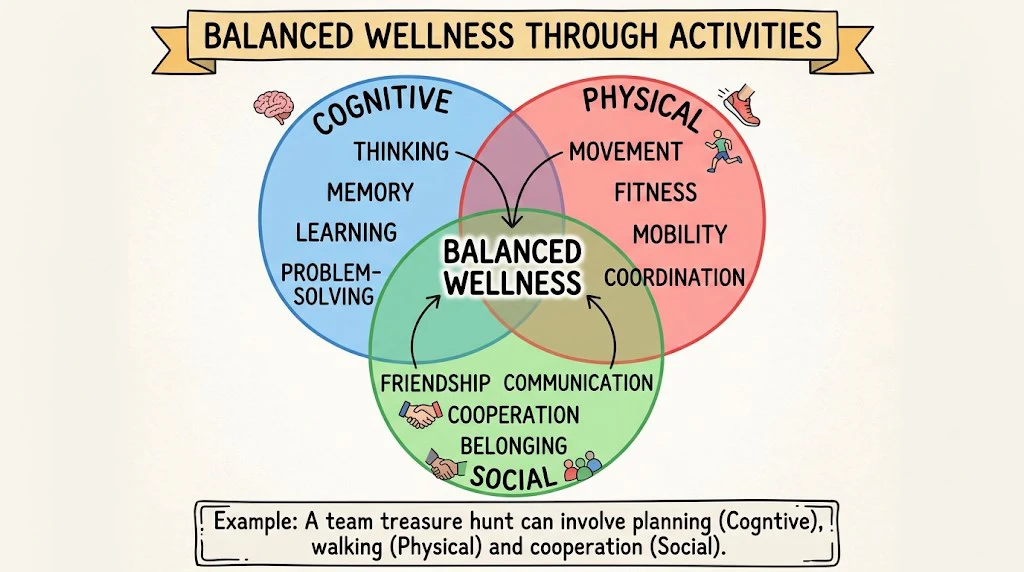
The curriculum identifies cognitive, physical, and social dimensions. These dimensions are connected, and an activity may contribute to more than one dimension at the same time.
A. Cognitive Dimension
The cognitive dimension concerns thinking, learning, memory, attention, problem-solving, and decision-making. Recreation can stimulate the mind by requiring participants to learn rules, plan strategies, remember sequences, or respond to changing situations.
- Board games and puzzles encourage planning, memory, and logical reasoning.
- Learning a dance routine develops memory, attention, and sequencing.
- Orienteering and nature walks encourage observation, navigation, and decision-making.
- Team games require participants to interpret situations and choose appropriate actions.
- Creative activities such as music, crafts, and drama encourage imagination and problem-solving.
B. Physical Dimension
The physical dimension concerns the functioning of the body and the ability to perform daily activities. Active recreation can improve fitness, movement skills, mobility, and general physical functioning. The effect depends on activity, frequency, intensity, and duration (see Principles of Training).
- Walking and cycling can improve cardiorespiratory endurance.
- Games and dance can develop coordination, balance, and agility.
- Suitable strengthening activities can improve muscular strength and endurance.
- Outdoor recreation can encourage movement and reduce prolonged sitting.
- Gentle mobility activities can support comfortable movement and flexibility.
C. Social Dimension
The social dimension concerns relationships, communication, belonging, cooperation, and participation in a community. Group recreation provides opportunities to interact, share responsibilities, and learn from others.
- Team games develop cooperation and shared responsibility.
- Community walks create opportunities for conversation and mutual support.
- Cultural events encourage appreciation of different traditions.
- Clubs and recreation groups can reduce isolation through regular social contact.
- Volunteering in community events develops civic responsibility and connection.
1.5.5 Types of Recreation Activities
Type |
Examples |
Possible Wellness Contribution |
|---|---|---|
Physical |
Walking, cycling, swimming, dance, games, and hiking. |
Supports physical fitness and may improve mood. |
Intellectual |
Reading for pleasure, chess, puzzles, and strategy games. |
Stimulates thinking, memory, and concentration. |
Social |
Group games, clubs, community events, and family activities. |
Builds relationships, communication, and belonging. |
Creative |
Drawing, crafts, music, drama, and photography. |
Encourages expression, imagination, and relaxation. |
Outdoor / nature |
Nature walks, bird observation, gardening, and camping. |
Encourages movement, observation, and connection with nature. |
Cultural |
Traditional games, dance, music, and cultural festivals. |
Supports identity, cultural learning, and social connection. |
1.5.6 Recreation-Wellness Matrix
A recreation-wellness matrix shows how different activities contribute to cognitive, physical, and social dimensions. Avoid assuming every activity contributes equally to every dimension. Explain the specific benefit and consider the participant’s circumstances.
Activity |
Cognitive Contribution |
Physical Contribution |
Social Contribution |
|---|---|---|---|
Football |
Tactical thinking and decision-making. |
Running, agility, and coordination. |
Teamwork and communication. |
Board games |
Memory, planning, and problem-solving. |
Usually limited physical movement. |
Turn-taking and friendly interaction. |
Dance |
Remembering movement sequences. |
Endurance, balance, and coordination. |
Group expression and shared enjoyment. |
Gardening |
Planning, sequencing, and learning about plants. |
Bending, carrying, and light-to-moderate movement. |
Sharing tasks and knowledge. |
Traditional games |
Understanding rules and strategy. |
Movement and coordination. |
Cultural exchange and participation. |
1.5.7 Pillars of Health and Wellness
The curriculum identifies six pillars: nutrition, exercise, sleep, stress management, relaxation, and hygiene. These pillars support one another. Regular physical activity can support sleep, while adequate sleep helps a learner recover and participate effectively. Good nutrition provides energy and nutrients needed for growth, learning, and activity.
A. Nutrition
Nutrition is the process through which the body obtains and uses nutrients from food and drinks. A balanced eating pattern supplies energy, supports growth and repair, and helps maintain health. Nutrients include carbohydrates, proteins, fats, vitamins, minerals, water, and dietary fibre.
- Carbohydrates: provide an important source of energy for activity.
- Proteins: support growth and repair of body tissues.
- Fats: provide energy, help absorb certain vitamins, and support normal body functions.
- Vitamins and minerals: support body processes, including immunity and bone health.
- Water: supports temperature regulation, transport of substances, and normal body function.
- Fibre: supports digestive health and is found in vegetables, fruits, legumes, and whole grains.
A balanced eating pattern should include a variety of foods, with attention to locally available options such as vegetables, fruits, beans, peas, lentils, whole grains, milk or suitable alternatives, eggs, fish, and other protein foods. Needs differ according to age, activity, health, culture, and availability. Learners should avoid extreme diets and should not use supplements or performance products without qualified advice.
B. Exercise and Physical Activity
Exercise is planned physical activity, while physical activity also includes everyday movement such as walking to school, active play, household tasks, and cycling. Regular activity supports physical fitness and can benefit mental and social health. A balanced routine should include aerobic activity, muscle- and bone-strengthening activities, and movement that develops flexibility, balance, and coordination.
C. Sleep
Sleep is a natural period of rest during which the body and brain carry out important recovery and regulation processes. Adequate sleep supports attention, learning, memory, mood, immune function, and physical recovery. Sleep needs vary with age, but adolescents generally require more sleep than adults. A consistent sleep routine and comfortable sleeping environment may support better sleep.
- Keep a reasonably consistent sleep and waking schedule.
- Create a quiet, dark, and comfortable sleeping environment where possible.
- Avoid intense exercise immediately before sleep if it makes settling difficult.
- Seek help from a trusted adult or health professional if persistent sleep problems affect daily life.
D. Stress Management
Stress is the body’s response to demands or challenges. Some short-term stress can help a person prepare for a task, but persistent or overwhelming stress may affect concentration, mood, sleep, and physical health. Stress management involves recognising stressors and using healthy strategies to respond.
- Plan tasks and break large assignments into manageable steps.
- Talk to a trusted person when a problem feels difficult to manage alone.
- Use physical activity, breathing exercises, or creative recreation to manage tension.
- Maintain supportive relationships and seek help when needed.
- Avoid harmful coping behaviours such as substance misuse or aggression.
E. Relaxation
Relaxation refers to activities and practices that reduce tension and create a sense of calm. It may include quiet breathing, gentle stretching, listening to music, reading, prayer or reflection, spending time in nature, or engaging in a peaceful hobby. Relaxation is not the same as sleep; it is a way of reducing mental and physical tension while awake.
F. Hygiene
Hygiene refers to practices that help maintain cleanliness and reduce the spread of infection. Personal hygiene is important in sport and recreation because participants share equipment, facilities, and sometimes close contact.
- Wash hands with soap and safe water, especially before eating and after using the toilet.
- Bathe regularly and wear clean clothing appropriate for activity.
- Keep fingernails short and clean where practical.
- Clean shared equipment and avoid sharing personal items such as towels or water bottles.
- Wear suitable footwear and keep minor cuts clean and covered.
- Use safe toilets and dispose of waste appropriately.
1.5.8 How the Pillars Influence Recreation Choices
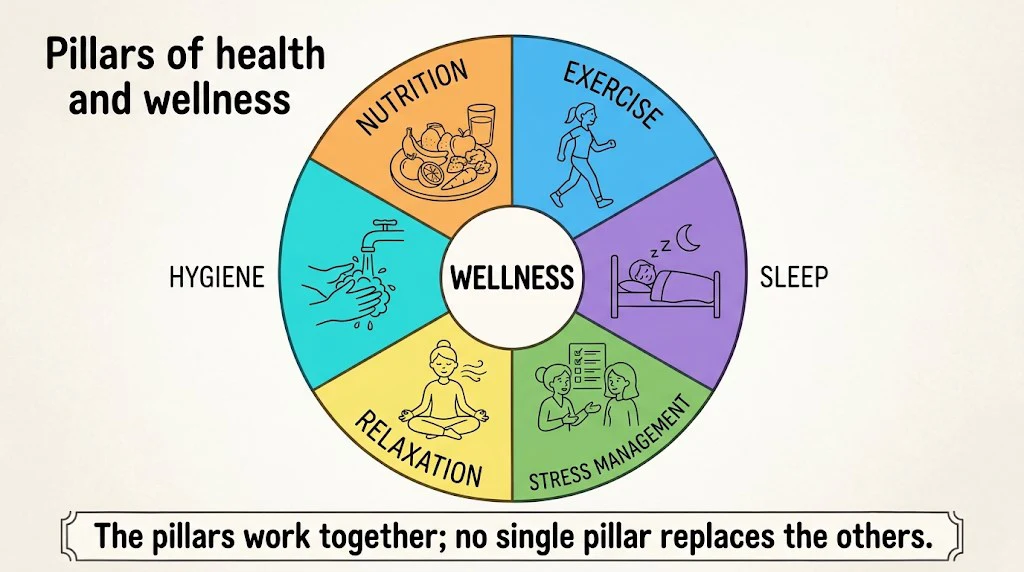
The pillars of health should be considered when selecting recreation activities because an enjoyable activity may still be unsuitable if it ignores safety, recovery, or personal needs. A learner planning a long outdoor walk should consider nutrition, hydration, sleep, weather, route safety, and hygiene. A learner choosing a late-evening high-intensity session should consider whether it may interfere with sleep.
Pillar |
Question Before Recreation |
Practical Example |
|---|---|---|
Nutrition |
Have I eaten appropriately and allowed time for digestion? |
Choose a suitable meal or snack and carry water for a long walk. |
Exercise |
Does the activity match my fitness and movement ability? |
Select a manageable route and pace. |
Sleep |
Am I sufficiently rested to participate safely? |
Postpone strenuous activity when severely sleep-deprived or unwell. |
Stress management |
Will the activity help me cope constructively? |
Choose a walk or group game rather than an activity that increases pressure. |
Relaxation |
Does my routine include time to recover and unwind? |
Balance energetic recreation with quiet activities. |
Hygiene |
Can I maintain cleanliness and reduce infection risks? |
Use clean equipment, wash hands, and avoid sharing towels. |
1.5.9 Road Safety During Outdoor Recreation
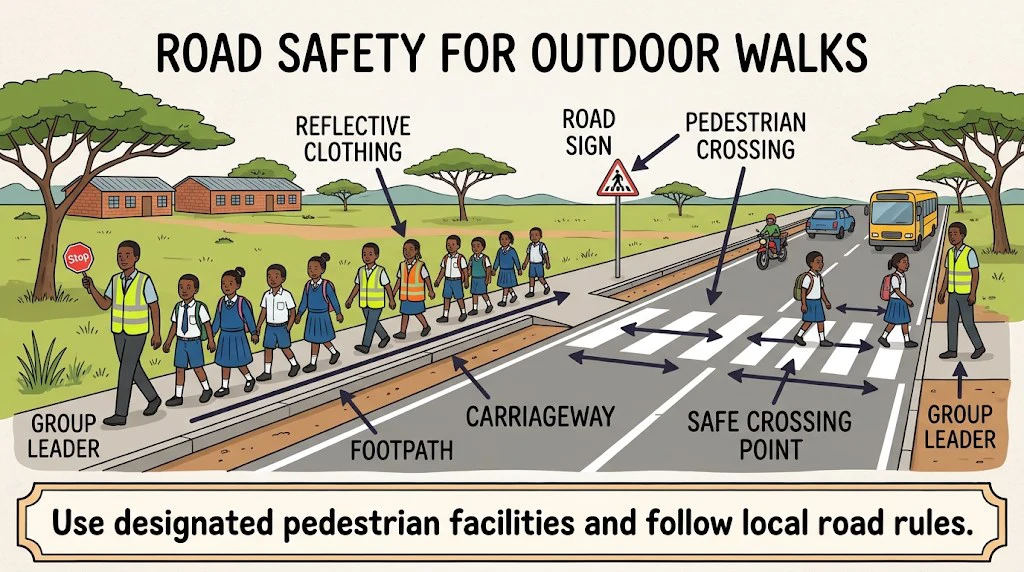
Outdoor recreation may involve walking, jogging, or cycling near roads. Road safety is essential because participants share space with vehicles and other road users. The safest route minimises exposure to traffic and provides appropriate pedestrian or cycling facilities.
- Use designated footpaths, pedestrian crossings, and cycle lanes where available.
- Where there is no footpath, follow local road rules and walk as far from moving vehicles as possible.
- Cross at safe, visible locations after checking traffic in all directions; never assume a driver has seen you.
- Wear visible clothing in low-light conditions and use lights or reflective items where appropriate.
- Avoid headphones at a volume that prevents awareness of traffic.
- Cycle predictably, obey road signs, and use a properly fitted helmet.
- Keep groups organised and avoid spreading across the road.
- Ensure learners are supervised and routes, meeting points, and emergency contacts are agreed.
- Do not hold games or exercise sessions on roads used by vehicles.
1.5.10 Planning a Recreation Programme
A recreation programme is an organised set of activities planned to meet participants’ interests and wellness needs. It should be varied, inclusive, affordable, and safe. The pillars of health should be considered so that the programme promotes balanced wellness rather than focusing on activity alone.
- Identify participants and their interests, abilities, access needs, and available time.
- Set clear aims, such as social connection, active living, cognitive stimulation, or relaxation.
- Select varied activities that address cognitive, physical, and social dimensions.
- Apply FITT considerations to physical activities and ensure intensity is appropriate.
- Plan nutrition and hydration, suitable rest and recovery, and hygiene measures.
- Select accessible venues and assess environmental and road-safety risks.
- Arrange equipment, supervision, first aid, and communication with participants.
- Implement the programme and observe participation, enjoyment, and safety.
- Collect feedback and make improvements.
1.5.11 Sample Weekly Recreation Plan
Day |
Activity |
Dimension Emphasised |
Pillars Considered |
|---|---|---|---|
Monday |
30-minute group walk |
Physical and social |
Exercise, hydration, sleep, and road safety. |
Tuesday |
Reading or puzzle session |
Cognitive |
Relaxation and stress management. |
Wednesday |
Dance or low-impact movement |
Physical and social |
Exercise, suitable nutrition, and hydration. |
Thursday |
Drawing or music |
Cognitive and creative |
Relaxation and stress management. |
Friday |
Traditional group game |
Physical, cognitive, and social |
Exercise, inclusion, and hygiene. |
Saturday |
Family gardening or nature activity |
Physical, cognitive, and social |
Exercise, nutrition awareness, and sun protection. |
Sunday |
Quiet leisure and recovery |
Cognitive and social |
Sleep, relaxation, and recovery. |
1.5.12 Worked Examples and Examination Practice
Worked Example 1: Classify a Recreation Activity
Question: A group takes part in a nature walk and identifies plants. Explain how it contributes to three dimensions of wellness.
- Cognitive: learners observe plants, compare features, and recall information.
- Physical: walking involves movement and can contribute to cardiorespiratory activity.
- Social: learners communicate, share observations, and cooperate.
Worked Example 2: Apply the Pillars
Question: A learner plans a two-hour outdoor cycling activity. Identify four pillars and explain how they should be considered.
- Exercise: select a route and pace that match ability.
- Nutrition: plan suitable food and water.
- Sleep: adequate rest supports alertness and safe decisions.
- Hygiene: clean clothing and personal hygiene reduce discomfort and infection risks. Road safety must also be planned through route selection, visibility, and helmet use.
Revision Questions
- Define recreation and wellness and distinguish between them.
- Explain the cognitive, physical, and social dimensions of wellness.
- Give examples of recreation activities that contribute to more than one dimension.
- Develop a matrix showing how five recreation activities support wellness.
- Explain the six pillars of health and wellness.
- Describe how nutrition, exercise, and sleep influence fitness.
- Suggest healthy ways of managing stress and promoting relaxation.
- Explain the importance of hygiene during sports and recreation.
- Outline road-safety measures for a school outdoor recreation walk.
- Design a one-week recreation programme that considers all six pillars.
Summary of Sub-Strand 1.5
- Recreation consists of chosen leisure activities for enjoyment, relaxation, or development.
- Wellness is an ongoing process of making choices that support balanced health and quality of life.
- The cognitive, physical, and social dimensions are connected and can be supported by varied recreation.
- The six pillars are nutrition, exercise, sleep, stress management, relaxation, and hygiene.
- Recreation programmes should consider participant needs, safety, inclusion, recovery, and resources.
- Outdoor activities require careful route planning and road-safety practices.
Compiled and reviewed for Education.co.ke by Fred ArapToo (B.Ed. Physics & Chemistry, Egerton University; M.Ed. Education Administration candidate, University of Kabianga; Experience AI Certified Educator — Google DeepMind, Raspberry Pi Foundation & YSK, 2025; national KSEF facilitator, patron and evaluator; EdTech and open-access education platforms innovator; secondary school science educator with 15+ years of experience).
Looking for more resources?
- Revision & past papers: Teacher.co.ke | Education.co.ke | Teacher.ac
- Career pathways & university placement guide: CareerMap.co.ke
- School management systems & related digital applications: Contact us via Teacher.co.ke or ShuleMax.co.ke