In Grade 11 Sports and Recreation under Strand 2.0 (Coaching), Sub-Strand 2.1 focuses on Basic Training Methods. Understanding how to select, plan, and safely deliver training methods helps coaches and learners improve athletic performance while minimising avoidable risks.
2.1.1 Meaning and Purpose of Sports Training
Sports training is a planned and repeated programme of physical and skill activities intended to improve an athlete’s ability to perform a sport. Training develops physical fitness, technical competence, tactical understanding, and confidence. It prepares the body and mind for the demands of practice and competition.
A training method is the organised way in which an exercise or practice activity is carried out. The coach selects a method after considering the sport, the athlete’s age and experience, the required fitness components, available facilities, health status, and the purpose of the session. For broader context on fitness components, see Fitness Training Methods.
Why Training Improves Performance
- Muscular adaptation: appropriately planned resistance exercise can improve the ability of muscles to produce force.
- Cardiorespiratory adaptation: regular endurance activity improves the body’s ability to deliver and use oxygen during sustained work.
- Movement efficiency: repeated practice helps learners coordinate body movements with less unnecessary effort.
- Speed and reaction: sprinting and agility drills develop acceleration, rapid changes of direction, and responses to cues.
- Mobility and flexibility: suitable mobility work helps learners achieve the movement range needed for sporting techniques.
- Confidence and concentration: familiar practice tasks help athletes make decisions under pressure.
- Injury-risk reduction: progressive conditioning, sound technique, and adequate recovery can reduce avoidable training-related risks, although no programme can eliminate injury.
2.1.2 Principles That Guide Training
A coach should apply principles of training so that exercise produces useful improvement without exposing participants to unnecessary strain.
Principle |
Meaning |
Coaching Application |
|---|---|---|
Specificity |
Training should reflect the movements, energy demands, and skills of the sport. |
A 400 m runner needs speed endurance; a table tennis player needs footwork, reaction, and repeated short bursts. |
Progressive overload |
The body must experience a manageable increase in training demand over time to adapt. |
Increase repetitions, resistance, distance, or complexity gradually rather than making sudden large increases. |
Individualisation |
People respond differently because of age, ability, health, experience, and recovery. |
Modify the same session for beginners and advanced athletes. |
Reversibility |
Fitness gains may decline when training is stopped or greatly reduced. |
Maintain suitable activity during breaks and return progressively after inactivity. |
Variation |
Changing activities and training stimuli can maintain motivation and develop a broad range of abilities. |
Alternate running, cycling, circuits, games, and skill drills as appropriate. |
Recovery |
Adaptation occurs when training is balanced with sufficient rest and recovery. |
Schedule easier sessions, sleep, hydration, and rest days. |
Worked Example 1: Applying Specificity
A school is preparing a handball team. The coach has one 40-minute conditioning session. A long, slow-distance run alone would not fully prepare players for repeated accelerations, jumps, rapid changes of direction, and short recovery periods. A more specific session could combine a warm-up, short shuttle runs, change-of-direction drills, repeated passing-and-moving sequences, and a cool-down. The coach should still include general aerobic conditioning in the wider programme.
2.1.3 Resistance Training
Resistance training is exercise in which muscles work against an external resistance or against the resistance of the body. The resistance may come from body weight, elastic bands, medicine balls, free weights, resistance machines, or safe improvised objects. The aim may be to improve muscular strength, muscular endurance, or power.
Types of Resistance Exercise
- Body-weight exercises: squats, lunges, press-ups, step-ups, planks, and controlled calf raises.
- Free-weight exercises: movements using dumbbells, barbells, or other weights. They require correct technique and appropriate supervision.
- Elastic resistance: bands provide variable resistance and can be useful for controlled strengthening exercises.
- Partner resistance: a partner provides light, controlled resistance. It should never involve sudden pulling or unsafe force.
- Medicine-ball exercises: controlled throws, carries, and rotational movements develop strength and power when suitable equipment and space are available.
Key Training Variables
Variable |
Explanation |
Example |
|---|---|---|
Exercise selection |
Choose movements that train relevant muscle groups and movement patterns. |
Squat pattern for leg strength; row pattern for upper-back strength. |
Load |
The resistance or difficulty of the exercise. |
A light resistance band or a manageable dumbbell. |
Repetitions |
Number of times an exercise is performed continuously. |
Eight controlled squats. |
Set |
A group of repetitions followed by rest. |
Two sets of eight squats. |
Rest interval |
Recovery time between sets or exercises. |
A beginner may need longer rest to maintain good technique. |
Frequency |
How often sessions are performed. |
A planned weekly schedule with recovery between demanding sessions. |
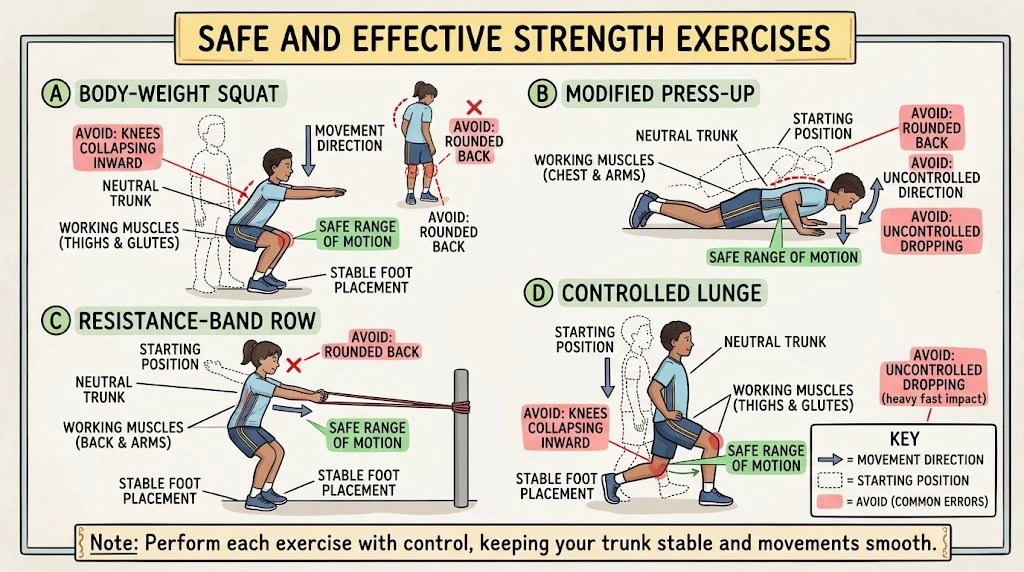
For school learners, the first priority is movement quality, not lifting the heaviest load. Learners should use manageable resistance, controlled movement, and full attention to technique. Maximal lifting, unsupervised heavy lifting, and competitive weight challenges are inappropriate for an ordinary school lesson.
A Safe Resistance-Training Session
- Check the training area and equipment. Ensure the floor is dry, the space is clear, and resistance bands are not damaged.
- Begin with a general warm-up such as light jogging, marching, and dynamic mobility.
- Demonstrate each exercise and explain breathing, posture, range of motion, and common errors.
- Start with low resistance and a small number of controlled repetitions.
- Allow adequate recovery and stop a set when technique deteriorates.
- Cool down and record how the learner responded to the session.
Worked Example 2: Planning a Beginner Circuit
A coach plans a circuit for learners who are new to resistance training. Stations: 1) chair-assisted squat, 2) wall press-up, 3) resistance-band row, 4) standing calf raise, and 5) front plank from knees. Learners work for 20 to 25 seconds at each station, then move safely after the coach’s signal. The coach prioritises correct technique and adjusts the task for any learner who experiences pain, dizziness, or unusual breathlessness.
2.1.4 Cardiovascular Training
Cardiovascular training develops the ability of the heart, lungs, blood, and working muscles to support physical activity over time. It is also called cardiorespiratory or endurance training. It is useful in sports that require sustained movement and in games where players repeatedly work, recover briefly, and work again.
Common Cardiovascular Methods
Method |
Description |
Suitable Examples |
|---|---|---|
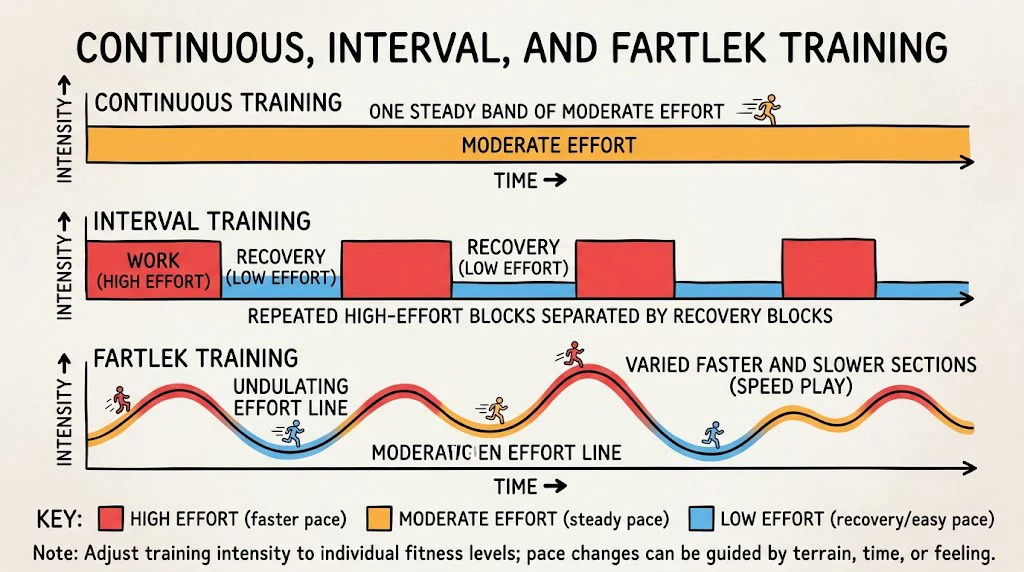
Continuous training |
Steady activity maintained for a sustained period without planned rest intervals. |
Easy running, brisk walking, cycling, and swimming. |
Interval training |
Periods of planned work alternate with periods of recovery. |
Repeated runs over a set distance with walking or jogging recovery. |
Fartlek training |
Continuous activity in which speed and intensity vary according to a planned or natural route. |
Jogging with faster efforts between landmarks. |
Circuit training |
A sequence of stations that may combine aerobic and strength exercises. |
Skipping, shuttle runs, step-ups, and body-weight exercises. |
Small-sided games |
Modified games provide repeated movement, decision-making, and sport-related conditioning. |
Three-versus-three handball in a defined area. |
The coach chooses intensity and duration according to the learners’ ability and the purpose of training. A beginner should not be required to match the volume or pace of a highly trained athlete. Talk-test responses, perceived effort, movement quality, and recovery can help a coach judge whether an activity is suitable.
Worked Example 3: Interval Session
A school coach wants to improve general endurance for a group of recreational hockey players. After a warm-up, the group completes six 1-minute runs at a controlled, challenging pace, each followed by 1 minute of walking or slow jogging. The coach observes breathing, posture, and recovery. Learners who cannot maintain safe technique reduce the pace or number of repetitions. The session ends with a cool-down.
2.1.5 Flexibility and Mobility Training
Flexibility is the ability of a joint or group of joints to move through a range of motion. Mobility refers to the ability to move a joint actively and with control through that range. Both can contribute to efficient sporting movement. The range needed differs between sports and between individuals.
Method |
How It Is Performed |
Example and Use |
|---|---|---|
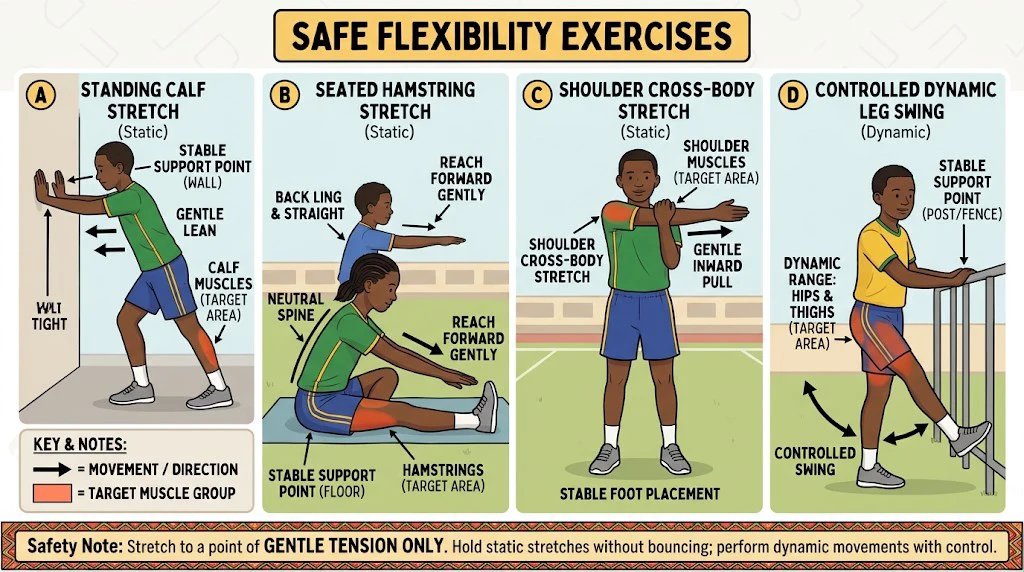
Static stretching |
A position is taken gradually and held without bouncing. |
A gentle calf stretch held comfortably after training. |
Dynamic stretching |
Controlled movements take joints through a gradually increasing range. |
Leg swings, arm circles, and walking lunges during a warm-up. |
Active flexibility |
The participant uses their own muscles to move and hold a position. |
Lifting a straight leg under control. |
Assisted stretching |
A partner or external support helps the participant reach a position. |
Only when taught, consented to, and applied gently; never force a joint. |
Dynamic movements are commonly used in a warm-up because they prepare the body for activity. Longer static stretches are often placed after activity or in a separate flexibility session. Stretching should create mild tension, not sharp pain. Bouncing forcefully, forcing a partner into a stretch, or stretching an injured area without appropriate guidance can be harmful.
2.1.6 Speed and Agility Training
Speed is the ability to move the body or a body part quickly. In sport it may include reaction speed, acceleration, maximum running speed, and movement speed. Agility is the ability to change direction or body position quickly while maintaining control and responding to a stimulus.
- Reaction drills: develop the ability to respond to a sound, visual signal, or opponent’s movement.
- Acceleration drills: teach athletes to build speed from a stationary or moving start.
- Maximum-speed drills: develop fast running mechanics over a short distance, with adequate recovery.
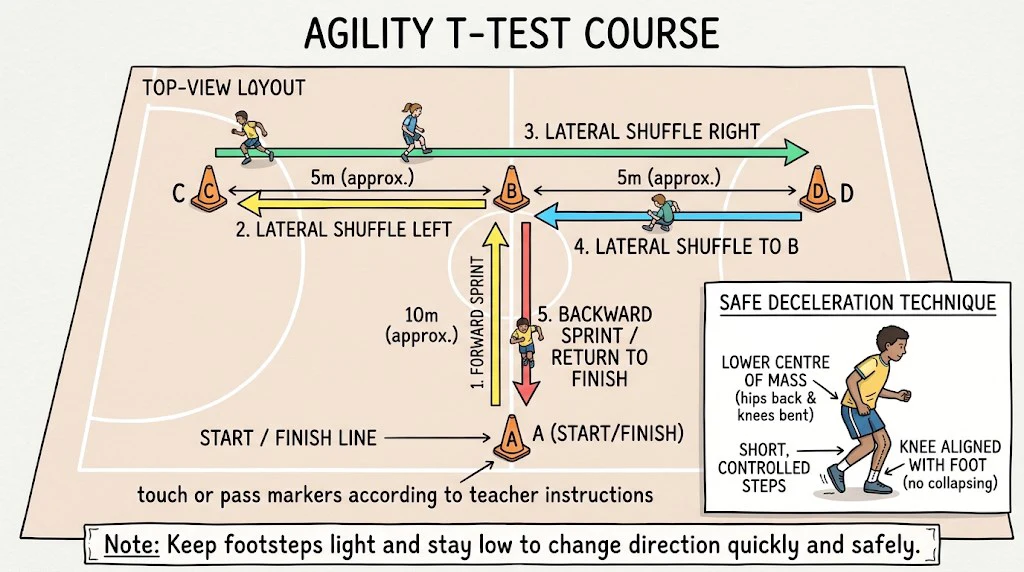
- Change-of-direction drills: practise planned cuts, turns, and deceleration.
- Reactive agility drills: require the athlete to respond to an unpredictable cue rather than simply follow a memorised route.
Quality is more important than the number of repetitions in speed training. Learners need sufficient recovery to perform each effort quickly and safely. The surface should be suitable, footwear appropriate, and the route free of obstacles. The coach should teach learners to slow down under control before sharp turns.
Worked Example 4: Selecting a Speed Drill
For a Baseball5 team, the coach wants players to react quickly after the ball is hit and move to a base. A suitable drill is a visual-cue start: learners begin in a ready position; when the coach points left or right, they accelerate to the indicated marker. The coach varies the cue and reminds learners to look up, avoid collisions, and decelerate before stopping.
2.1.7 Skill-Specific Training
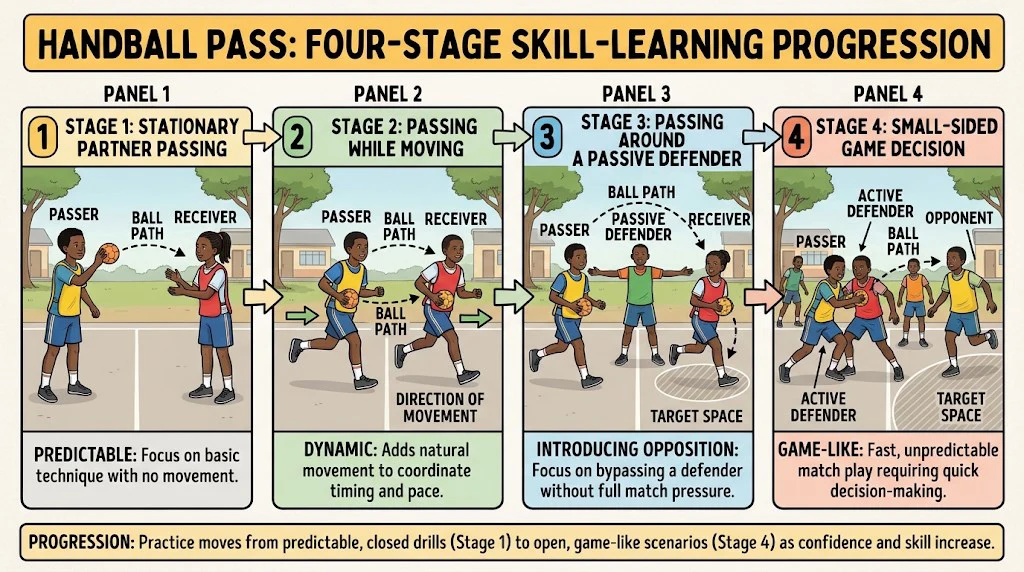
Skill-specific training develops the technical actions required in a particular sport or event. It should reflect the movement pattern, equipment, playing space, decisions, and conditions of the sport. Skills are first learned in manageable parts where necessary, then combined and practised in realistic situations.
Sport |
Skill-Specific Training Activity |
Performance Focus |
|---|---|---|
Handball |
Passing to a moving partner, catching under pressure, and shooting from different angles. |
Timing, accuracy, balance, decision-making, and teamwork. |
Hockey |
Dribbling around markers, push passing, and receiving while moving. |
Stick control, body position, scanning, and safe stick use. |
Baseball5 |
Batting/striking practice, running to bases, and defensive fielding sequences. |
Contact, reaction, placement, movement, and communication. |
Table Tennis |
Serve placement, forehand/backhand rallies, and footwork patterns. |
Racket angle, timing, control, recovery position, and anticipation. |
Long jump |
Approach-run rhythm, take-off drills, and landing practice. |
Speed control, board accuracy, take-off posture, and safe landing. |
Skill practice can be organised using blocked practice, varied practice, and game-like practice. Blocked practice repeats one task to build familiarity. Varied practice changes distance, direction, or target. Game-like practice adds decisions and realistic pressure. Coaches should select the approach according to the learner’s stage and the skill being learned.
2.1.8 Linking Training Methods to Sports
Most sports require a combination of training methods. The coach should identify the dominant demands of the sport rather than assume that one method is sufficient.
Sport/Event |
Resistance |
Cardiovascular |
Flexibility/Mobility |
Speed/Agility |
Skill-Specific |
|---|---|---|---|---|---|
Handball |
Leg and trunk strength; controlled upper-body strength |
Repeated high-intensity efforts and recovery |
Shoulder, hip, and ankle mobility |
Acceleration, jumps, and changes of direction |
Passing, catching, shooting, defensive movement |
Hockey |
Leg, trunk, and upper-body strength |
Intermittent endurance |
Hip, ankle, and shoulder mobility |
Short sprints and direction changes |
Dribbling, passing, receiving, and tackling |
Baseball5 |
General strength and trunk control |
Repeated short efforts |
Shoulder, hip, and trunk mobility |
Reaction and short acceleration |
Striking, fielding, base running |
Table Tennis |
Leg and trunk strength/endurance |
Repeated short bursts |
Hip, ankle, shoulder, and wrist mobility |
Footwork and reaction |
Serve, return, rally placement |
Long jump |
Explosive leg and trunk strength |
Short approach-run conditioning |
Hip and ankle mobility |
Acceleration and approach rhythm |
Take-off, flight, and landing |
Distance running |
General strength and posture |
High priority: aerobic endurance |
Mobility for efficient stride |
Pace changes and finishing speed |
Pacing, running economy, and race tactics |
2.1.9 Planning and Evaluating a Training Session
A training session normally contains a preparation phase, a main activity phase, and a recovery phase. The coach should state the session objective, prepare equipment, check risks, organise groups, and decide how progress will be observed. For more on safety checks, review Risk Management in Sports.
Session Part |
Purpose |
Possible Activity |
|---|---|---|
Introduction and safety check |
Explain objective, check readiness, and identify hazards. |
Attendance, health check-in, footwear, and surface inspection. |
Warm-up |
Gradually prepare the body and focus attention. |
Light movement followed by dynamic mobility and activity-specific drills. |
Main training |
Develop the selected fitness component or skill. |
Resistance circuit, interval running, agility drill, or technical practice. |
Cool-down |
Gradually reduce activity and reflect on effort. |
Easy movement, comfortable mobility, and review. |
Evaluation |
Check whether the objective was achieved and identify adjustments. |
Observation checklist, learner reflection, and training record. |
Worked Example 5: A 45-Minute Session Outline
Objective: improve change-of-direction control for a school handball group. Minutes 0–5: attendance, objective, and safety check. Minutes 5–12: warm-up and dynamic movement. Minutes 12–20: deceleration and planned cutting technique. Minutes 20–32: cone-based change-of-direction drills with recovery. Minutes 32–40: small-sided handball applying the movement. Minutes 40–45: cool-down, feedback, and reflection. The coach adjusts the plan if the surface is wet, learners are fatigued, or the group needs more time to learn the movement.
2.1.10 Common Training Errors and Corrective Action
Common Error |
Why It Is a Problem |
Corrective Action |
|---|---|---|
Increasing training load too quickly |
May lead to excessive fatigue and increased injury risk. |
Progress gradually and monitor response. |
Using poor technique to complete repetitions |
Reinforces unsafe or inefficient movement. |
Reduce resistance or speed; demonstrate and practise correctly. |
Training the same component every session |
May create imbalance and reduce motivation. |
Use a balanced plan matched to the sport. |
Ignoring rest and recovery |
Can reduce performance and contribute to overtraining. |
Plan rest, sleep, hydration, and easier sessions. |
Copying an elite athlete’s programme |
Elite programmes may not suit a beginner’s age, development, or capacity. |
Individualise training and seek qualified guidance. |
Failing to warm up or check the area |
Leaves preventable hazards and poor preparation unaddressed. |
Use a consistent preparation routine and safety inspection. |
Summary: Basic Training Methods
- Resistance training develops strength, muscular endurance, and power through suitable resistance.
- Cardiovascular training improves the body’s ability to sustain activity and recover between efforts.
- Flexibility and mobility training support controlled movement through the range needed by a sport.
- Speed training develops rapid movement; agility combines rapid change of direction with control and response.
- Skill-specific training develops the techniques and decisions required in a particular sport.
- Effective training applies specificity, progressive overload, individualisation, variation, and recovery.
- Coaches plan, demonstrate, observe, give feedback, adapt activities, and evaluate results.
Quick Revision Questions
- Distinguish between speed and agility.
- Explain why progressive overload should be gradual.
- Name two cardiovascular training methods and give a sporting example of each.
- Design a short skill-specific drill for Table Tennis.
- Explain why recovery is part of training rather than wasted time.
Compiled and reviewed for Education.co.ke by Fred ArapToo (B.Ed. Physics & Chemistry, Egerton University; M.Ed. Education Administration candidate, University of Kabianga; Experience AI Certified Educator — Google DeepMind, Raspberry Pi Foundation & YSK, 2025; national KSEF facilitator, patron and evaluator; EdTech and open-access education platforms innovator; secondary school science educator with 15+ years of experience).
Looking for more resources?
- Revision & past papers: Teacher.co.ke | Education.co.ke | Teacher.ac
- Career pathways & university placement guide: CareerMap.co.ke
- School management systems & related digital applications: Contact us via Teacher.co.ke or ShuleMax.co.ke